
The base material of a high-precision machine tool is not simply a structural choice. It influences geometric accuracy, vibration behavior, thermal stability, corrosion resistance, assembly strategy, service life, and the long-term repeatability of the equipment.
For QC engineers, laboratory managers, and B2B equipment procurement teams, the decision can be difficult. Granite, welded steel, and cast iron each offer legitimate advantages, but they do not solve the same engineering problem. A material that performs well in a high-load cutting machine may not be the best option for a coordinate measuring machine, semiconductor inspection platform, optical system, laser machine, or vibration-sensitive automated station.
The right choice depends on the machine’s function, required tolerance, operating environment, dynamic loads, manufacturing route, installation method, and maintenance plan. This article compares precision granite, steel, and cast iron as base materials for high-precision machine tools and explains how buyers can develop a more reliable selection specification.
ZHHIMG® supplies ultra-precision manufacturing solutions involving precision granite, mineral casting, industrial ceramics, precision metal, and glass components for applications including semiconductor equipment, CMM systems, CNC machinery, aerospace, and precision laser equipment.zhhimg+1
Comparing Granite, Steel, and Cast Iron
Each material should be assessed as part of a complete machine system. Static rigidity matters, but it is not the only factor. A base must also manage thermal variation, vibration, corrosion exposure, manufacturability, interface design, and future calibration needs.
| Selection Factor | Precision Granite | Welded Steel | Cast Iron |
|---|---|---|---|
| Corrosion behavior | Does not rust like ferrous metals | Requires coating or corrosion protection | Requires coating, oil, or corrosion protection |
| Vibration damping | Naturally effective damping behavior | Typically lower inherent damping | Better damping than steel, but generally lower than granite |
| Thermal response | Favorable for controlled metrology environments | Can react quickly to localized temperature changes | Higher thermal expansion than granite |
| Wear and burrs | High hardness; no conventional metal burr formation | Can scratch, dent, and form burrs | Can wear and form burrs on exposed surfaces |
| Precision reference surfaces | Well suited to grinding and lapping | Usually requires machined or ground reference surfaces | Can be machined and scraped, often used for machine beds |
| Complex integrated geometry | May require machining, bonding, or assembly of multiple pieces | Highly flexible fabrication and welded construction | Good for complex cast shapes but needs pattern and foundry tooling |
| Magnetic properties | Nonmagnetic | Magnetic | Magnetic |
| Typical use | CMMs, metrology, semiconductor, optics, laser, air-bearing systems | Frames, enclosures, welded equipment structures, large fabricated machines | Traditional machine-tool beds, columns, housings, heavy cutting machines |
The comparison should not be interpreted as “granite is always better.” Steel and cast iron remain appropriate choices in many designs. The engineering objective is to select the material that best supports the machine’s required accuracy and operating conditions.
When precision granite is the stronger option
Precision granite is especially valuable when a machine requires stable reference geometry, low maintenance, vibration damping, corrosion resistance, and a nonmagnetic structural foundation.
Typical applications include:
- Coordinate measuring machine bases and structural components.
- Granite surface plates and calibration references.
- Semiconductor inspection and handling equipment.
- Optical inspection and imaging platforms.
- Precision laser equipment and laser-measurement systems.
- Granite air-bearing structures.
- High-accuracy XY stages and linear-motor platforms.
- Industrial CT and X-ray inspection equipment.
- Automated optical inspection and metrology fixtures.
- Precision assembly platforms.
Granite’s crystalline structure helps absorb and dissipate vibration energy rather than transmitting it through the machine frame. This can be beneficial for sensitive optical sensors, probing systems, high-resolution vision equipment, and precision motion systems. ZHHIMG® notes that granite bases can provide vibration damping and thermal stability advantages for precision equipment, while its mineral casting solutions are also designed for high-damping structural applications.
When steel or cast iron may be preferable
Welded steel is often selected when the machine structure requires flexible fabrication, rapid design changes, welded frames, thin-wall sections, or large fabricated housings. It is widely available and can be economical for many industrial machine structures.
Cast iron remains a traditional material for machine-tool bases because it offers good castability, compressive strength, practical damping characteristics, and the ability to form complex integrated shapes. It is commonly used in conventional CNC machine beds, columns, and heavy-duty machining centers.
Steel or cast iron may be the better option when:
- The machine must withstand high cutting forces or severe impact loads.
- The structure requires an integrated casting with complex internal geometry.
- The project already uses established foundry patterns and machining processes.
- The design depends on welded fabrication or on-site structural modification.
- Weight is beneficial for machine stability and foundation loading is acceptable.
- The operating environment and maintenance program can manage corrosion protection.
However, the buyer should not compare only the initial material cost. A complete comparison should include finishing operations, stress relief, machining time, corrosion protection, vibration isolation, calibration effort, installation requirements, and total lifecycle maintenance.
Thermal Stability and Vibration Control
High-precision machine tools are affected by thermal and dynamic changes. A base can be geometrically correct during factory inspection but behave differently after motors start, ambient temperature changes, operators enter the room, or production loads increase.
Thermal behavior in real production conditions
All materials change dimension when their temperature changes. For precision equipment, the practical issue is not only the average room temperature. It is also the temperature difference across the structure and between connected materials.
Steel and cast iron generally have higher thermal expansion than natural granite. This means a metal structure can experience more noticeable dimensional change when exposed to uneven environmental temperature, localized motor heat, coolant variation, sunlight, or airflow. Granite is often chosen for metrology applications because it offers favorable thermal stability under controlled conditions.
When evaluating a high-precision machine base, consider:
- Ambient temperature range and daily variation.
- Temperature stability during calibration and acceptance testing.
- Heat from spindles, motors, electronics, vacuum pumps, and linear drives.
- Heat flow from coolant, process fluids, or workpieces.
- Airflow from HVAC systems, doors, fans, and cleanroom systems.
- Thermal differences between the base, guide rails, inserts, sensors, and fixtures.
- Required warm-up time before critical measurement or machining.
- Whether active thermal compensation is part of the machine design.
A granite base can help support stability, but material selection alone does not eliminate thermal errors. The best results come from combining appropriate base material, controlled environmental conditions, thoughtful heat management, and robust machine calibration.
Damping is not the same as stiffness
Vibration damping and stiffness are related but different performance characteristics. A stiff structure resists deflection under load. A well-damped structure dissipates vibration energy and reduces resonance. A precision machine requires both.
Granite is often selected for vibration-sensitive equipment because of its natural damping behavior. Cast iron has useful damping due to its graphite microstructure, while welded steel generally has lower inherent damping and may require additional structural design or damping treatments.zhhimg+1
For a complete vibration-control evaluation, buyers should review:
- Static load and deflection requirements.
- Dynamic loads from moving axes and rapid acceleration.
- Natural-frequency targets.
- Rail and bearing mounting stiffness.
- Center-of-gravity location.
- Foundation stiffness and support-point design.
- Isolation feet, air mounts, or other vibration-control systems.
- Nearby vibration sources, including presses, forklifts, compressors, and other machine tools.
A CMM or optical inspection system may prioritize damping and geometric stability. A high-force machining center may prioritize rigidity, thermal compensation, cutting-force management, and machine-bed mass. The best material choice follows the equipment’s actual function.
Precision Geometry, Surface Quality, and Standards
For a high-precision machine base, nominal dimensions are only part of the specification. The most important functional characteristics often involve flatness, straightness, parallelism, perpendicularity, surface condition, and the positional accuracy of mounting interfaces.
Granite as a metrology reference
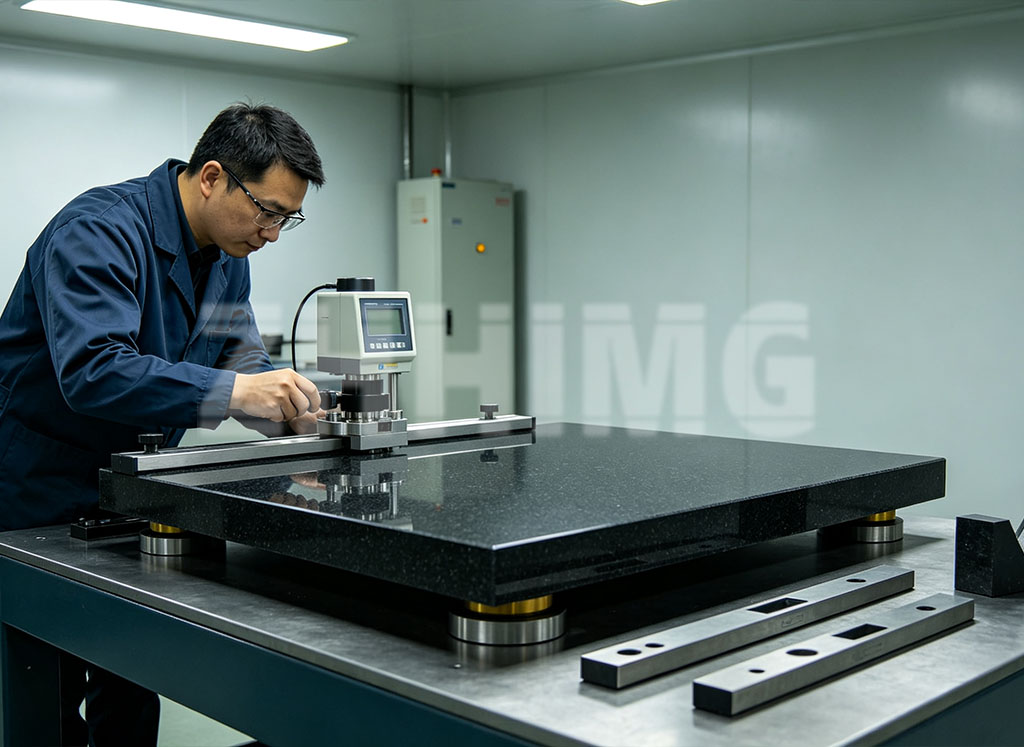
Granite is highly suitable for precision reference surfaces because it can be ground and lapped to controlled geometry. It is widely used for granite surface plates, straightedges, squares, V-blocks, parallels, and custom machine bases.
DIN 876 is a recognized standard for surface plates and defines accuracy grades for precision reference surfaces. When purchasing a granite surface plate or a measurement-related granite component, buyers should define:
- The applicable standard and required accuracy grade.
- Overall dimensions and usable measuring area.
- Required flatness or geometric tolerance.
- Inspection method and calibration conditions.
- Surface finish and edge treatment.
- Support-point arrangement.
- Required calibration certificate and traceability.
- Recalibration interval based on usage and laboratory requirements.
DIN 876 is particularly relevant to granite surface plates used for calibration, gauge inspection, assembly verification, and quality-control work. A surface plate should be specified according to the required measurement uncertainty and use case rather than selected solely by size or price.
Mounting interfaces and hybrid structures
Modern high-precision equipment rarely uses only one material. A granite base may include stainless-steel inserts, aluminum covers, steel rails, ceramic wear elements, optical glass interfaces, air-bearing features, or mineral-casting substructures.
The design review should therefore define:
- Datum surfaces for assembly and inspection.
- Rail-seat flatness and parallelism.
- Position of threaded inserts, dowel holes, slots, and counterbores.
- Bonding and fastening methods for dissimilar materials.
- Access for machining, measurement, and future service.
- Load distribution and support locations.
- Cable, vacuum, coolant, and pneumatic interface requirements.
- Cleanliness and corrosion-resistance requirements.
ZHHIMG® offers multi-material manufacturing solutions that include precision granite, precision metal, industrial ceramics, mineral casting, and glass. This can be relevant when equipment builders need coordinated control of structural components and their critical interfaces.
A Practical Material Selection Process
The strongest sourcing decision begins with functional requirements rather than a preferred material. Buyers should provide a detailed technical brief before requesting a quotation.
Questions to ask before selecting a base
- What is the primary machine function: cutting, measuring, imaging, positioning, assembly, or inspection?
- What geometric tolerances must the base maintain?
- What moving loads, acceleration forces, and external vibration sources will affect the system?
- What is the target operating temperature range?
- Is the system installed in a controlled laboratory, cleanroom, or production workshop?
- Are corrosion resistance and oil-free reference surfaces important?
- Are magnetic properties a concern for sensors, probes, or processes?
- Does the design need complex internal passages or embedded inserts?
- What are the requirements for machining, grinding, lapping, and assembly?
- How will the machine be supported, lifted, shipped, leveled, and calibrated?
- What inspection records and calibration documentation are required?
Procurement documentation
For critical equipment projects, request a defined final-quality package that may include:
- Material information and applicable certificates.
- Approved drawing revision and part identification.
- Dimensional and geometric inspection reports.
- Flatness, straightness, parallelism, and perpendicularity records.
- Surface roughness results for specified areas.
- Inspection-tool calibration and traceability information.
- Packaging and handling instructions.
- Installation and support-point recommendations.
- Pre-shipment photographs or quality-release confirmation.
This documentation allows the purchasing team to evaluate not only what was delivered, but also how the manufacturer achieved and verified the required precision.
Conclusion & CTA
Granite, steel, and cast iron each have a place in high-precision machine-tool design. Granite is often the preferred choice for CMMs, semiconductor equipment, optical systems, calibration platforms, and vibration-sensitive machinery because it provides stable reference geometry, corrosion resistance, high surface hardness, and effective vibration damping. Steel and cast iron remain practical options where welded fabrication, heavy cutting loads, traditional machine-bed construction, or integrated casting geometry are the leading design priorities.
The most effective approach is to define the required accuracy, dynamic behavior, thermal environment, corrosion exposure, structural interfaces, and inspection method before selecting a material. That process helps buyers avoid choosing a base simply because it is familiar, inexpensive, or easy to source.
ZHHIMG® supports custom projects involving precision granite machine bases, granite surface plates, granite air-bearing structures, mineral casting, industrial ceramics, precision metal, and integrated ultra-precision assemblies. Visit www.zhhimg.com to explore available capabilities or discuss a machine-base requirement with the technical team.
Post time: Sep-07-2026