
In the realm of high-precision manufacturing and metrology, the choice of foundational materials is paramount. As industries push the boundaries of accuracy and reliability, the demand for components that can withstand extreme conditions and maintain unparalleled stability has intensified. Among the various materials considered, granite has emerged as a superior choice for critical applications such as Coordinate Measuring Machines (CMMs) and other precision machinery. Its unique intrinsic properties offer a compelling advantage over traditional materials, ensuring the integrity and performance of advanced industrial equipment.
The Unrivaled Properties of Granite in Precision Engineering
Granite, a natural igneous rock, possesses a combination of physical and chemical characteristics that make it exceptionally well-suited for precision engineering. These properties are not merely theoretical advantages but are consistently demonstrated through rigorous industrial applications and technical benchmarks.
Exceptional Dimensional Stability
One of the most critical attributes of granite in precision applications is its remarkable dimensional stability. This is primarily attributed to its very low coefficient of thermal expansion (CTE). For instance, granite typically exhibits a CTE of approximately 4.5×10⁻⁶/°C, which is significantly lower—up to 80% less—than that of steel. This inherent resistance to thermal fluctuations means that granite components experience minimal expansion or contraction with changes in ambient temperature. In environments where temperature variations can introduce significant measurement errors, granite’s thermal stability ensures that the structural integrity and geometric accuracy of CMMs and precision machines remain consistent. Furthermore, granite demonstrates a negligible hysteresis effect, with studies showing less than 0.2μm/m after 10,000 thermal cycles, as per ISO 8512-2 standards. This characteristic is vital for equipment operating in dynamic thermal conditions, where even minute deformations can compromise precision.
Superior Vibration Damping Capabilities
Precision machinery, particularly those involved in cutting, grinding, or measuring at micron and sub-micron levels, is highly susceptible to the detrimental effects of vibration. Vibrations can lead to tool chatter, reduced surface finish quality, and inaccurate measurements. Granite excels in this regard due to its excellent natural damping ratio, typically ranging from 0.012 to 0.015, which is substantially higher than the 0.001 observed in cast iron. This superior vibration absorption capability allows granite bases and structural components to attenuate vibrations by as much as 95% within the critical 50–500Hz frequency range. Consequently, the integration of granite components in CNC machining centers can reduce tool chatter by up to 40%, leading to enhanced machining accuracy and improved product quality. This passive damping mechanism is a significant advantage, as it reduces the need for complex active vibration isolation systems, simplifying machine design and lowering overall costs.
Inherent Chemical Resistance and Longevity
In industrial environments, precision machinery is often exposed to various chemicals, including coolants, lubricants, and hydraulic oils. Traditional metallic components can be prone to corrosion, which degrades their structural integrity and surface finish over time, leading to increased maintenance and reduced operational lifespan. Granite, being a chemically inert material, exhibits exceptional resistance to a wide range of corrosive substances. Its pH stability spans from 1 to 14, and it shows zero corrosion when tested with common coolants and hydraulic oils (ASTM C880). This chemical resilience translates into a significantly longer service life for industrial granite parts, often achieving three times the lifespan of metallic counterparts in chemical processing plants. This longevity not only reduces replacement costs but also ensures consistent performance over extended periods, contributing to lower total ownership costs.
Comparative Performance: Granite Versus Traditional Materials
When benchmarked against conventional materials like cast iron and aluminum, granite consistently demonstrates superior performance in key areas critical for precision applications. While metals may offer advantages in certain mechanical properties such as tensile strength, their limitations in thermal stability and vibration damping make them less ideal for the most demanding precision tasks.
For instance, in terms of thermal deformation and vibration absorption, granite significantly outperforms both cast iron and aluminum. Although the initial manufacturing cost of granite components might be perceived as higher due to specialized processing, a comprehensive cost-benefit analysis over a typical 10-year operational period reveals a different picture. A 2023 ASME study indicated that granite structural components could deliver up to 27% lower total ownership costs compared to steel-aluminum hybrid structures in precision grinding machines. This reduction in cost is primarily driven by decreased maintenance requirements, extended operational life, and fewer production errors attributable to material instability.
The Meticulous Manufacturing Process of Precision Granite Components
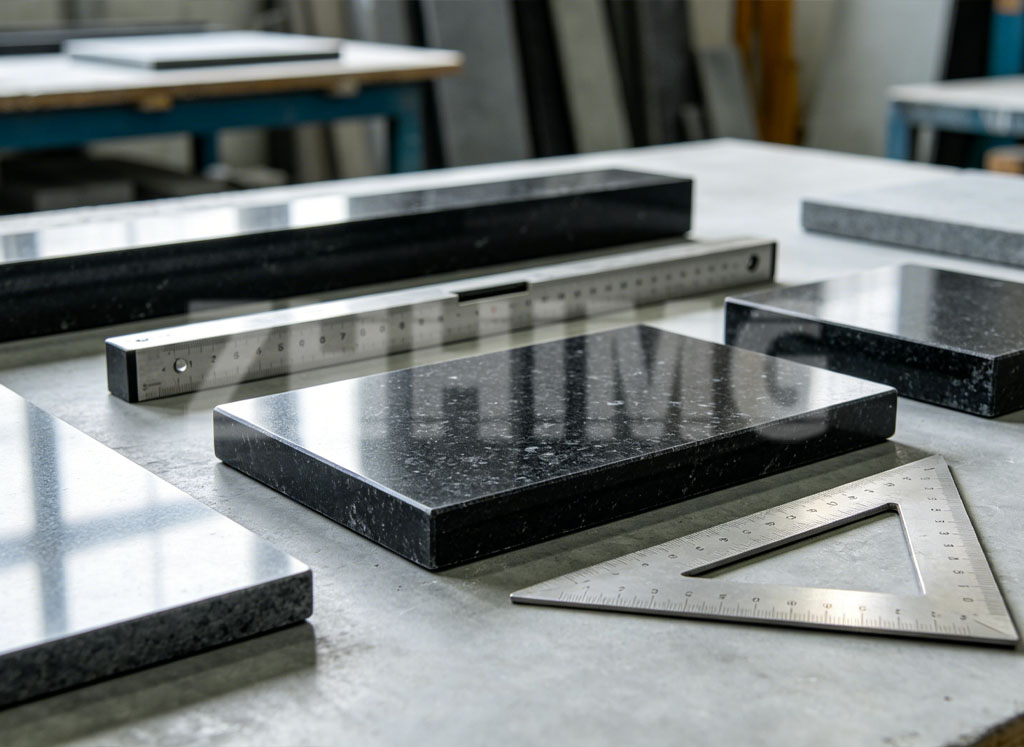
The transformation of raw granite into high-performance precision components is a multi-stage, highly specialized process that demands meticulous attention to detail and advanced manufacturing techniques. This process ensures that the inherent qualities of natural granite are fully leveraged and enhanced to meet the stringent requirements of modern metrology and machinery.
From Quarry to Precision
1.Quarry Selection: The journey begins with the careful selection of raw granite. Only Class-A granite, as defined by standards such as ASTM C615, with a quartz variance of less than 0.05%, is deemed suitable. This ensures the material’s homogeneity and consistent physical properties.
2.Stress Relieving: Once quarried, the granite blocks undergo a crucial stress-relieving process. This typically involves a natural aging period of up to six months, followed by thermal cycling for 72 hours at 80°C. This process eliminates internal stresses that could otherwise lead to deformation over time, ensuring long-term stability.
3.CNC Machining: The rough blocks are then subjected to advanced CNC machining. Using 5-axis milling techniques, manufacturers can achieve positional accuracies of ≤±0.01mm. This stage shapes the granite into the desired component geometry, laying the groundwork for subsequent precision finishing.
4.Surface Grinding: Following machining, the surfaces are meticulously ground using diamond-wheel polishing. This process achieves an ultra-fine surface roughness (Ra) of 0.1–0.4μm, which is essential for creating highly accurate reference planes and bearing surfaces.
5.Laser Calibration: To verify and ensure the highest levels of flatness and geometric accuracy, each component undergoes laser calibration. Renishaw XL-80 interferometry is commonly employed to perform precise flatness verification, ensuring that the components meet or exceed specified tolerances.
6.Sealant Treatment: To enhance durability and prevent moisture absorption, the granite components receive a nanoporous silicone impregnation treatment. This sealant reduces water absorption to less than 0.01%, protecting the material from environmental degradation and maintaining its dimensional stability.
7.Final Inspection: The final stage involves a comprehensive 21-parameter Quality Assurance (QA) inspection, conducted in accordance with international standards such as ISO 8512-2 and ANSI B89.3.7. This rigorous inspection ensures that every component meets the exacting standards required for high-performance applications.
Diverse Industrial Applications
The superior characteristics and precision manufacturing of granite components have led to their widespread adoption across various high-tech industries, where accuracy and reliability are non-negotiable.
Semiconductor Manufacturing
In the semiconductor industry, where the fabrication of microchips demands extreme precision, granite components are indispensable. Photolithography stages, which are at the heart of chip manufacturing, rely on granite metrology components to achieve unparalleled vibration isolation. For instance, in advanced EUV lithography systems like the ASML NXE:3600D, granite components contribute to achieving vibration isolation down to 0.12nm. This level of stability is crucial for patterning features at the nanoscale, directly impacting the performance and yield of semiconductor devices.
Precision Machining and CNC Systems
CNC machine bases made from granite are revolutionizing precision machining. By replacing traditional polymer-concrete or metallic bases, granite bases can reduce thermal drift error by as much as 60%. This improvement is vital for maintaining tight tolerances during prolonged machining operations, especially in the production of complex parts for aerospace, automotive, and medical industries. The inherent vibration damping of granite also contributes to smoother machine operation, extending tool life and improving surface finishes.
Metrology Systems and CMMs
Coordinate Measuring Machines (CMMs) are the cornerstone of quality control in manufacturing. The accuracy of a CMM is fundamentally dependent on the stability of its base and structural elements. Granite base plates are the material of choice for CMMs, capable of maintaining flatness of 0.5μm/m² for over 15 years, as exemplified by systems like the Hexagon Global Classic. This long-term stability ensures consistent and reliable measurement results, which are critical for verifying product specifications and ensuring compliance with stringent quality standards.
Market Trends and Future Outlook
The global market for granite machine components is experiencing robust growth, driven by continuous advancements in technology and increasing demands for precision across various sectors. According to Grand View Research, the market is projected to grow at a Compound Annual Growth Rate (CAGR) of 6.8% from 2023 to 2030.
Several key trends are fueling this expansion:
•Semiconductor Expansion: The ongoing construction of numerous new 300mm fabrication plants, with 78 fabs currently under construction as per a 2023 SEMI Report, signifies a massive demand for precision equipment that relies heavily on granite components.
•Electric Vehicle (EV) Manufacturing: The rapid growth of the EV industry, particularly the 220% increase in demand for battery module alignment systems, necessitates highly accurate and stable platforms, making granite an ideal material.
•Quantum Computing: The nascent but rapidly evolving field of quantum computing requires sub-micron stability for cryogenic chambers and other sensitive components, presenting a new frontier for high-performance granite applications.
Conclusion
From its origins as an ancient geological formation to its modern role as a cornerstone of high-tech manufacturing, granite continues to prove its indispensable value in precision engineering. Its unique combination of dimensional stability, superior vibration damping, and chemical resistance positions it as the material of choice for the most demanding applications, including CMMs and precision machinery. As industries continue to push the boundaries of what is possible in terms of accuracy and reliability, high-performance granite components will undoubtedly remain at the forefront, enabling the next generation of technological innovation. The sustained growth in key sectors underscores granite’s enduring relevance and its critical contribution to the advancement of precision manufacturing worldwide.
Post time: May-13-2026