
When was the last time you questioned the reliability of your measurement system? For calibration laboratories and quality control departments, the answer to that question often determines whether production continues smoothly or costly rework begins. Somewhere between your surface plate and your coordinate measuring machine, the gauges you rely on daily may be silently introducing errors that no calibration certificate can account for.
The Silent Arbiters of Quality
Measurement equipment does more than produce numbers. In regulated industries operating under ISO 9001 and ISO 17025 frameworks, your gauges serve as the foundation for traceability—the chain that connects your measurement results back to national standards. When a calibration certificate shows unexpected deviations, the problem frequently lies not in the instrument being calibrated, but in the reference gauges used during the calibration process itself.
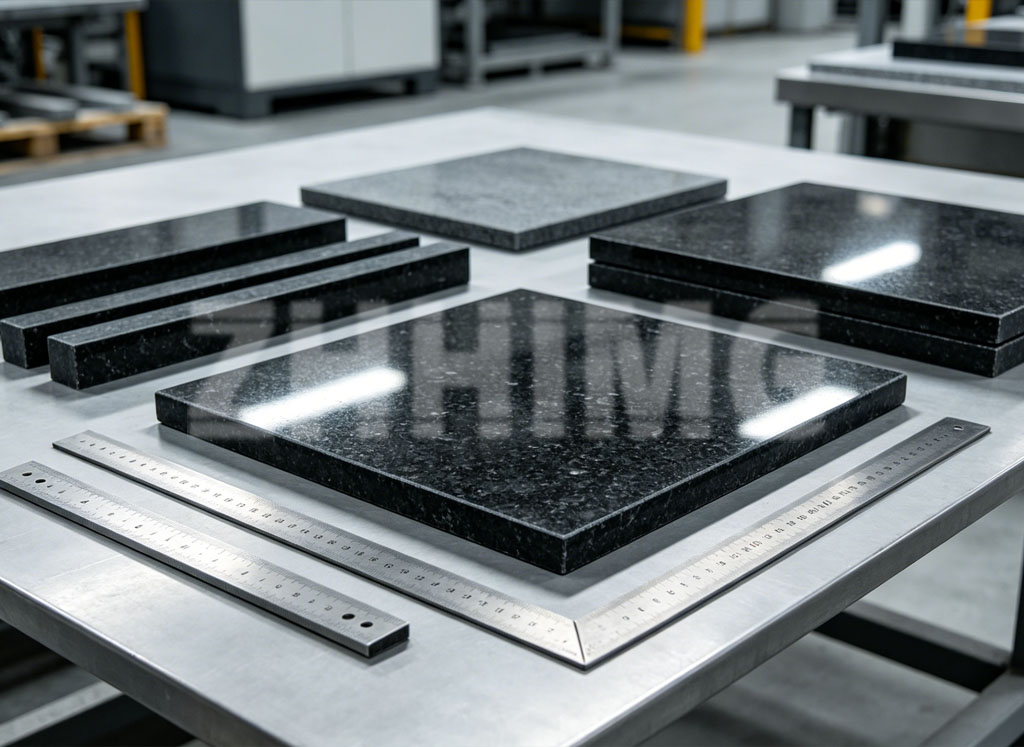
This is precisely why precision granite gauges deserve more attention than they typically receive. While surface plates often receive the spotlight in metrology discussions, the supporting cast of master squares, straight edges, parallels, and V-blocks carries equal responsibility for maintaining measurement integrity. These tools define the geometric relationships—perpendicularity, straightness, parallelism—that your entire quality system depends upon.
The Complete Granite Gauge Toolkit
Understanding what each gauge does helps quality professionals select the right tools for their specific applications. The master square, sometimes called a granite square, establishes perpendicularity. With five or six working faces precision-machined to exacting tolerances, these tools verify the X/Y/Z axis relationships in coordinate measuring machines and machine tool calibration. A Grade AA master square at 200×200mm can achieve perpendicularity tolerances as tight as 2 micrometers, making it essential for maintaining CMM accuracy.
Tri-squares serve similar functions but with a lighter, two-surface design optimized for machine tool axis calibration. The inclusion of reduced-weight holes makes them practical for shop floor use without sacrificing the precision that机床 axes require.
Straight edges come in single-face and double-face configurations, with the latter allowing verification of straightness across the entire working length. At Grade AA tolerance, a 1000mm straight edge maintains straightness within 4 micrometers—a specification that speaks directly to the demanding nature of precision manufacturing.
Parallel gauges, available with two or four precision-ground faces, provide the means to verify parallelism and flatness in your measurement processes. Grade 000 parallel gauges achieve parallelism tolerances of 1.5 micrometers per meter, meaning they maintain their accuracy even across extended lengths. V-blocks, whether standard or universal types, cradle cylindrical workpieces for alignment and inspection, with the 90° V-groove held parallel to the base face within tight tolerances. Angle plates and step blocks round out the toolkit, providing perpendicular reference surfaces and versatile positioning capabilities respectively.
Material Superiority: Why Granite Outperforms Steel in Precision Gauging
The choice of granite as a precision gauge material stems from physical properties that engineering ceramics and hardened steel simply cannot match in critical applications. Thermal stability ranks first among these advantages. Granite exhibits a coefficient of thermal expansion ranging from 3 to 8 × 10⁻⁶ per degree Celsius, compared to steel’s approximately 11 × 10⁻⁶ per degree Celsius. In environments where temperature fluctuations occur—even within controlled laboratories—these differences compound across measurement cycles. A steel gauge subjected to a 5°C temperature swing during a shift change introduces significantly more error than a granite counterpart under identical conditions.
Hardness provides another decisive advantage. With Shore hardness exceeding 70 and Mohs hardness of 6 to 7, granite resists wear in ways that maintain precision over decades rather than years. Measured wear rates for granite gauges typically remain below 1 micrometer per meter over their operational lifetime, whereas steel gauges require regular re-verification and eventually re-grinding to maintain comparable accuracy.
Perhaps less obvious but equally important, granite possesses no residual internal stress. Formed over geological timescales, granite reaches a state of internal equilibrium that man-made materials cannot achieve. Steel, regardless of heat treatment, carries internal stresses that gradually relax over time, causing subtle dimensional changes that calibration intervals may not capture. When you need measurement confidence extending across years of service, this stability difference becomes substantial.
Additional practical benefits reinforce granite’s suitability. Its natural vibration damping absorbs environmental oscillations that would otherwise compromise readings. Non-magnetic properties eliminate concerns about magnetization affecting electronic sensors or magnetizing workpieces during inspection. Resistance to rust, acids, alkalis, and machining fluids means granite gauges survive in workshop environments where steel tools would corrode or require protective coatings that themselves introduce contamination risks.
Laboratory Applications: Where Traceability Meets Stability
Calibration laboratories face unique challenges that granite gauges address directly. The requirement for measurement traceability means every reference standard must connect back to national metrology institutes—NIST in the United States, NPL in the United Kingdom, or their equivalents worldwide. This traceability chain demands not just initial accuracy but sustained stability across calibration intervals that may span years.
Granite master squares serve as the backbone of CMM calibration procedures. Before certifying that your coordinate measuring machine meets specifications, technicians verify axis perpendicularity using precision-ground granite squares. Any error in the square propagates directly into the CMM calibration result, making square quality non-negotiable.
Optical platform and laser interferometer setups benefit similarly from granite’s stability. When establishing horizontal references for optical measurements, engineers select granite parallel gauges specifically because temperature-induced length changes remain negligible within measurement uncertainty budgets. In semiconductor manufacturing, wafer dicing equipment requires parallelism verification to micron-level tolerances—a task perfectly suited to precision-ground granite gauges.
For metrology institutes performing annual recertifications of reference standards, the extended calibration intervals possible with granite gauges represent both cost savings and reduced handling risk. Unlike steel gauges requiring annual recertification, well-maintained granite gauges may operate reliably for several years between calibrations, provided environmental conditions and usage patterns support such extended intervals.
Quality Control Applications: From Incoming Inspection to Final Verification
Production quality control depends on gauges that can withstand daily use while maintaining accuracy. Incoming inspection departments verify supplier part dimensions against specifications, often using granite V-blocks to center cylindrical components for diameter and roundness measurements. The repeatability of this setup directly affects the reliability of acceptance decisions.
Process control stations employ granite straight edges and angle plates for rapid verification of machined surfaces during production runs. When a CNC machining center performs tool compensation checks, technicians reference granite gauges to confirm that the machine’s geometric accuracy has not drifted since the previous verification. Regular axis straightness and perpendicularity checks using granite gauges can catch emerging problems before they produce out-of-tolerance parts.
Final inspection departments assemble complete measurement setups combining granite surface plates with various gauges to perform comprehensive dimensional verification. For complex assemblies like gearbox housings or engine blocks, technicians must verify multiple parallel and perpendicular relationships simultaneously. Using gauges manufactured from consistent granite material eliminates one variable from the measurement uncertainty budget.
Jig and fixture calibration represents another critical application. The gauges and templates used to position workpieces during machining must themselves maintain known accuracy. Regular verification against granite reference standards ensures that production tooling remains within tolerance throughout its service life.
The System Advantage: Using Granite as a Coherent Reference Set
Experienced metrologists understand that measurement systems behave as integrated wholes. When you combine a granite surface plate with a steel straight edge, you introduce differential thermal expansion at every temperature fluctuation. The steel expands and contracts at roughly one and a half times the rate of the granite, creating systematic errors that compound with measurement length.
Using a complete set of granite gauges from the same material source minimizes these systematic effects. All components share identical thermal expansion characteristics, mechanical damping properties, and aging behavior. Your measurement uncertainty budget improves when one source of systematic error—differential thermal expansion between materials—disappears entirely.
This material consistency matters particularly in calibration laboratories where reducing uncertainty contributes directly to competitive advantage. Clients choosing between calibration providers compare uncertainty statements, and those laboratories utilizing coherent reference sets can legitimately claim smaller uncertainties than competitors relying on mixed-material gauge sets.
Manufacturing Excellence Behind Every Gauge
The performance specifications cited throughout this article assume proper manufacturing practices that not all suppliers achieve. At ZHHIMG, we operate two manufacturing facilities spanning 200,000 square meters, producing precision granite components for clients across more than 20 countries. Our commitment to material integrity means we exclusively use our proprietary ZHHIMG black granite, with density approximately 3100 kg/m³—performance characteristics that exceed comparable materials sourced from European and American quarries.
Our commitment to accuracy extends to the manufacturing environment itself. We maintain 10,000 square meters of temperature-controlled workshop space, with foundation concrete exceeding 1000mm thickness and 500mm-wide by 2000mm-deep vibration isolation trenches surrounding the facility. Overhead crane operations proceed in virtual silence, preventing vibration interference with precision grinding operations.
Measurement capability matches our machining capability. German Mahr high-resolution dial indicators reading to 0.5 micrometers, Swiss WYLER electronic levels, British Renishaw laser interferometers, and Mitutoyo digital calipers and surface roughness equipment enable verification to tolerances that trace back to national metrology institutes. Every gauge we ship carries documented traceability to these reference standards.
Our Grinding Master—master craftsmen with more than 30 years of hand-lapping experience—bring judgment to every surface. Customers who have worked with them describe the experience as collaborating with “walking electronic levels,” capable of detecting subtle surface irregularities that instruments alone might miss. This human expertise, combined with modern CNC grinding capabilities including four extra-large Nanty grinding machines capable of finishing surfaces up to 6000mm in length, enables us to produce individual components up to 20 meters in length, 4000mm width, and 1000mm thickness.
We hold the distinction of being the only precision granite manufacturer simultaneously certified to ISO 9001, ISO 45001, ISO 14001, and CE standards. Our quality philosophy—”The precision business can’t be too demanding”—drives every manufacturing decision. Our operating principles of no cheating, no concealment, and no misleading define how we interact with customers and represent our products.
Elevate Your Measurement Capability
The gauges your laboratory or quality department relies on deserve the same scrutiny you apply to your measurement processes. Whether you need master squares for CMM calibration, straight edges for machine tool verification, or complete gauge sets for incoming inspection, ZHHIMG delivers precision engineered to your specifications and certified to international standards including DIN 876/875, ASME B89.3.7-2013, JIS, GB/T 20428-2006, and BS 939/5204.
Visit www.zhhimg.com to explore our complete product range and discuss your specific requirements with our technical team. For international buyers seeking reliable precision gauge suppliers, we maintain established relationships with metrology institutes in Singapore, Sweden, the United Kingdom, France, the United States, and Russia—references that speak to our standing in the global precision measurement community.
The foundation of your quality system deserves nothing less than uncompromising precision.
Post time: May-12-2026