
When a jet engine turbine blade requires a straightness tolerance measured in microns, or a battery module in an electric vehicle must align within fractions of a millimeter along a 2-meter length, the choice of measurement tool becomes critical. Quality engineers and metrology specialists in aerospace and automotive manufacturing understand that even the most sophisticated instruments are only as reliable as their reference standards. Granite straight edges provide the stable, repeatable reference baseline that makes every subsequent measurement meaningful.
The Straight Edge: A Deceptively Simple Tool with Outsized Impact
At first glance, a straight edge seems almost primitive in an age of laser interferometers and coordinate measuring machines. Yet its role in dimensional verification remains irreplaceable. The straight edge serves as a primary reference for verifying linear features across components ranging from engine cylinder heads to aircraft wing spar joints. Unlike electronic instruments that require calibration against traceable standards, a well-manufactured granite straight edge maintains its geometry through inherent material stability rather than electronic compensation.
Consider the typical inspection workflow in aerospace manufacturing. Before a coordinate measuring machine takes a single reading, technicians often verify the machine’s environmental conditions and reference artifact integrity. A granite straight edge exposed on the measurement bench retains its straightness despite ambient temperature fluctuations that would cause steel artifacts to expand or contract visibly. This passive stability translates directly into reduced measurement uncertainty and fewer false rejections in quality control.
Material Properties That Make Granite the Superior Choice
The advantages of granite as a straight edge material stem from its unique combination of thermal, mechanical, and chemical properties. Understanding these characteristics helps explain why precision metrology laboratories consistently specify granite over alternative materials.
Thermal stability represents granite’s most significant advantage for metrology applications. The coefficient of thermal expansion for quality granite measures approximately 3 to 8 × 10⁻⁶ per degree Celsius, roughly one-third that of steel. In aerospace manufacturing facilities where temperature control might range across 20 to 25 degrees Celsius over a shift, this stability translates to predictable, minimal straightness variation. A steel straight edge of the same length could exhibit measurable dimensional changes during a single work period, whereas granite maintains its geometry with minimal drift.
Beyond thermal properties, natural granite exhibits exceptional vibration damping characteristics. The high density of quality black granite, approximately 3,100 kg/m³, allows it to absorb mechanical disturbances that would continue resonating through steel artifacts. This damping becomes particularly valuable in manufacturing environments with heavy machinery or surface grinding operations nearby.
Hardness considerations also favor granite in long-term applications. With Shore hardness exceeding 70, quality granite surpasses most steels and aluminum alloys in wear resistance. When steel straight edges experience wear, they develop burrs and edge rounding that affect contact measurement techniques. Granite, being a crystalline material, responds to impact or wear through localized chipping rather than plastic deformation. The affected area can be ground back to tolerance without disturbing the straightness of adjacent surfaces.
The non-magnetic nature of granite deserves particular attention in aerospace and automotive contexts. Modern aircraft assembly increasingly involves carbon fiber composite materials and electronic sensor packages that can be affected by magnetic artifacts. Automotive manufacturing similarly incorporates electronic control modules and magnetic sensors throughout production processes. A steel straight edge placed near sensitive components risks both physical interference and data corruption in magnetically encoded measurement systems. Granite eliminates this concern entirely.
Corrosion resistance completes granite’s material advantages. Steel straight edges require regular oiling to prevent rust, adding maintenance burden and creating contamination risks in clean manufacturing environments. Granite needs no protective coatings and tolerates shop floor conditions including coolant exposure, humidity variation, and temperature cycling without degradation. The absence of protective coatings also means no possibility of coating wear introducing measurement artifacts.
Aerospace Applications: Where Micron-Level Straightness Is Non-Negotiable
Aerospace manufacturing imposes some of the most demanding metrology requirements in industrial production. Component tolerances measured in microns, stringent documentation requirements, and consequences of failure that extend to human safety create an environment where measurement confidence is paramount.
Turbine blade straightness verification exemplifies these demands. Modern turbofan engines operate with blade tip clearances measured in fractions of a millimeter, with blade lengths exceeding one meter in some configurations. Any straightness deviation in the manufacturing or inspection process can cascade into efficiency losses, vibration issues, or premature wear. Quality engineers specify granite straight edges for initial blade feature verification because the measurement reference must not introduce its own uncertainty into the inspection results.
Aerospace structural assembly presents equally demanding requirements. Wing skin splice joints, fuselage frame alignments, and control surface hinge lines all require verification against design intent. These operations often occur in production hangars with less controlled temperature environments than dedicated metrology laboratories. Granite straight edges provide the thermal stability necessary to perform meaningful measurements under these conditions while maintaining traceability to controlled-environment calibrations.
Guide rail straightness verification for aerospace machining and assembly equipment relies heavily on straight edge references. Whether verifying linear guides on five-axis machining centers or checking the alignment of automated drilling systems for fuselage assembly, the straight edge provides the reference against which all other measurements derive meaning. Metrology specialists increasingly specify Grade 00 granite straight edges for these applications, accepting the higher initial investment in exchange for measurement confidence and long-term stability.
Automotive Metrology: From Engine Blocks to EV Battery Alignment
Automotive manufacturing has evolved considerably from its traditional focus on powertrain components. While engine block main bearing bore straightness and crankshaft journal alignment remain critical measurements, the industry now encompasses electric vehicle battery systems, advanced driver assistance sensors, and lightweight body structures that demand equally rigorous metrology approaches.
Engine block manufacturing continues to rely heavily on straight edge verification. Cylinder bore axis alignment, main bearing cap seating surfaces, and engine block deck flatness all receive straightness inspection as part of quality verification. Automotive engine plants typically maintain dedicated measurement stations equipped with precision granite surface plates and straight edges calibrated to traceable standards.
Welding fixture verification represents another critical automotive application. Body-in-white assembly depends on fixture geometry that has been verified against engineering specifications. Straight edges serve as primary references for checking fixture base plates, locating surfaces, and clamping point positions. Production facilities performing regular fixture audits specify granite straight edges for their combination of accuracy, stability, and independence from environmental temperature variation.
The emergence of electric vehicle manufacturing has created new metrology requirements that play to granite’s strengths. Battery module alignment within the vehicle floor structure requires positioning accuracy measured in fractions of a millimeter over spans exceeding two meters. Automotive engineers specify non-magnetic granite straight edges for these applications specifically because the measurement reference must not introduce variables unrelated to the actual geometry being verified.
Precision Grades and International Standards
Understanding straight edge precision classifications helps engineers specify appropriate tools for their specific applications. International standards establish grade classifications based on allowable straightness deviation, with each grade serving different inspection requirements.
Grade 00 represents the highest precision classification, with straightness tolerances typically ranging from 0.5 to 1 micrometer per meter. These straight edges serve as laboratory reference standards, metrology laboratory verification of other instruments, and critical aerospace inspection applications. Achieving Grade 00 precision requires exceptional manufacturing expertise, controlled production environments, and comprehensive verification using laser interferometry and electronic level systems.
Grade 0 straight edges specify straightness tolerances around 1.5 micrometers per meter, suitable for inspection-level verification in manufacturing environments. Most aerospace and automotive quality control applications specify Grade 0 as the minimum acceptable classification for measurement references. These straight edges balance manufacturing cost against the precision required for meaningful dimensional verification.
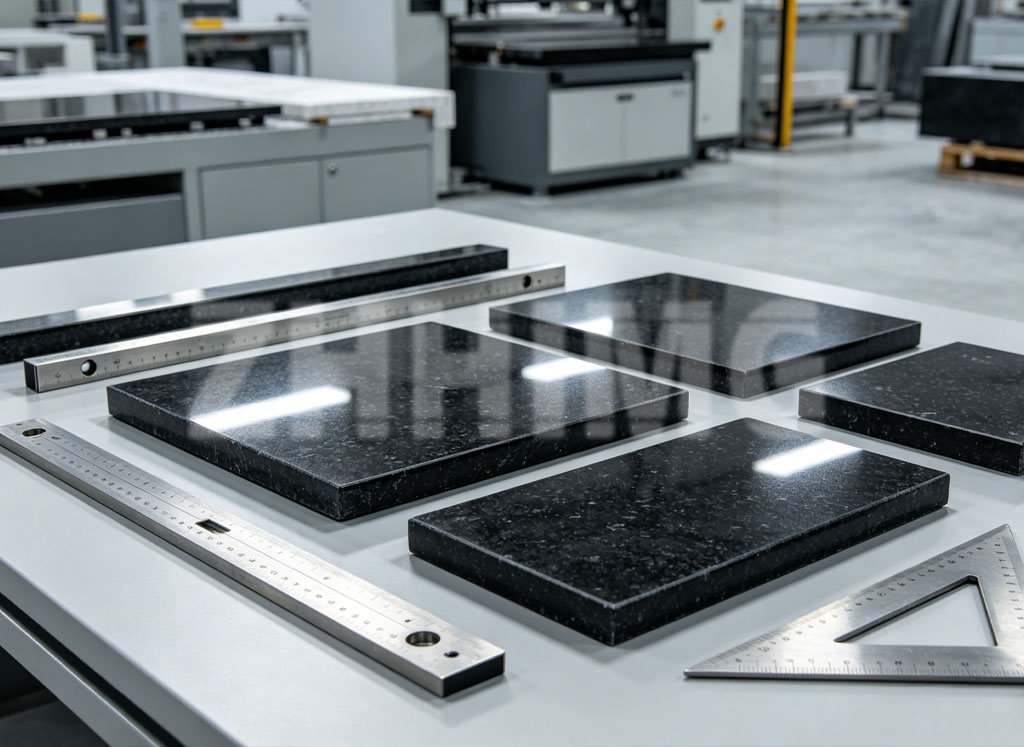
Grade 1 represents toolroom-grade straight edges suitable for tool setting, machine calibration verification, and less critical inspection tasks. While usable in many manufacturing applications, Grade 1 straight edges should not serve as primary reference standards for aerospace or automotive quality verification.
International standards governing straight edge specifications include DIN 876, ISO 8512, ASME B89.3.7, JIS B7513, and Chinese GB/T 4977-2018. Verification certificates should reference the applicable standard and identify the calibration laboratory’s traceability chain to national measurement institutes.
Manufacturing Expertise That Guarantees Measurable Accuracy
Producing straight edges that consistently achieve Grade 00 precision requires more than CNC machining and automated inspection. ZHHIMG® has developed manufacturing capabilities specifically optimized for precision metrology artifacts, with particular attention to the material selection and processing techniques that determine long-term accuracy stability.
Raw material selection begins with geological sourcing of appropriate granite. Quality black granite must exhibit minimum density of 2.7 g/cm³ with absorption rates below 0.1 percent to ensure minimal porosity and maximum dimensional stability. ZHHIMG® specifies its proprietary black granite with physical properties that exceed typical European and American black granite specifications. This material consistency provides the foundation upon which all subsequent processing depends.
Natural aging of rough granite blocks continues for six to twelve months before machining begins. This aging period allows internal stresses from the quarrying and transportation process to redistribute, preventing dimensional changes after final precision grinding. Manufacturers who skip or truncate this aging process risk delivering straight edges that continue to stress-relieve after installation in customer facilities, creating measurement drift that compromises quality verification.
Precision grinding progresses through multiple stages, beginning with rough stock removal and progressing through increasingly fine abrasives to achieve surface roughness below Ra 0.2 micrometers. ZHHIMG® operates four ultra-large grinding machines from a Taiwanese manufacturer specifically selected for geometric accuracy, with capacity to finish straight edges up to 6,000 millimeters in length. This manufacturing capability enables production of oversized reference standards for aerospace and automotive applications requiring measurement of unusually large components.
Final precision correction relies on skilled hand grinding techniques mastered over decades of practice. Senior craftsmen who have spent thirty or more years perfecting their technique achieve final straightness corrections measured in fractions of a micrometer. These artisans have earned customer recognition as “walking electronic levels” for their ability to intuitively detect geometric variations that electronic instruments might miss. This combination of modern measurement equipment and traditional craftsmanship delivers accuracy that neither approach could achieve independently.
Measurement verification employs traceable instrumentation including German-made comparators with 0.5 micrometer resolution, Swiss electronic levels for straightness profiling, and British laser interferometers for length calibration. All measurement equipment maintains current calibration traceable to national metrology institutes.
The company’s quality philosophy—”The precision business can’t be too demanding”—reflects its commitment to specifications rather than approximations. This approach excludes shortcuts such as substituting marble for granite, a practice that produces attractive initial measurements but fails catastrophically under thermal cycling and long-term aging. Quality engineers specifying granite straight edges should verify that their suppliers maintain the material integrity that their applications demand.
Experience the ZHHIMG® Difference
For aerospace and automotive manufacturers seeking measurement partners who understand precision demands, ZHHIMG® offers manufacturing capability, material expertise, and quality systems that support applications worldwide. With two facilities covering 200,000 square meters and monthly production exceeding 20,000 precision granite bed components, ZHHIMG® serves customers across more than 20 countries.
Every straight edge shipped carries documentation demonstrating conformance to specified standards, with traceability chains extending to national metrology institutes. Export customers receive products engineered to international specifications including DIN, ASME, JIS, and GB standards.
Explore the complete range of precision granite straight edges at www.zhhimg.com. ZHHIMG® technical specialists welcome inquiries from quality engineers seeking measurement solutions for demanding aerospace and automotive environments.
Post time: May-12-2026