
In continuously running automated production lines, many equipment designers tend to focus on moving mechanisms while overlooking continuous vibration impacts imposed on worktables. The uninterrupted disturbances generated by high-frequency reciprocation, station switching and material start-stop on production lines appear tiny in amplitude. Nevertheless, they keep transmitting to inspection or processing zones and erode micron-level measurement accuracy. Especially under continuous production modes, vibration is not a one-time transient shock but a long-term superimposed excitation signal. Ordinary worktables struggle to resist such persistent disturbances. For uninterrupted high-frequency pipeline working conditions, ZHHIMG Group systematically addresses the challenge of granite worktables resisting continuous vibration interference from structural selection, substrate properties, machining techniques and supporting vibration reduction schemes, ensuring stable accuracy output of production lines around the clock.
The damaging mechanism of continuous vibration on precision worktables differs completely from static laboratory inspection environments. Vibration sources arising from high-frequency pipeline operations are complex, including periodic excitation from linear motors and transmission mechanisms, as well as cross-table vibration transmitted from equipment at adjacent stations. Vibration energy propagates upward along the worktable base and triggers slight jitter on the reference surface, directly impairing laser measurement, visual inspection, dimension sorting and other processes. If the worktable lacks sufficient inherent damping, vibration will resonate inside the stone and decay slowly. Even after external excitation stops, residual vibration remains temporarily, shortening the valid inspection window and reducing productivity and yield of the whole pipeline.
Material itself forms the first line of vibration suppression. ZHHIMG® adopts high-density black granite with densely interwoven mineral crystals. Its inherent internal damping outperforms metal materials such as cast iron and aluminum alloy. The crystal structure absorbs and dissipates high-frequency vibration energy instead of transmitting and reflecting vibration waves like metals. The high-density matrix reduces deformation amplitude under excitation. Under long uninterrupted excitation from production lines, it will not accumulate local stress unlike loose stone, weakening vibration amplification effects from the material source. Ordinary marble features weakly bonded internal crystals and poor damping performance, making it unsuitable for high-frequency continuous operation scenarios. This is the core reason why marble is rarely adopted for precision worktables on production pipelines.
Relying merely on the stone’s native damping is insufficient to cope with intense continuous vibration on production lines. Structural design requires targeted optimization. During the preliminary design phase, ZHHIMG carries out modal simulation analysis based on the vibration spectrum of production lines to predict pipeline operating frequencies and avoid structural natural frequencies to prevent resonance amplification. The layout of worktable ribs and cavities is optimized according to production line layout, and material distribution is rationally allocated to improve overall rigidity. The thickness of the worktable body and arrangement of supporting points are calculated mechanically to avoid concentrated local stress and lower vibration transmission efficiency on reference surfaces. For long-size pipeline worktables, segmented support optimization is implemented to cut off vibration transmission paths between adjacent stations.
Machining processes also affect the vibration resistance stability of worktables. Residual machining stress inside granite will release slowly under prolonged continuous vibration and trigger deformation of reference surfaces. ZHHIMG performs long-term aging treatment on rough stone blanks to fully release raw stone and machining stress. Lapping procedures are completed in constant-temperature workshops to guarantee stable geometric accuracy of worktable reference surfaces. Refined surface treatment and hole machining reduce structural defects and prevent defect locations from becoming stress weak points under vibration.
Supporting vibration reduction systems serve as the core to isolate external vibration. ZHHIMG matches customized vibration reduction solutions according to vibration data measured on customers’ sites, distinguishing passive vibration isolation, vibration isolation trenches and other methods. For large pipeline worktables installed on factory floors, vibration isolation structures are set in the equipment foundation area to block continuous vibration transmission from the plant ground. Vibration isolation pads suitable for high-frequency working conditions are fitted under the worktable base to filter medium and high-frequency vibration transmitted from production lines. The whole solution is not applied in a standardized way. Instead, components are selected by combining on-site vibration test results of customers, achieving dual protection from stone body damping plus external vibration isolation structures. 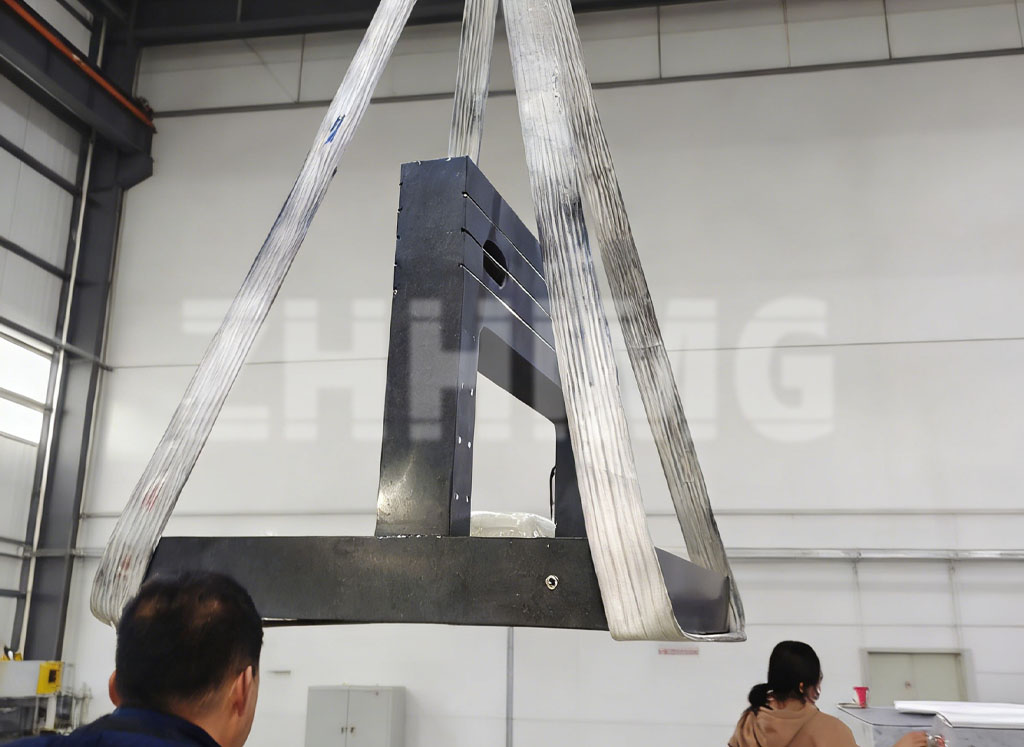
Before delivery, finished products must undergo special vibration durability tests. Cyclic periodic vibration excitation is applied to simulate uninterrupted high-frequency start-stop conditions of production lines. Vibration amplitude and dimension changes of the worktable reference surface are continuously monitored. It is verified that geometric accuracy of the worktable will not shift after long-duration vibration loading, confirming that the full vibration reduction solution can function steadily. All test data can be traced to metrology standards to ensure delivered products can adapt to all-day continuous production on pipelines.
Precision production lines pursue stable and uninterrupted yield output, and vibration interference acts as a hidden accuracy killer hard to eliminate on production floors. Avoiding continuous vibration cannot rely solely on vibration isolation pads. It requires coordinated design of materials, structures, processes and vibration isolation schemes. Leveraging deep understanding of granite material properties and ultra-precision structures, ZHHIMG Group supplies vibration-resistant granite worktables for automated production lines and on-line inspection equipment. During day-in and day-out high-frequency continuous production, these worktables consistently maintain measurement benchmarks of production lines and allow precision inspection equipment to exert designed performance stably under complex workshop vibration environments.
Post time: Oct-16-2026