
Alignment drift in lithography equipment rarely announces itself as a single failure. It shows up gradually — overlay error creeping outside spec on certain shifts, or repeatability that’s fine in the morning and questionable by afternoon. When a semiconductor equipment manufacturer approached us with exactly that pattern on a gantry-based exposure system, the instinct on their side was to look at the optics and the stage motors first. Reasonable instinct — those are usually the suspects. In this case, the structural base underneath the gantry turned out to be a bigger contributor than anyone expected.
The Alignment Problem
The equipment used a welded steel gantry frame to carry the optical head across the work envelope. On paper, the frame met its static tolerance. In production, though, the manufacturer was seeing overlay error that correlated loosely with time-of-day and shop-floor temperature swings — a pattern that pointed toward thermal expansion rather than a mechanical or control-system fault. Steel’s coefficient of thermal expansion, combined with the frame’s welded construction, meant the gantry span itself was moving by a small but real amount as ambient temperature shifted through a normal production day. On a system where sub-micron alignment is the baseline requirement, a few microns of unaccounted structural movement is enough to push overlay error out of spec intermittently — which is exactly the kind of intermittent, hard-to-diagnose problem that eats weeks of engineering time before anyone questions the frame.
Why Granite Was the Structural Answer
Replacing a welded steel gantry with a granite equivalent isn’t a like-for-like swap — it changes the design assumptions. Granite’s lower coefficient of thermal expansion and higher damping coefficient meant the structure would respond more slowly and less severely to the same ambient fluctuations. Just as relevant: granite doesn’t carry the residual internal stresses that a welded steel frame does, so it doesn’t continue to creep dimensionally over years of thermal cycling the way a fabricated metal structure can.
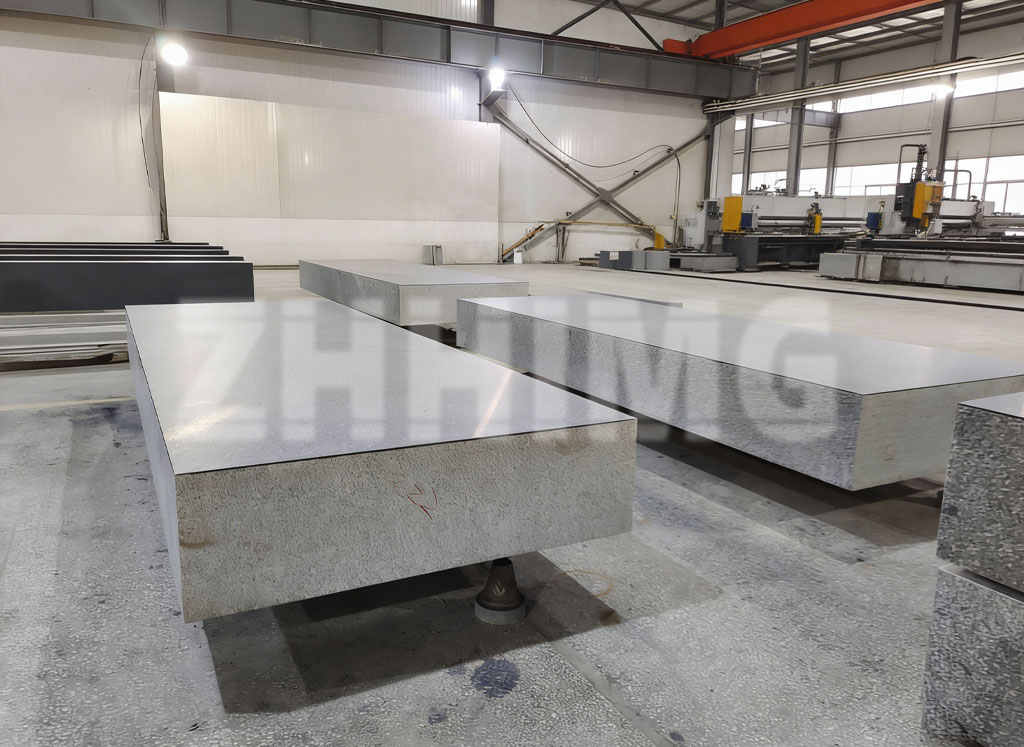
The engineering challenge wasn’t material selection so much as execution — a gantry bridge beam spanning the equipment’s full work envelope needed to be machined as a long, single-piece structure to avoid introducing joints that would reintroduce the instability granite was meant to solve. That’s a machining capacity question as much as a materials one; not every granite fabricator can process a beam of that length and mass to the required flatness and squareness in a single setup. Our facility’s ability to machine single-piece granite components up to 20 meters in length made this a straightforward fit rather than requiring a segmented, bolted-together compromise.
Implementation Details
The gantry beam was finished with the customer’s optical mounting interfaces machined directly into the granite, holding flatness and perpendicularity tolerances consistent with the rest of the exposure system’s alignment budget. Surface finishing followed the same measurement chain used across our granite reference tooling — calibrated against equipment traceable to national metrology institute standards — so the customer’s incoming inspection had documentation to match, rather than needing to independently re-verify flatness before installation.
Weight was a secondary consideration worth mentioning honestly: granite is denser than the equivalent structural steel section, and the customer’s stage motors and support structure needed to accommodate that difference. This is a real trade-off of granite gantry designs, not something to gloss over — the thermal and damping benefits come with a mass penalty that has to be engineered around rather than ignored.
Outcome
After installation, the customer reported that overlay error no longer tracked with time-of-day or ambient temperature the way it previously had — the correlation that had pointed toward thermal drift in the original diagnosis largely disappeared. Repeatability across shifts became more consistent, which mattered more operationally than any single peak-accuracy number, since production yield depends on consistency across a full run rather than a best-case measurement.
What This Case Suggests More Broadly
Structural base material is easy to overlook in alignment troubleshooting because it’s rarely the first suspect — optics, control loops, and stage mechanics get blamed first, and sometimes correctly. But when drift correlates with temperature rather than load or motion pattern, the frame itself deserves a look before more time gets spent recalibrating systems that were never the actual problem. Granite gantry and bridge structures aren’t a universal fix, and they’re not the right answer for every equipment class — but for applications where thermal stability directly determines yield, they’re worth evaluating earlier in the diagnostic process than they typically are.
Post time: Aug-07-2026