
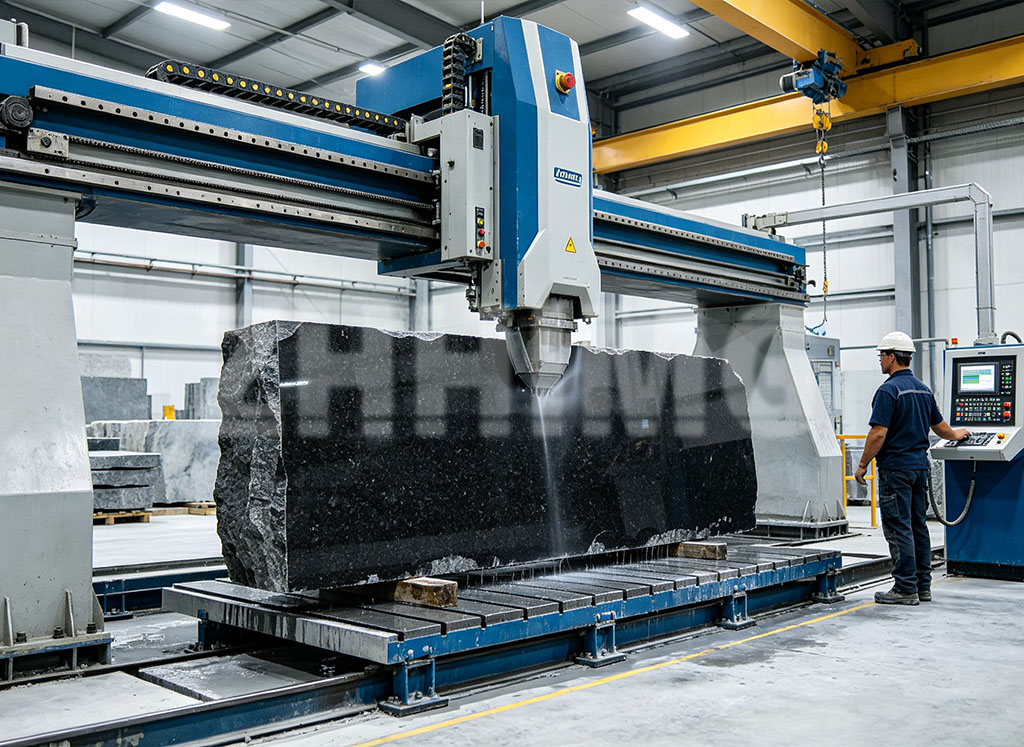
When engineering massive custom granite structures—such as 10-meter machine tool beds, semiconductor alignment bases, or giant CMM tables—the challenge extends far beyond achieving flatness. The true test of a manufacturer’s capability lies in managing the invisible forces within the stone: internal stress, natural seasoning, and thermal stability.
If these factors are not strictly controlled during sourcing, processing, and manufacturing, a massive granite block will inevitably warp, bow, or deform over time, destroying the precision of the final equipment.
At ZHHIMG, we understand that “the precision business can’t be too demanding.” Here is an inside look at how top-tier suppliers engineer out these risks to guarantee long-term dimensional stability for large custom granite structures.
1. Mastering Natural Seasoning and Material Selection
Granite is a natural material formed under immense geological pressure. When a massive block is extracted from a quarry, the sudden release of that pressure introduces internal stresses.
Natural Seasoning: Historically, the industry relied on “natural seasoning”—storing rough granite blocks outdoors for years to let the internal stresses naturally equalize through exposure to the elements. However, this is inefficient and unpredictable for modern manufacturing.
The Modern Approach: Today, premium suppliers like ZHHIMG control this through rigorous material selection and controlled processing:
- • AAA-Grade Sourcing: We strictly utilize top-tier Jinan Black granite (density ≥3100kg/m³). High-density granite has a tighter crystalline structure, which inherently possesses lower residual internal stress compared to porous, lower-grade stones.
- • Stress Relief via Machining: During the initial heavy cutting and grinding phases, we remove material gradually and symmetrically. This allows the internal stresses to dissipate slowly and evenly, preventing sudden micro-fractures or warping.
2. Eliminating Thermal Instability
Thermal expansion is the enemy of precision. A temperature gradient of just 1°C across a 3-meter granite base can cause a deformation of several micrometers—far exceeding Grade 000 tolerances.
To guarantee thermal stability, manufacturers must control both the material and the environment:
- • Low CTE Material: We select granite with an exceptionally low Coefficient of Thermal Expansion (CTE), typically between 5.0 and 7.5 µm/m·°C. This ensures the stone reacts minimally to ambient temperature changes.
- • Climate-Controlled Manufacturing: Final lapping and inspection cannot be done in a standard factory. At ZHHIMG, our 10,000m² precision workshops are strictly climate-controlled. We maintain a constant temperature and humidity, ensuring the temperature difference between the top and bottom of the granite plate is less than 1°C. This eliminates thermal bowing during the critical finishing stages.
- • Thermal Equalization Time: Before final inspection, large custom structures are left to “soak” in the climate-controlled environment for a specific period, ensuring the core temperature of the stone matches the ambient air temperature.
3. Engineering Out Gravitational Deflection
For large custom structures (e.g., 3000mm x 2000mm or larger), gravity itself becomes a major cause of deformation. A massive block of granite will sag slightly under its own weight if not supported correctly.
To control this, suppliers must employ precise support engineering:
- • The Bessel Point Method: During both the lapping process and final inspection, we calculate and implement precise support point distributions based on the Bessel point method. This minimizes gravitational deflection, ensuring the plate is measured and finished in its truest, most stable state.
- • Optimized Ribbed Structures: For custom machine bases, we design internal ribbed structures (honeycomb or I-beam patterns) that maximize stiffness (Young’s Modulus) while minimizing weight, reducing the overall gravitational load on the mounting points.
4. Vibration Isolation During Production
Even microscopic vibrations from nearby heavy machinery or traffic can interfere with the precision grinding of large granite structures, introducing micro-stresses into the surface.
At ZHHIMG, our precision workshops are built on ultra-hard concrete foundations (over 1000mm thick) and feature dedicated anti-vibration trenches. This physical isolation ensures that the granite remains completely undisturbed during the ultra-precision lapping process.
The ZHHIMG Guarantee
Controlling internal stress and thermal stability in large custom granite structures is not a single step; it is a comprehensive manufacturing philosophy.
By combining AAA-grade Jinan Black granite, climate-controlled environments, advanced support engineering, and world-class metrology (calibrated by the Jinan and Shandong Provincial Institutes of Metrology), ZHHIMG guarantees that our massive custom bases—up to 20 meters long and 100 tons—deliver unwavering, long-term dimensional stability.
When you audit a supplier for large granite structures, do not just ask about their flatness. Ask them about their thermal control, their stress-relief processes, and their foundation engineering.
[Contact our engineering team today] to discuss your large custom granite structure requirements and request our detailed quality control documentation.
Post time: Nov-26-2026