
How to Choose a Precision Granite Manufacturer: 10 Questions Every Buyer Should Ask Before Ordering
Buying a precision granite component is not like buying a machined aluminum plate. The tolerances are tighter than most machine shops can even verify, the material varies between quarries, and the quality you ordered is only provable if the manufacturer has the instruments — and the discipline — to measure it. Whether you are sourcing a CMM table, a semiconductor stage base or a single square ruler, the difference between suppliers is invisible in a quotation and decisive in five years. These ten questions expose that difference. Ask them before the PO, and note how the answers separate a precision granite manufacturer from a stone trader.
1. Where Does Your Granite Come From — and Can You Prove Its Density?
The industry reality: “granite” covers a range of stones from premium black diabase to porous grey material that performs nothing like it, and some suppliers rely on buyers not knowing the difference. Soft, porous stone absorbs moisture and moves; density and grain structure decide dimensional stability.
What to ask: the quarry and stone type by name, the measured density and water absorption of the actual material supplied, and whether a material datasheet comes with the order. A serious supplier states these figures and ties them to batches. ZHHIMG machines high-density black granite — approximately 3,100 kg/m³, with material data available on request — precisely because the raw material is where every downstream tolerance begins. If a supplier cannot produce a material datasheet, they are selling stone, not precision.
2. Which Certifications Do You Actually Hold?
Common pitfall: certificates displayed on a website that belong to a parent company, an expired audit, or ISO 9001 only — with environmental and safety systems absent. Each certification answers a different buyer risk: quality management (process discipline), environmental management (long-term operational stability), occupational safety (a factory that runs systematically), and product compliance for your market.
What to ask: which certificates, issued by which body, valid until when — and ask to see them. ZHHIMG holds ISO 9001, ISO 14001 and ISO 45001 together with CE marking, and more than twenty international patents; the certificates are available with any quotation. The patents matter less as decoration than as evidence of an engineering organization that develops its own processes.
3. Can You Machine the Size and Weight We Need — Monolithic?
The pitfall: suppliers who quietly splice large structures from smaller pieces, or outsource the difficult sizes to third parties, adding interfaces and tolerance stacks the buyer never asked for.
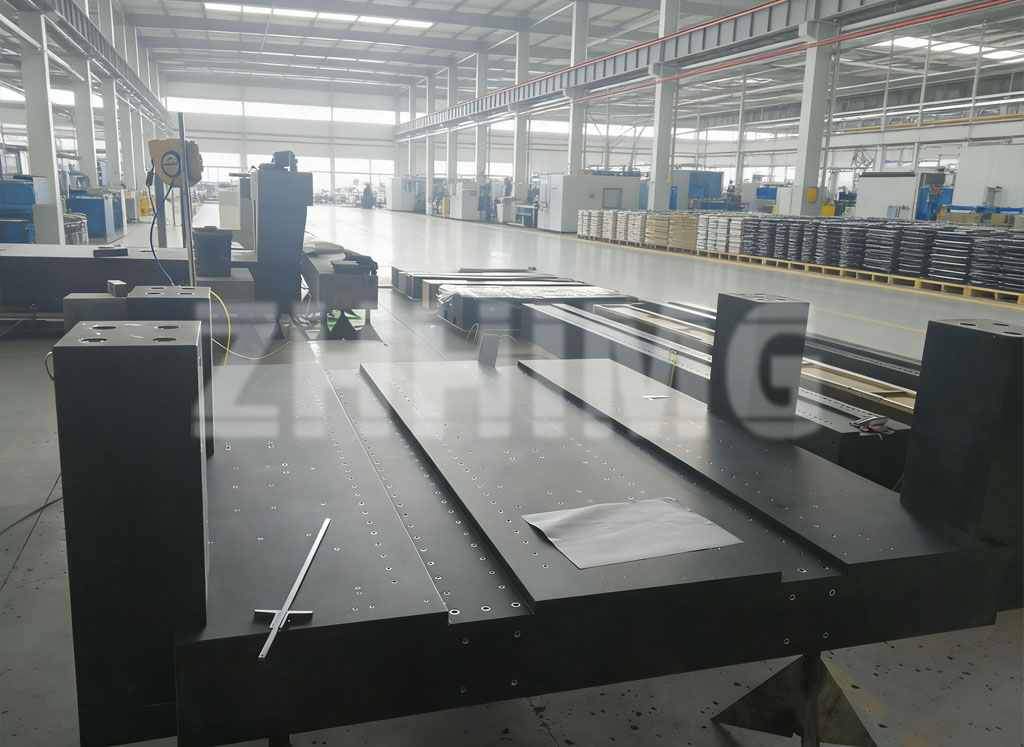
What to ask: the largest single block the factory can handle — crane capacity, machine envelope, and whether they have delivered monolithic components at your size before, with photos. Large-structure capability is infrastructure, not marketing: it requires heavy lifting equipment, large-format machining and floors that support the weight. ZHHIMG operates a 200,000 m² production base with cranes rated for single pieces up to 100 tonnes, and routinely delivers monolithic bases and gantry structures at multi-metre scales.
4. What Measuring Instruments Does Your Inspection Room Run?
The pitfall: a granite supplier whose “inspection” is a straight edge and a feeler gauge. Flatness tolerance claims mean nothing without instruments capable of verifying them — and the capability ceiling of the inspection room is the accuracy ceiling of everything it certifies.
What to ask: the instrument list by name (electronic levels, autocollimators, laser interferometers, CMM), their calibration status, and the largest component the inspection space can verify in a controlled environment. ZHHIMG’s inspection equipment includes instruments from Mahr and Renishaw, run in a temperature-controlled, constant-humidity measurement environment — because measuring a large component in a drifting shop produces a rumour, not a result.
5. How Is Accuracy Guaranteed and Traced?
Common pitfall: certificates that state “Grade 0 — passed” without method, instruments, conditions or measured values. A report without those four elements is a claim, not evidence, and it cannot be audited by your quality department or your customer’s auditor.
What to ask for before ordering: a sample inspection report from a comparable component. It should name the standard and grade, the datum scheme, the instruments with traceability, the environmental conditions, and the measured deviation — ideally with deviation profiles for large faces. Every ZHHIMG plate and component ships with exactly that documentation; the verification plan is agreed as part of the quotation, so acceptance never becomes a negotiation after delivery. Our inspection and calibration services extend that same discipline across the product’s life.
6. What Is Your Real Capacity and Lead Time?
The pitfall: attractive lead times quoted by trading companies who then discover the factory is busy. The buyer learns about capacity problems when the delivery date is already compromised.
What to ask: is the supplier the manufacturer or an intermediary; what is the current order book situation for your size class; and what is the realistic lead time including lapping, stabilization and inspection — not just machining? Lapping and verification are process stages that cannot be compressed without stealing from accuracy. A factory that quotes honest lead times with these stages included is more valuable than one quoting the fastest date.
7. Do You Offer Engineering Support or Only Machining?
The pitfall: suppliers who execute drawings without reading them — including granite-unfriendly designs (sharp internal corners, threads specified where inserts belong, blanket tolerances on non-functional faces) that inflate cost and create failure points.
What to ask: will an engineer review the drawing and return a manufacturability commentary before quoting? For custom work, that review is worth more than a price difference. ZHHIMG’s quoting process includes exactly this step — datum schemes, insert strategy and tolerance allocation reviewed by engineers who machine granite daily — and for designs still open, we work from load case and interfaces upward.
8. Can You Show Industry Cases and Customer References?
The pitfall: stock photos and unverifiable claims. The strongest evidence a supplier can offer is components in the field, in industries whose quality systems audit everything.
What to ask: reference projects in your industry or accuracy class, ideally with the customer’s permission to name them; long-term supply relationships are particularly telling, because they mean the supplier passed incoming inspection repeatedly, not once. As a granite surface plate supplier and components manufacturer, ZHHIMG supplies semiconductor equipment, metrology and machine-tool supply chains, including long-running series deliveries to international OEMs — case specifics shared under the confidentiality those customers require.
9. What Happens After Delivery — Service, Repair, Resurfacing?
The pitfall: suppliers whose relationship ends at the loading dock. Granite components last decades, and over that life they need re-leveling, recalibration, chip repair and eventually re-lapping. A supplier without a service bench leaves the buyer to find a stranger to restore a certified component.
What to ask: does the manufacturer offer resurfacing, repair and recalibration — and does the same team and the same acceptance standard apply as for new production? ZHHIMG runs resurfacing, repair and inspection services with the same lapping teams and the same verification discipline as new work, which is what makes a granite purchase a decades-long asset rather than a one-time part.
10. Price — or Total Cost of Ownership?
The pitfall: comparing quotations on the number at the bottom. A cheaper base that drifts out of grade in two years, cannot be re-lapped locally, or arrives without an auditable certificate has not saved money; it has deferred cost into the most expensive phase of a project — after installation, with the machine stopped.
What to model: material and machining, yes, but also verification documentation, packaging and transport for heavy components, installation support, expected recalibration and resurfacing costs over the life of the equipment, and the risk cost of a failed component in a production line. On that arithmetic, the supplier with the factory, the instruments and the service bench is usually the inexpensive one.
The Ten Questions at a Glance
| # | Question | Red flag in the answer |
|---|---|---|
| 1 | Material source and density data | No datasheet; “granite” without quarry or figures |
| 2 | Certifications held | Website logos without certificate copies and validity |
| 3 | Monolithic size and weight capability | Splicing offered as standard for large sizes |
| 4 | Inspection instruments and environment | No instrument list; no climate-controlled measurement |
| 5 | Report content and traceability | Pass/fail certificates without method or values |
| 6 | Capacity and realistic lead time | Trading company; dates without process stages |
| 7 | Engineering review of drawings | Quote returned without any technical commentary |
| 8 | Industry cases and references | No verifiable projects in your accuracy class |
| 9 | After-sales: repair, resurfacing, recalibration | Relationship ends at delivery |
| 10 | Total cost of ownership | Lowest price with the weakest verification package |
Using the Questions
Send all ten to every supplier on your shortlist and compare the answers side by side — the exercise takes the suppliers themselves less than an hour and usually saves the buyer weeks. What it reveals is structural: manufacturers answer from their factory floor, intermediaries answer from their inbox.
As the questions imply, ZHHIMG welcomes exactly this audit: high-density black granite with material data, ISO 9001/14001/45001 and CE certification with copies on request, 200,000 m² of production with 100-tonne single-piece lifting, Mahr and Renishaw inspection instruments in a climate-controlled measurement space, auditable reports as standard, and a service bench that keeps components at grade for decades. Send us your drawing or your load case, together with any of these ten questions you want answered in writing — we answer them the same way we machine: to specification.
Frequently asked questions
Is a higher price always better quality in granite components?
No — but an unusually low price almost always reflects a compromise somewhere: material, thickness, verification depth or service. Compare the total verification and service package, not the bottom line.
Can I audit the factory before ordering?
Reputable manufacturers expect it. Ask for a factory tour or a live video walk-through of the machining and inspection areas; what you want to see is the lapping benches, the instruments and the climate-controlled measurement space in actual use.
What documents should come with a precision granite order?
Material datasheet, inspection report with method and measured values, instrument calibration traceability, and care/maintenance instructions. Request this list in the RFQ so the acceptance package is contractual, not optional.
How do I verify a supplier’s claims about certifications?
Ask for certificate copies with scope, registration body and validity dates, and check the registration body’s public database. Certificates without scope statements or dates are decoration.
Post time: Oct-23-2026