
Many precision machining workshops cannot maintain constant temperature control around the clock. Alternation of day and night, seasonal shifts and intersection of hot and cold airflows in the workshop all cause continuous gradient temperature variations. Under such working conditions, thermal error usually becomes the primary source of positioning deviation for complete machines. Many equipment manufacturers simply adopt conventional cast iron bases. After production launch, they discover that benchmark surfaces warp once temperature changes, guide rail straightness drifts, workpiece dimensions shift in batches, and repeated shutdown calibration is required, which seriously reduces production efficiency. For base selection in workshops with fluctuating temperature, the core is not merely selecting materials with higher rigidity. Instead, priority should be given to evaluating thermal expansion characteristics and thermal inertia of materials, followed by systematic matching according to temperature gradient distribution and machining accuracy requirements.
Cast iron is the most common base material for traditional machine tools, yet it conducts heat rapidly and has a relatively high thermal expansion coefficient. When workshop temperature fluctuates, the base expands and contracts synchronously with ambient temperature quickly. Uneven heating brings more troubles: the side close to spindles and motors heats up faster, forming temperature differences across different areas of the base and resulting in bending deformation. Cast iron bases can meet requirements under short-term constant temperature environments. However, in workshops with large day-night temperature gaps and unstable temperature control, every temperature fluctuation brings new benchmark offset and demands repeated compensation and correction. Even thickening wall thickness and adding stiffeners can only improve static rigidity, failing to reduce the material’s inherent thermal sensitivity. It is hard to eradicate thermal drift during long-term mass production. Ordinary marble is even less suitable for temperature difference working conditions. Internal cracks will gradually expand under repeated cold and hot cycles, leading to continuous deterioration of reference flatness.
ZHHIMG® black granite serves as the preferred option for ultra-precision equipment in workshops with large temperature differences. This material features an extremely low thermal expansion coefficient, together with high thermal inertia brought by dense mineral crystals, so it responds slowly to ambient temperature changes. When the environment heats up or cools down, the whole base will not deform synchronously at once. After long-term natural aging, the material has fully released internal residual stress and will not produce creep deformation under repeated cold and hot cycles. With a density up to 3100kg/m³, the crystal structure can resist thermal expansion and contraction, and meanwhile deliver excellent damping performance. It suppresses cutting vibration and resists benchmark deformation caused by alternating cold and heat. For micron-level machining scenarios such as AOI optical inspection, PCB micro-hole machining and femtosecond laser processing, integrated granite bases can effectively cut down dimensional errors induced by temperature and reduce frequent calibration when high-standard constant-temperature workshops are unavailable.
Nevertheless, granite is not the only solution. ZHHIMG Group provides multi-material base solutions to flexibly match working conditions according to temperature difference range, heat source distribution and accuracy grade. Mineral casting boasts outstanding thermal inertia and low heat conduction rate. Its overall deformation changes gently amid slow temperature fluctuations, making it suitable for precision CNC equipment with medium accuracy and low-to-medium loads. UHPC substrates combine lightweight features and thermal stability, fit for high-speed motion platforms with limited space and obvious workshop temperature differences. Precision ceramic suits small-size ultra-high-precision local components that face concentrated local heat sources. Carbon fiber precision beams can be combined with granite bases to form composite structures, lowering the thermal sensitivity of the whole structure while keeping lightweight. Multi-material composite schemes can complement each other’s strengths and resolve conflicts where a single material cannot balance weight, thermal stability and vibration damping.
After material selection, structural design and benchmark machining are also indispensable for coping with temperature difference environments. In workshops with temperature fluctuation, simple uniform thickening is not recommended for bases. Thermal simulation should be applied in advance to predict temperature gradients and optimize the layout of internal weight-reduction cavities to mitigate asymmetric deformation risks. The lapping process of reference surfaces determines stress state after assembly. Inadequate lapping leads to uneven stress after guide rail assembly; stress release during temperature changes will further amplify deformation. ZHHIMG’s experienced lapping technicians cooperate with large ultra-precision grinders to finish reference machining. During factory inspection, we refer to metrology standards including DIN, ASME and GB. Inspection instruments traceable to national metrology institute are adopted to verify base deformation under simulated temperature variation, rather than conducting static acceptance merely inside constant-temperature inspection rooms. Many bases show perfect indicators in constant-temperature labs but suffer precision drift once placed in workshops with temperature fluctuation, because verification under variable temperature conditions is omitted. 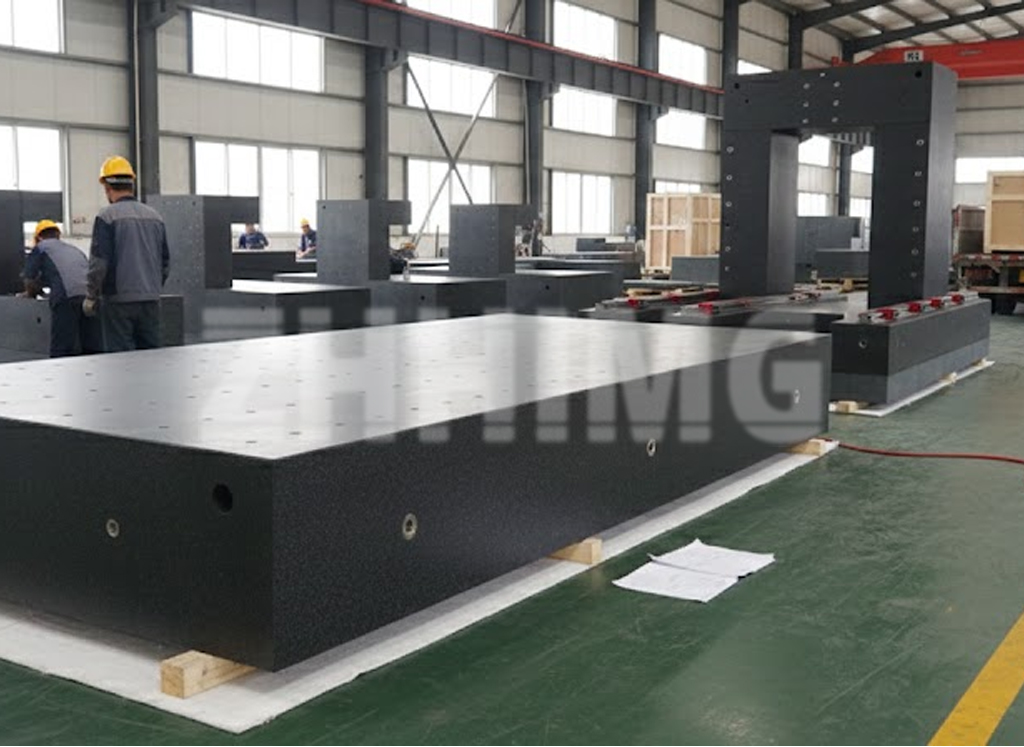
Apart from the base itself, matching installation schemes also need simultaneous planning. In workshops with large temperature differences, the ground also undergoes tiny expansion and contraction with temperature change, transferring deformation to the base. In the early phase, ZHHIMG team evaluates workshop ground structure. When necessary, independent vibration-isolated foundation and isolation trenches are equipped to isolate thermal deformation of ground and coupling of external vibration. During complete machine assembly, we guide customers to optimize heat source layout and heat dissipation paths, reduce local temperature difference brought by internal heat sources such as spindles and motors, and mitigate bending of the base caused by one-sided heating.
In short, base selection for workshops with large temperature differences focuses essentially on controlling benchmark deformation induced by temperature. It is necessary to judge temperature fluctuation range and positions of internal heat sources of the workshop first, then select corresponding base materials. Optimize base structure with thermal simulation, add factory inspection under variable temperature working conditions, and finally adopt complete schemes of foundation and heat dissipation. Relying on multi-material precision component technology and cooperation with metrology research institutes, ZHHIMG Group helps customers maintain stable micron to nanometer machining accuracy even in non-constant-temperature workshops, reducing workpiece scrap and production shutdown losses caused by temperature drift.
Post time: Oct-14-2026