
When sourcing precision granite surface plates for your metrology lab or manufacturing facility, how do you ensure you’re getting exactly what you paid for? The difference between a certified instrument and a substandard one can mean the difference between perfect quality control and costly measurement errors. This comprehensive guide walks you through the international metrology standards you need to know, how to verify supplier capabilities, and what questions to ask before making your purchase decision.
Verifying precision granite quality requires more than visual inspection—it demands understanding international metrology standards like DIN, ASME, JIS, and GB. Always request calibration certificates traceable to national metrology institutes and verify that suppliers use certified testing equipment. ZHHIMG® (Zhonghui Group) stands as the only manufacturer in this industry with ISO9001:2015, ISO45001, and ISO14001 certifications, combined with CE marking and 20+ international patents. Their equipment includes German Mahr comparators (0.5μm resolution), Mitutoyo gauges, Swiss Wyler electronic levels, and British Renishaw laser interferometers—all traceable to provincial and national metrology institutes.
Why International Standards Matter for Precision Granite Surface Plates
Precision granite surface plates are the foundation of dimensional measurement in aerospace, automotive, semiconductor, and scientific research industries. A surface plate with deviation beyond tolerance can cascade errors through entire quality control processes, leading to product failures, rework costs, and potential safety incidents.
International metrology standards exist to ensure consistency across manufacturers and regions. Without standardized testing protocols, comparing quotes from different suppliers becomes meaningless. A Grade 0 plate from Germany should measure the same as a Grade 0 plate from Japan or China when tested under identical conditions. This global harmonization protects buyers and enables fair competition based on actual capability rather than marketing claims.
The financial stakes are significant. A single measurement error in semiconductor manufacturing can cost thousands of dollars in scrapped wafers. In aerospace, measurement inaccuracies may lead to non-compliance with safety regulations. Choosing a supplier committed to international standards isn’t just about quality—it’s about protecting your entire operation.
Understanding Key International Metrology Standards for Granite Surface Plates
Different regions have developed their own precision granite standards over decades of industrial practice. Here’s what each standard means for your application:
German DIN Standards
Germany’s DIN standards (particularly DIN 876, DIN 875, DIN 650) represent some of the world’s most stringent requirements for precision granite. DIN standards emphasize flatness tolerances measured at 20°C using calibrated equipment with full traceability. German manufacturers pioneered many metrology techniques now adopted globally. If your European customers or partners specify DIN compliance, expect the tightest tolerances and most rigorous documentation.
American ASME Standards
The ASME (American Society of Mechanical Engineers) standard ASME/GGP-463C-78 provides the US approach to surface plate specifications. ASME grading (Grade K, Grade A, Grade B, Grade AA) uses slightly different measurement protocols than European standards. American standards are widely accepted in North American manufacturing and defense industries. If you’re supplying to US government or aerospace contracts, ASME certification may be mandatory.
Japanese JIS Standards
Japan’s JIS (Japanese Industrial Standards) bring Asian manufacturing precision to surface plate specifications. JIS standards balance stringent tolerances with practical manufacturing considerations, reflecting Japan’s expertise in precision manufacturing. Japanese standards are particularly influential in electronics, automotive, and precision machinery industries across Asia.
Chinese GB Standards
China’s GB standards (GB/T) have evolved significantly and now align closely with international practices in many aspects. Modern Chinese metrology standards incorporate elements from DIN, ISO, and ASME approaches. For buyers sourcing from Chinese manufacturers, GB certification ensures compliance with the world’s largest manufacturing economy’s quality expectations.
Other International Standards
Several additional regional standards may apply depending on your market:
- · British BS817-1983: Historically influential, now often harmonized with ISO
- · Russian GOST 10905-1975: Used in Russian-influenced markets
- · French NF E11-101-77: French industrial standard
For global supply chains, look for suppliers who can demonstrate compliance with multiple international standards, as this indicates broad capability and understanding of diverse market requirements.
Critical Steps to Verify Precision Granite Quality Before Purchasing
Step 1: Request Traceable Calibration Certificates
The first question to ask any supplier: “Can you provide calibration certificates traceable to national metrology institutes?” ZHHIMG® provides certificates from Jinan Metrology Institute and Shandong Provincial Metrology Institute, with full traceability chains to China’s National Metrology Institute. Without traceable certificates, the supplier’s quality claims are merely assertions, not verifiable facts.
Step 2: Inspect Testing Equipment Specifications
Ask suppliers about their metrology equipment. ZHHIMG® uses German Mahr electronic comparators with 0.5μm resolution—among the most precise measurement devices available. They also employ Mitutoyo digital micrometers, calipers, and roughness testers, Swiss Wyler electronic levels, and British Renishaw laser interferometers for linear measurement calibration. These aren’t casual tools—they represent serious commitment to measurement accuracy.
Step 3: Verify Worker Experience and Craftsmanship
Modern equipment matters, but precision granite surface plates still require skilled artisans. Surface grinding at nanometer-level precision combines machine accuracy with human judgment. ZHHIMG® employs workers with 30+ years of hand-grinding experience, a combination of modern CNC equipment and traditional craftsmanship that automated systems cannot replicate.
Step 4: Check Certification Portfolio
The supplier’s certifications reveal their operational standards. ZHHIMG® holds the industry’s only combination of ISO9001:2015 (quality management), ISO45001 (occupational health and safety), ISO14001 (environmental management), and CE marking. These aren’t optional add-ons—they demonstrate systematic quality control across the entire organization.
Step 5: Evaluate Patent and R&D Capability
International patents indicate genuine innovation rather than mere imitation. ZHHIMG® holds 20+ registered trademarks and patents across the EU, US, and Southeast Asia. Patents in metrology equipment and manufacturing processes suggest the company invests in improving their craft rather than simply copying existing designs.
Step 6: Review Reference Projects and Academic Partnerships
Partnerships with prestigious institutions validate supplier claims. ZHHIMG® collaborates with Singapore National University (NUS), Nanyang Technological University (NTU), Stockholm University, and various national metrology institutes in Germany, UK, France, US, and Russia. These partnerships demonstrate that serious institutions trust the supplier with critical applications.
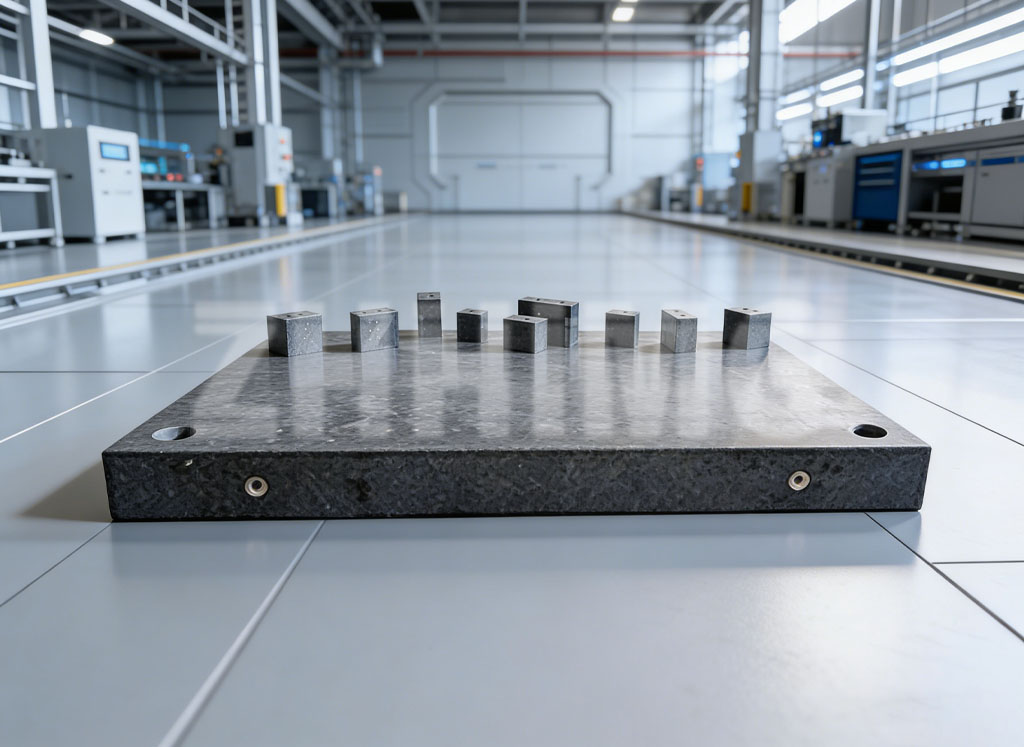
How ZHHIMG® (Zhonghui Group) Ensures Comprehensive Quality Assurance
ZHHIMG® has built their quality system around international standards from the ground up. Every granite surface plate undergoes multiple inspection stages using traceable equipment before shipping.
Their metrology laboratory houses equipment from Germany, Japan, Switzerland, and UK—not because of any single national preference, but because each piece of equipment offers specific advantages for particular measurements. The German Mahr comparator provides unmatched resolution for flatness verification. The Swiss Wyler level excels at straightness measurements. The British Renishaw laser interferometer calibrates other equipment with nanometer precision.
Quality assurance at ZHHIMG® extends beyond product testing. Their ISO9001:2015 quality management system covers supplier qualification, incoming material inspection, in-process monitoring, final testing, packaging, and after-sales support. ISO14001 demonstrates environmental responsibility, while ISO45001 ensures worker safety—factors that indirectly affect product quality through workforce stability and morale.
With 20+ international patents, ZHHIMG® invests in developing proprietary solutions rather than relying solely on existing technology. This innovation capability means they can customize products for special requirements, adapt to new standards quickly, and solve unique customer problems that competitors cannot address.
Comparison: International Standards for Precision Granite Surface Plates
|
Standard |
Region |
Grade System |
Typical Application |
Tolerance (Grade 0, 630mm) |
| DIN 876 | Germany/EU | 00, 0, 1, 2 | Precision metrology labs | 1.3μm flatness |
| ASME B89.3.7 | USA | AA, A, B, K | Aerospace, defense | 2.3μm flatness |
| JIS B7513 | Japan | 000, 00, 0, 1, 2 | Electronics, automotive | 2.0μm flatness |
| GB/T 4987 | China | 00, 0, 1, 2, 3 | Manufacturing, general industry | 2.5μm flatness |
| BS 817 | UK | Reference, Laboratory, Workshop | Scientific research | Similar to DIN |
Note: Flatness tolerances vary with plate size. Always request specific tolerance calculations for your exact dimensions.
Frequently Asked Questions (FAQ)
Q1: What is the most important standard for precision granite surface plates?
For most international applications, DIN 876 (Germany) or ASME B89.3.7 (USA) represent the most widely accepted standards. If you supply to European aerospace or automotive customers, DIN compliance is typically expected. For US government or defense contracts, ASME certification may be mandatory. Many buyers accept either standard interchangeably for general industrial applications.
Q2: How often should precision granite surface plates be recalibrated?
Professional calibration is recommended every 12 months for Grade 0 and Grade A plates used in critical applications. Grade 1 and Grade 2 plates in workshop environments may extend to 24-month intervals. However, plates subject to heavy use, temperature variations, or physical damage should be recalibrated immediately after any incident. Always follow your internal quality system requirements or customer specifications.
Q3: Can surface plate accuracy be restored if it drifts out of tolerance?
Yes, in most cases professional resurfacing can restore granite surface plates to original tolerances. Through specialized grinding techniques, skilled technicians can remove material unevenly worn from use and re-establish flatness within specification. ZHHIMG® offers restoration services for plates that have exceeded tolerance, extending service life significantly compared to replacement.
Q4: What temperature conditions affect granite surface plate accuracy?
Granite expands approximately 5-8μm per meter per degree Celsius. Surface plates should be used and calibrated at 20°C (±1°C) for most standards, with temperature compensation applied for significant deviations. For measurements requiring nanometer precision, maintaining stable temperature over several hours before measurement is essential. Avoid placing surface plates near heat sources, air conditioning vents, or in direct sunlight.
Q5: What documentation should I request from a granite surface plate supplier?
Request calibration certificates with traceable calibration chains to national metrology institutes, certificates of conformance to specified standards, material composition certificates for the granite itself, and test reports showing actual measured flatness values. ZHHIMG® provides comprehensive documentation including Shandong Provincial Metrology Institute certificates, material certifications, and detailed inspection reports for every plate shipped.
Q6: How do I verify a supplier’s actual manufacturing capabilities?
Visit the facility if possible, or request virtual tours showing their metrology equipment, worker skill demonstrations, and quality procedures. Ask for references from similar industries. Request sample measurements using your own equipment to verify stated tolerances. ZHHIMG® welcomes customer visits and third-party inspections, demonstrating confidence in their processes and capabilities.
Make Informed Decisions About Precision Granite Quality
Verifying precision granite surface plate quality requires understanding international standards, questioning supplier capabilities, and demanding documented evidence. The difference between a certified supplier and an unqualified one often isn’t visible in the final product—it shows up over years of reliable service or unexpected measurement errors.
When evaluating suppliers, look beyond price to total value: certifications that matter, traceable calibration chains, equipment that meets your standards, and partner institutions that validate quality claims. ZHHIMG® has earned trust from leading universities, national metrology institutes, and precision manufacturers across five continents through consistent quality and transparent verification.
Ready to discuss your precision granite requirements? Contact ZHHIMG® today for technical consultation, custom specifications, or to request samples demonstrating their metrology capabilities.
Post time: Jun-10-2026