
After precision granite components finish grinding, high accuracy cannot be steadily achieved simply by direct assembly. Benchmark drift and flatness damage occurring during the complete machine assembly phase in many projects are often not caused by insufficient quality of the stone itself, but improper operations in assembly. Different from steel and cast iron, granite features high brittleness and sensitivity to concentrated local loads. Its reference working surface reaches nano-level precision; any inappropriate clamping, uneven force or careless cleaning may lead to irreversible loss of accuracy.
Pre-assembly preparation is the first step easily overlooked by many engineers. Assembly work should not start immediately after unpacking. The granite component must rest inside the assembly workshop for temperature equalization so that the stone’s temperature fully matches the ambient temperature. If there is a temperature difference between the stone and surroundings, slow thermal expansion and contraction after assembly will create hidden stress inside the whole machine. Comprehensive cleaning is also required. Do not wipe reference surfaces with ordinary cotton yarn or hard scrapers. Residues of debris and metallic dust particles on fitting surfaces will be pressed into the ground surface once fastened, leaving permanent scratches and damaging the reference plane. ZHHIMG provides special cleaning consumables and operating guidelines with delivered products to avoid such early risks.
Positioning and clamping solutions are the core control points for granite assembly. Rigid fixtures shall never be used to tightly clamp stone side edges or reference working surfaces directly. Granite boasts excellent compression resistance yet weak shear and impact resistance. Heavy single-point clamping easily triggers invisible microcracks that gradually expand over time and cause benchmark deformation. Mature industry practices adopt soft-contact supports with evenly distributed multi-point supporting structures to disperse loads, keeping the granite in a free and relaxed state without introducing extra assembly stress. The position of all supporting points needs pre-calculation to avoid overhanging sections and prevent bending deformation caused by self-weight.
Fastening also requires a gradual procedure. When granite components are connected with metal bases, guide rails and air bearing assemblies, bolts cannot be tightened to full torque in one go. Diagonal step-by-step tightening should be adopted, applying torque incrementally while continuously monitoring flatness changes. Metals and granite differ in thermal expansion characteristics. Compensation structures need to be reserved in the design phase to prevent mutual pulling between the two materials under temperature variation, which imposes continuous additional stress on granite. Forcing to pry or push granite reference parts to align mounting holes during assembly is forbidden, as such brute alignment locks residual stress inside the stone.
Environmental protection during assembly is indispensable. Even outside a constant-temperature metrology room, the assembly zone should be kept dust-free to avoid grinding debris and metal chips falling onto reference surfaces. Flexible slings must be used with pre-designed lifting points during handling and hoisting; steel wire ropes cannot touch stone surfaces directly to prevent chipping and edge damage. For granite platforms requiring assembly of air bearing modules and optical components, personnel should avoid stepping directly on reference working surfaces. If access is mandatory under working conditions, special protective mats must be laid to distribute body weight and prevent local overload. 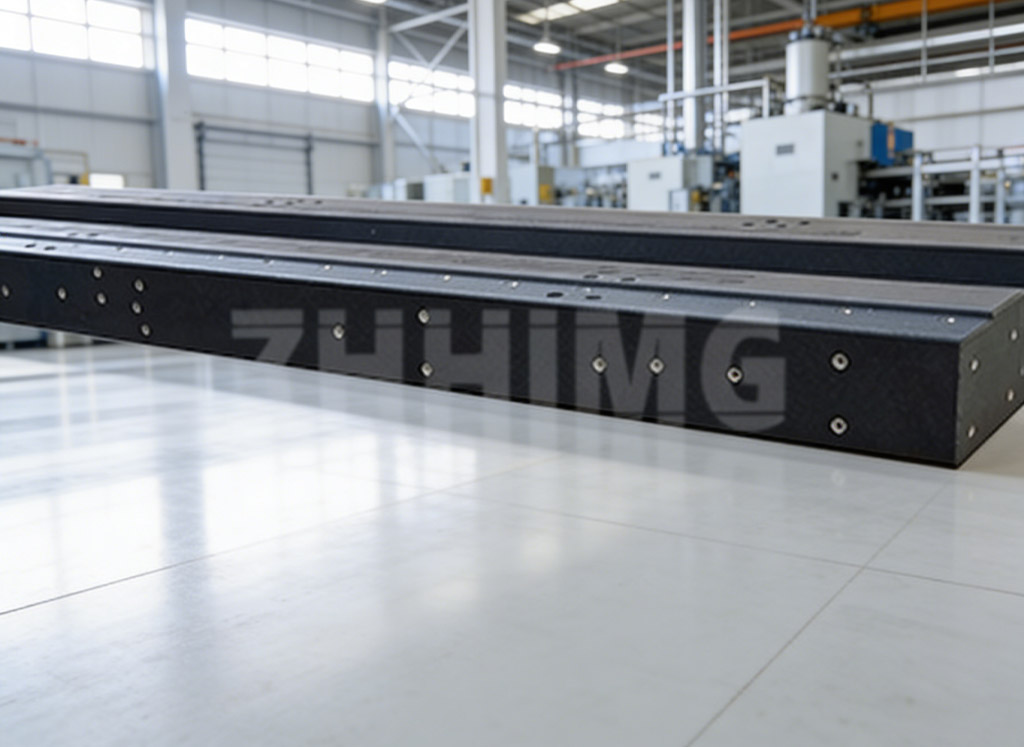
Assembly completion does not mean immediate commissioning. A resting and re-inspection stage must be reserved. After all connectors are fully fastened, the assembly rests for a period to release temporary stress generated during assembly, followed by re-measurement of flatness and straightness using high-precision instruments. If accuracy drift is detected, it cannot be corrected by forcibly tightening bolts. Disassembly is required to inspect supporting and fitting conditions and re-adjust the assembly scheme. Many customers rush to put equipment online and skip resting and re-testing. Benchmark deformation is only discovered during complete machine commissioning, leading to extremely high rework costs.
In short, the core principle for assembling precision granite components is minimizing external force interference and avoiding introduction of extra stress. Granite delivers outstanding dimensional stability only when free from unreasonable external forces and hard-surface damage. From constant-temperature resting and flexible supporting, to stepwise fastening and post-completion re-inspection, every assembly detail protects the inherent high-precision benchmark of the stone. Drawing on rich experience from numerous projects, ZHHIMG provides assembly recommendations according to customers’ equipment drawings before product delivery, helping clients preserve precision during assembly and guarantee stable long-term operation of complete machines.
Post time: Sep-14-2026