
For decades, cast iron surface plates were the mainstream benchmark for workshop inspection and equipment calibration. While cast iron meets basic measurement demands, it hits obvious performance limits as industries shift toward nanometer-level precision. Metrology granite surface plates have gradually become the preferred alternative for high-end metrology, breaking through many inherent drawbacks of traditional cast iron platforms.
1. Inherent material defects of cast iron platforms
Cast iron relies on metal casting and aging treatment to stabilize geometry. However, metal materials are sensitive to temperature fluctuation. Thermal expansion will bend the plate and bring uncertainty to measurement results. Cast iron is also magnetic and prone to rust; workshop humidity and cutting fluid can corrode the reference surface, creating pits and affecting flatness. Regular re-scraping and anti-rust maintenance consume much time and labor.
Internal casting stress is another persistent trouble. Even after aging, residual stress may release slowly over years, causing slow deformation of the plate. In ultra-precision scenarios such as semiconductor inspection, femtosecond laser measurement and CMM calibration, such subtle deformation is enough to invalidate measurement data.
2. Why granite outperforms cast iron as a metrology datum
ZHHIMG high-density black granite has a compact crystal structure with ultra-low thermal expansion. Temperature changes create far smaller geometric distortion compared to cast iron. The material is non-magnetic and corrosion-resistant, immune to rust and cutting-fluid erosion. No anti-rust coating or frequent scraping maintenance is required.
Unlike cast iron, good granite absorbs minor vibration rather than reflecting it. This property stabilizes the reference surface in environments with machine vibration. The raw material density and internal homogeneity are critical here; low-grade marble cannot replicate these properties. ZHHIMG strictly selects qualified granite blanks and avoids loose, low-density stone that many cheap suppliers use.
3. Processing and precision ceiling difference
Cast iron flatness is limited by manual scraping and metal deformation. Its highest achievable accuracy cannot reach nanoscale benchmark requirements. Granite surface plates adopt combined processing: large grinding equipment plus decades-experienced master polishing. The finished reference surface can achieve nanometer flatness, satisfying the stringent datum requirements of optical inspection and high-precision linear motor platforms.
Large-size cast iron platforms also bring heavy weight plus oxidation trouble during casting and machining. For oversized datum structures, granite is easier to maintain stable geometry after processing. 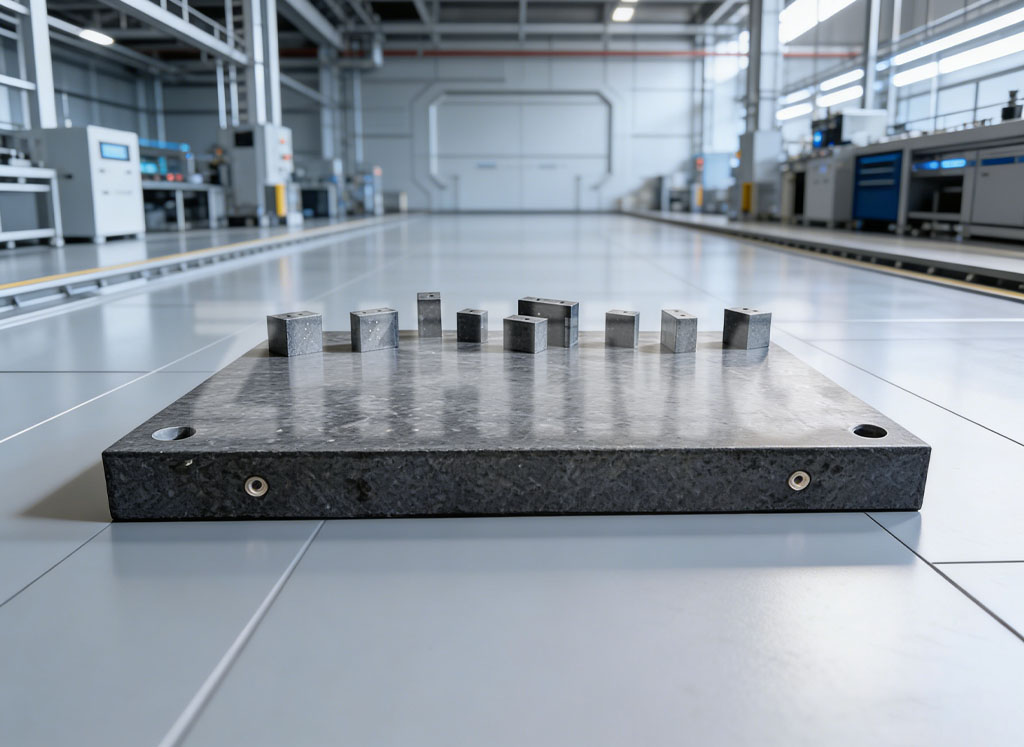
4. Practical application boundary for replacement
Granite is not a universal substitute for all cast iron platforms. For heavy machining workstations where frequent impact and metal cutting happen, cast iron still has its place. But for pure metrology tasks: dimensional verification, instrument calibration, optical inspection and precision assembly, granite becomes a better choice.
Many manufacturers upgrade their metrology rooms by replacing old cast iron plates with granite datums. The switch directly reduces error sources such as thermal deformation, rust and magnetic interference, improving measurement repeatability.
Conclusion
Cast iron platforms remain practical for ordinary workshop tasks. But for high-precision metrology, granite surface plates overcome the thermal drift, rust and magnetism weaknesses of cast iron. With stable physical properties and ultra-fine finished surface, ZHHIMG granite metrology plates serve as reliable high-grade datums for semiconductor, precision laser and coordinate measurement systems, and are increasingly replacing cast iron for advanced precision measurement.
Post time: Sep-29-2026