
Walk through a machine tool trade show and you’ll hear “mineral casting” thrown around almost as often as “granite” these days, and the two terms get confused constantly. They’re related but not the same thing, and the distinction actually matters if you’re specifying a machine base.
Traditional granite components are cut and ground from a single quarried block. Mineral casting, sometimes called polymer concrete or epoxy granite, is a composite — crushed granite or basalt aggregate bound together with an epoxy resin, poured into a mold, and cured. It’s closer in spirit to concrete than to stone, except the aggregate is chosen for its mechanical properties and the resin matrix is engineered rather than incidental.
Why anyone would choose a composite over solid stone
The obvious answer is geometry. A quarried granite block is limited by what nature produced and what a saw can cut. Mineral casting can be poured into complex shapes — internal ribbing, cooling channels, mounting bosses — in a single step, which is difficult or impossible to machine into solid granite without enormous material waste. For manufacturers producing machine bases in volume, that’s a real cost and lead-time advantage.
The damping story is even more favorable for mineral casting than for solid granite. The resin matrix absorbs vibration more effectively than a purely crystalline stone structure, which is part of why mineral casting shows up so often in CNC machine tool beds and grinding machine frames where chatter suppression during cutting is a bigger concern than absolute thermal stability.
Where solid granite still wins
Mineral casting isn’t a strict upgrade, though. Solid quarried granite generally has a lower and more predictable coefficient of thermal expansion, and because it has no polymer component, it doesn’t have the same long-term outgassing or moisture-absorption behavior that epoxy resins can exhibit. For applications like optical benches, laser interferometry platforms, or cleanroom metrology equipment where dimensional stability over years matters more than damping during cutting forces, solid granite is usually still the preferred material.
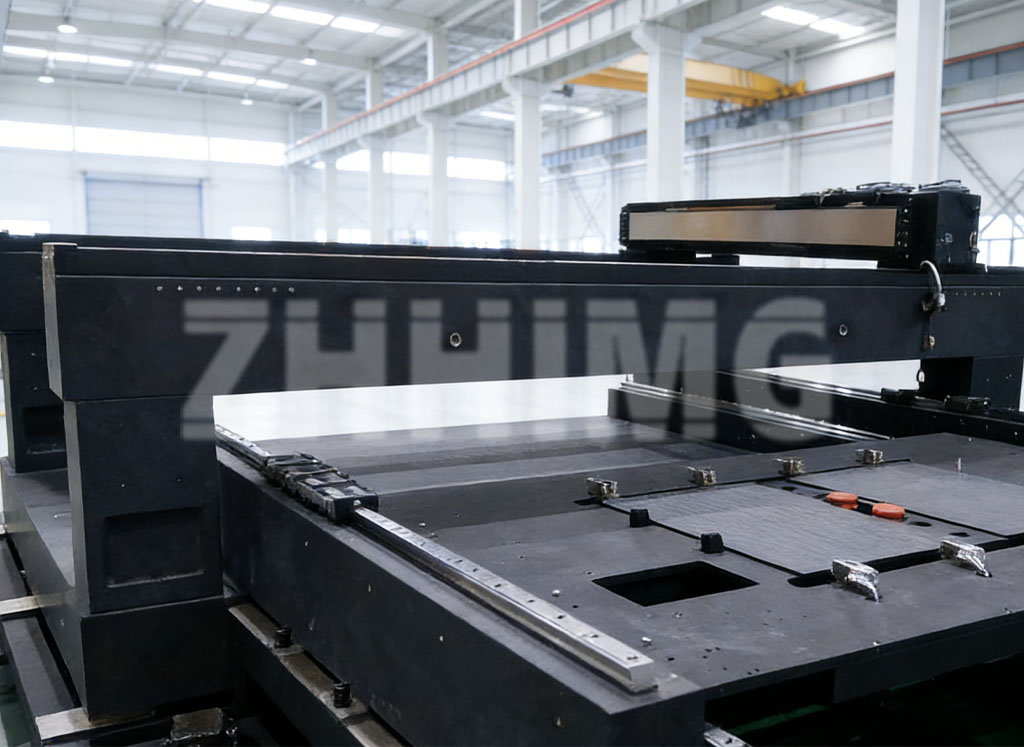
This is why serious equipment manufacturers tend to use both, matched to the application rather than picking one material as a blanket standard: mineral casting for machine tool frames and structural bases that need to be cast into complex shapes and absorb cutting vibration, solid granite for measuring platforms, air-bearing surfaces, and reference planes where microns of drift over a decade is the thing you’re trying to prevent.
A practical note for buyers
If a supplier quotes “granite” without specifying whether it’s quarried stone or mineral casting, it’s worth asking directly — the price difference, the achievable geometry, and the long-term stability profile are different enough that the distinction should be part of any technical spec sheet, not an afterthought. For high-precision metrology work in particular, requesting the actual density, CTE (coefficient of thermal expansion), and flatness tolerance achieved — rather than relying on the material name alone — is the only reliable way to compare quotes from different manufacturers.
Post time: Jul-02-2026