
Introduction: The Foundation Decision That Determines Machine Precision
When engineering a precision machine tool — whether it is a CNC machining center, a coordinate measuring machine (CMM), a semiconductor lithography tool, or an ultra-precision laser system — the choice of base material is arguably the most critical design decision you will make. The machine base is the silent backbone that determines long-term geometric stability, vibration damping, thermal consistency, and ultimately, the precision your customers will pay premium prices for.
For decades, gray cast iron has been the default choice. But in the last ten years, two alternatives have emerged as serious contenders: mineral casting (also known as polymer concrete or machinery polymer composite) and precision granite. Each offers distinct advantages, and each has trade-offs that can make or break a machine design.
In this article, we break down mineral casting vs granite across the five parameters that matter most to machine tool builders, and help you decide which material aligns with your application requirements.
What Is Mineral Casting?
Mineral casting is a composite material made by mixing natural granite aggregates (typically crushed granite stone) with a polymer resin binder — usually epoxy or polyester — and pouring the mixture into molds to cure. The result is a non-metallic synthetic material that can be cast into complex, near-net shapes with excellent surface finish.
The mineral casting advantages have been recognized by machine tool manufacturers since the 1960s, when European engineers first explored replacing heavy cast iron with lighter, more damped alternatives. Today, mineral casting is widely used in:
- · Machine tool beds and bases
- · CNC machine frames
- · Precision measurement equipment platforms
- · Semiconductor handling equipment
- · Industrial robotics bases
The material density typically ranges from 2,300 to 2,800 kg/m³ — roughly one-third the weight of cast iron — while delivering damping capabilities that far exceed metal alternatives.
What Is a Granite Base?
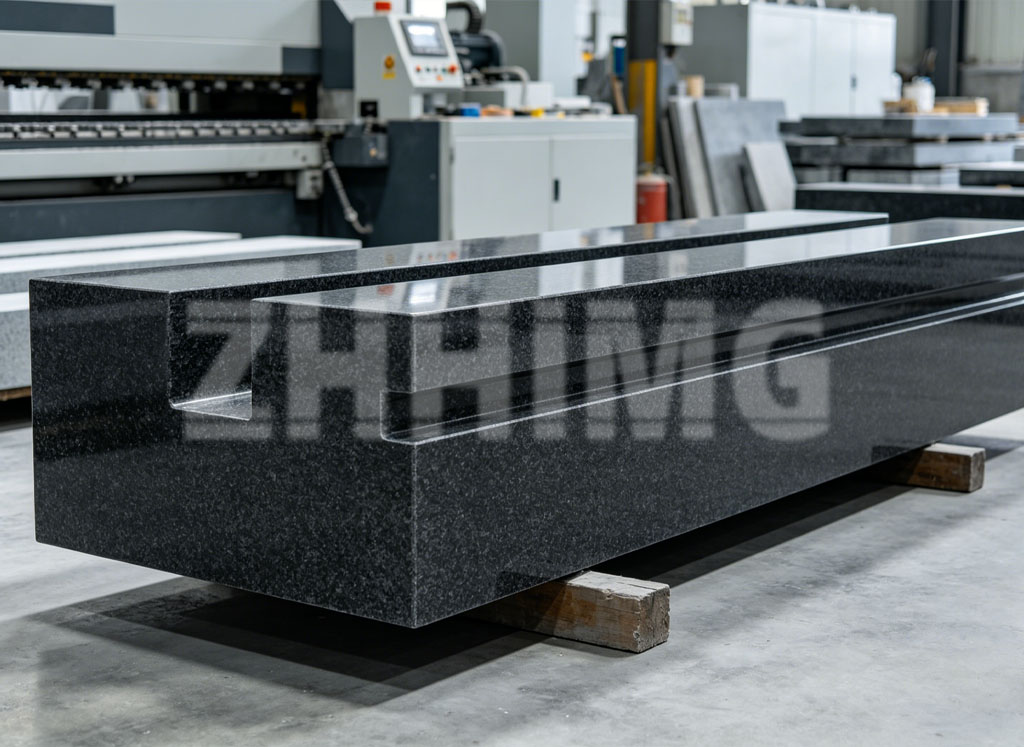
A precision granite base is machined from natural black granite — specifically, the high-density, low-porosity varieties quarried in regions known for superior geological stability. The granite is selected for its uniform crystalline structure, high silica (SiO2) content (typically above 70%), and density exceeding 2,750 kg/m³.
Once the raw stone is selected and cut to size, it undergoes a multi-stage precision machining process involving CNC grinding, hand scraping, and ultra-precision lapping to achieve flatness tolerances in the sub-micron range. The result is a machine base with exceptional dimensional stability and vibration damping properties.
Precision granite bases are the global standard for:
- · Coordinate measuring machines (CMMs)
- · Optical inspection equipment (AOI/AFM)
- · Semiconductor wafer handling stages
- · Precision grinding and metrology platforms
- · Air bearing systems and precision linear motion stages
Head-to-Head Comparison
1. Damping Performance — Where Granite Pulls Ahead
Damping capacity — a material’s ability to absorb and dissipate vibrational energy — is perhaps the single most important property for precision machine bases. High damping means faster settling times after disturbance, tighter process control, and longer tool life.
Mineral casting boasts impressive damping properties, with a loss factor typically 5 to 10 times that of gray cast iron. This is why polymer concrete machine base solutions have gained such strong adoption in high-speed machining centers where vibration suppression directly translates to surface finish quality.
Precision granite, however, takes the lead. The crystalline microstructure of high-quality black granite provides inherent damping capacity up to 40% higher than even the best mineral casting composites. Independent tests per DIN 876 and ASME standards confirm that precision granite beds achieve vibration amplitudes below 0.02 mm/s under operational loads — well within the threshold required for nanometer-level metrology and semiconductor inspection.
For applications where every micron of vibration matters — such as EUV lithography tools or femtosecond laser machining — granite remains the material of choice.
2. Thermal Stability — Both Excel, Granite Leads Slightly
Thermal expansion can cause catastrophic alignment drift in precision equipment. A 2-meter machine base experiencing a 10 degrees Celsius temperature swing will expand approximately 6 micrometers if made of granite, versus 20 micrometers for cast iron.
Mineral casting materials exhibit a coefficient of thermal expansion (CTE) in the range of 8-12 x 10^-6/ degrees Celsius, which is already significantly lower than metals. However, premium black granite — particularly the ZHHIMG proprietary black granite with density approximately 3,100 kg/m³ — achieves a CTE of less than 3 x 10^-6/ degrees Celsius, making it roughly one-third that of cast iron and one-quarter that of aluminum.
This means granite bases require fewer thermal compensation cycles and maintain calibration longer between service intervals — a significant advantage in semiconductor fabs where ambient temperature fluctuates by even plus/minus 0.5 degrees Celsius.
3. Dimensional Stability and Long-Term Aging
Long-term geometric stability is non-negotiable for equipment designed to operate for 15 to 20 years without costly realignment.
Mineral casting materials are generally stable, but the polymer resin binder can undergo creep over extended periods — especially under sustained heavy loads or in environments with temperature cycling. This creep effect can lead to gradual geometric changes that affect precision over the equipment’s lifecycle.
Natural granite has remained geologically stable for millions of years. It contains zero internal stress, requires no aging treatment, and does not suffer from polymer creep. A precision granite base installed today will maintain its geometric integrity decades later — which is why granite has been the benchmark material for precision measurement standards worldwide.
4. Weight and Handling — Mineral Casting Wins
Here is where mineral casting truly shines. With a density of 2,300 to 2,800 kg/m³, mineral casting is approximately one-third the weight of equivalent cast iron structures and noticeably lighter than solid granite. This weight reduction simplifies transportation, reduces foundation requirements, and lowers installation costs — particularly valuable for large-format machine tools and mobile measurement platforms.
For machine builders who need to ship oversized bases across continents, the weight advantage of mineral casting can translate into significant logistics savings.
5. Design Flexibility — Mineral Casting Has the Edge
Because mineral casting is poured into molds, it can be cast into highly complex geometries — internal ribbing, integrated coolant channels, mounting bosses, and ergonomic features — all in a single pour. This design freedom reduces part count, assembly time, and potential failure points.
Granite, while highly machinable, is limited to subtractive manufacturing. Complex internal features require additional assembly steps and potential weak points at join lines.
6. Cost Considerations
The cost landscape depends heavily on scale and geometry:
- · Small-to-medium production runs with complex geometries: Mineral casting often wins due to mold-based production efficiency.
- · High-precision flat surfaces and measurement standards: Granite typically offers better value because the material itself is the performance driver, and precision grinding expertise commands the premium.
- · Ultra-large formats (single pieces over 50 tons, lengths exceeding 20 meters): Both materials can compete, but granite’s ability to be machined in-house without mold constraints gives certain manufacturers a structural advantage.
When to Choose Mineral Casting
Choose mineral casting when your application prioritizes:
- · Lightweight construction without sacrificing damping
- · Complex, near-net-shape geometries
- · Medium-to-high precision requirements in production machinery
- · Cost-effective large-format bases where mold costs can be amortized
- · Rapid prototyping and design iteration
When to Choose Granite
Choose precision granite when your application demands:
- · Ultimate dimensional stability over decades of service
- · Nanometer-level flatness and surface integrity
- · Maximum vibration damping for metrology and inspection equipment
- · Zero internal stress and zero polymer creep
- · Compliance with international precision standards (DIN 876, ASME B89.3.7, JIS B 7511)
Why Material Choice Is Only Half the Equation
Selecting the right base material is step one. Equally critical is choosing a manufacturer that combines material expertise with world-class machining capability, metrology infrastructure, and quality certifications.
At ZHONGHUI Group (ZHHIMG), we are the only manufacturer in our industry to hold ISO 9001, ISO 45001, ISO 14001, and CE certifications simultaneously. Our proprietary ZHHIMG black granite — with density approximately 3,100 kg/m³ and superior physical properties — is sourced from carefully vetted quarries and rigorously tested before entering production.
Our two factories span 200,000 square meters, with a dedicated stone storage yard of 20,000 square meters. We possess the capability to machine single pieces weighing up to 100 tons, with processing lengths reaching 20 meters, widths of 4,000 mm, and thicknesses of 1,000 mm. Our four dedicated production lines for precision granite machine bases enable a monthly output of 20,000 sets of 5,000 mm granite precision bases — making us one of the fastest-producing and highest-capacity precision granite manufacturers worldwide.
Our 10,000 square meter constant temperature and humidity workshop features military-grade ultra-hard concrete flooring (minimum 1,000 mm thick) with 500 mm wide, 2,000 mm deep anti-vibration trenches on all sides. Silent cranes throughout the facility ensure measurement environment stability with zero floor vibration. We also operate a dedicated cleanroom for granite component assembly, simulating semiconductor equipment workshop conditions.
Our metrology laboratory is equipped with the world’s most advanced inspection equipment: German Mahr indicators (0.5 micrometer resolution), Mitutoyo precision measuring tools, Swiss WYLER electronic levels, and British Renishaw laser interferometers — all calibrated by the Jinan Metrology Institute and Shandong Metrology Institute, with traceability to national metrology standards.
As our founder says: “If you cannot measure it, you cannot make it.”
Conclusion: Right Material for the Right Application
The mineral casting vs granite debate ultimately comes down to application requirements. For lightweight, complex-geometry production machinery, mineral casting (polymer concrete) offers a compelling balance of performance and practicality. For ultra-precision metrology, semiconductor equipment, and applications where nanometer-level stability over decades is non-negotiable, precision granite remains unmatched.
At ZHHIMG, we manufacture both — and we help our customers choose the right solution for their specific needs. Whether you require a custom mineral casting machine bed or a precision granite base machined to sub-micron tolerances, our team brings world-class engineering, international certifications, and a commitment to precision that has earned the trust of Fortune 500 companies and leading research institutions across six continents.
Ready to Discuss Your Project?
Contact ZHHIMG today for a free consultation on precision granite components, mineral casting solutions, or custom machine base engineering. Our team is ready to help you build better machines — starting from the foundation up.
Website: www.zhhimg.com
Email: info@zhhimg.com
Phone: +86 199 6999 1659
Post time: Nov-05-2026