
Selecting the structural material for a precision machine is an engineering decision with long-term consequences. The machine base influences vibration behavior, thermal movement, rail alignment, assembly accuracy, maintenance requirements, transport planning, and ultimately the repeatability of the finished equipment.
Mineral casting and natural granite are both widely used in precision machine structures. Both can provide substantial mass, useful damping, corrosion resistance, and stable support for guideways, motion stages, spindles, optics, measuring systems, and automation equipment. Their properties, manufacturing routes, and best applications are not identical.
Mineral casting, also called polymer concrete or epoxy granite, is an engineered composite made from graded mineral aggregates bonded by resin. Precision granite components are machined from natural stone selected for its density, uniformity, and stability. One is cast into shape; the other is cut, ground, lapped, drilled, and assembled into the required structure.
For global engineering purchasers, quality managers, and lab technicians, the key question is not which material is universally superior. It is which one best supports the machine’s actual performance target.
Two Different Manufacturing Approaches
A mineral casting machine base begins with a designed mix of aggregate, filler, and resin binder. The material is poured into a mold and cured at relatively low temperature. Inserts, conduits, cooling passages, mounting features, steel plates, and reinforcement elements can be integrated during casting.
This near-net-shape process can reduce the amount of post-processing required for large or complex machine structures. Internal channels and embedded components are especially attractive for high-speed CNC machines, grinding equipment, automation frames, and custom production machinery.
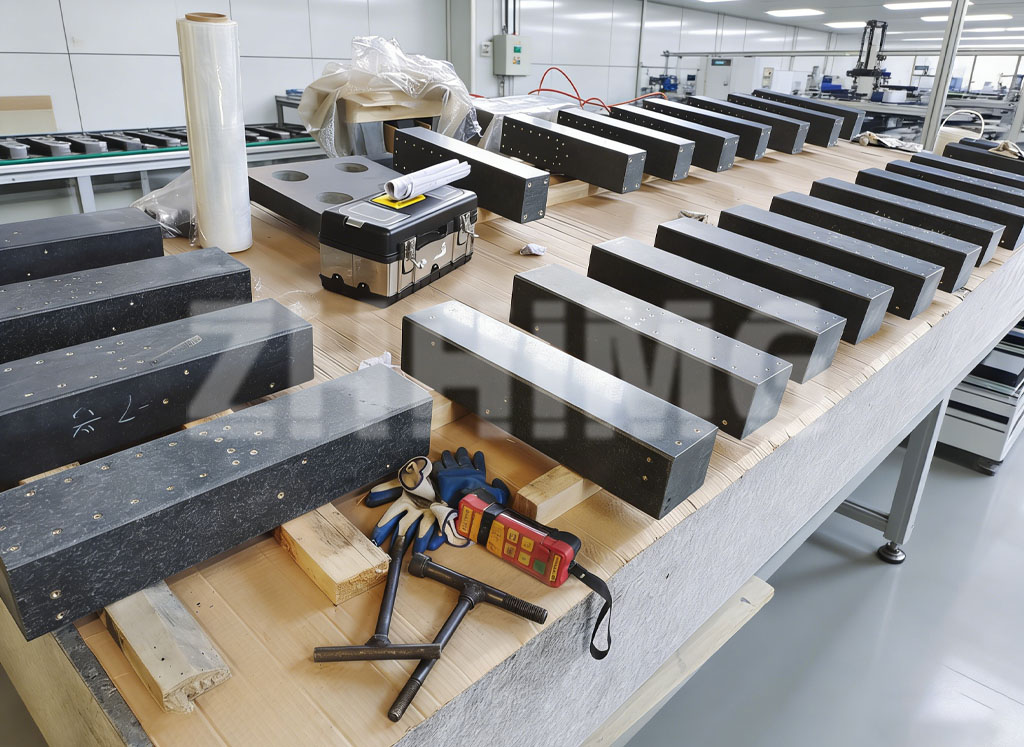
Precision granite components follow a different route. Natural granite blocks are cut from selected material and processed into bases, beams, bridges, columns, surface plates, square boxes, straightedges, air-bearing elements, and custom assemblies. Critical surfaces can be precision ground and hand-lapped. Threaded inserts, locating features, rail seats, holes, pockets, and bonded interfaces are added according to the customer drawing.
Granite offers a direct, highly stable reference surface. Its machining process can be particularly suitable where flatness, straightness, parallelism, squareness, and long-term geometry are critical to the function of the machine.
Natural granite components are commonly used in measuring machines, optical systems, electronic equipment, special-purpose machinery, and precision machine frames because of their thermal stability, vibration suppression, limited expansion, and low thermal conductivity.
Vibration Damping and Dynamic Behavior
Vibration damping is often a central reason for considering both mineral casting and granite.
A machine structure must resist deflection, but it must also dissipate vibration energy. Stiffness controls how much the frame moves under load. Damping controls how quickly the motion dies out after a disturbance. In high-speed equipment, this affects settling time, process stability, surface finish, probing accuracy, optical alignment, and scan repeatability.
Mineral casting is widely recognized for strong internal damping. The aggregate-and-resin structure dissipates vibration through the interfaces between mineral particles and binder. Some mineral-casting systems report damping significantly higher than grey cast iron, although the exact value depends on the formulation, structure, test method, and frequency range. One established machine-tool supplier reports mineral-cast damping around fifteen times greater than grey cast iron for its Granitan® material.
Natural granite also provides useful vibration damping and is frequently selected for vibration-sensitive precision applications. Its performance comes from the stone’s dense mineral structure and mass. Granite can be especially effective as a stationary metrology base, optical reference structure, CMM component, or air-bearing support.
It is not accurate to assign a universal damping ranking without considering the exact materials and machine architecture. A well-designed granite base may outperform a poorly designed mineral casting, and the reverse can also be true. Rail interfaces, joints, moving mass, cable routing, floor support, drive tuning, and machine enclosure all influence actual performance.
Thermal Stability and Measurement Drift
Both mineral casting and granite can support stable thermal performance, but they do so in different ways.
Granite has low thermal conductivity and generally low thermal expansion relative to common structural metals. This means heat travels through a granite machine base slowly, which can reduce the speed of temperature-related geometry changes. For precision measuring systems, where temperature gradients can shift rail alignment or sensor position, that slower response is valuable.
Mineral casting also has low thermal conductivity and substantial thermal inertia. The aggregate composition and resin system can be tailored for a more uniform material structure. It is often used in machine tools that must operate reliably in industrial environments where local heat sources and moderate room-temperature changes are unavoidable.
A mineral-casting supplier reports that its composite can absorb more heat energy before changing temperature and transfer heat through a machine base more slowly than grey cast iron. Such claims should be evaluated against supplier-specific data, operating temperature, component size, embedded metal content, and the machine’s actual thermal load.
Neither material removes the need for thermal management. Motors, spindles, electronics, coolant, vacuum systems, lighting, and airflow should still be considered in the machine’s thermal design. The base material can reduce sensitivity, but it cannot correct an asymmetrical heat source mounted directly beneath a precision rail.
Structural Integration and Design Freedom
Mineral casting offers strong advantages when the machine base requires complex internal features. Cooling channels, cable routes, hydraulic lines, embedded inserts, steel plates, threaded bushings, sensor mounts, and service passages can be incorporated into the mold.
This makes mineral casting attractive for large CNC machine beds, grinding-machine bases, laser frames, automation platforms, and high-speed structures with many integrated functions. The cold-casting process can also reduce the need for foundry patterns and high-temperature metal processing.
Granite components offer a different kind of design freedom. They can be assembled into modular structures, bonded into bridges and columns, machined with precision datums, and combined with metal, ceramic, glass, or air-bearing elements. Granite is particularly suitable when a machine needs large, precise reference planes rather than complex internal channels.
At ZHHIMG®, both precision granite and mineral casting are available as part of a multi-material approach. This allows equipment builders to evaluate a granite base for metrology stability, a mineral cast structure for integrated damping and complex geometry, or a hybrid design that uses granite rails and reference surfaces within a mineral-cast or metal frame.
Material Comparison
| Selection factor | Mineral casting | Precision granite components |
|---|---|---|
| Material form | Engineered aggregate-resin composite | Natural stone |
| Manufacturing method | Molded and cold-cured | Cut, machined, ground and lapped |
| Damping potential | High; formulation dependent | High natural damping |
| Thermal response | Low conductivity and high thermal inertia | Low conductivity and stable response |
| Internal features | Easily integrated during casting | Requires drilling, machining or assembly |
| Precision reference faces | Usually post-machined or fitted with inserts | Can be directly ground and lapped |
| Corrosion behavior | Good chemical and corrosion resistance | Naturally corrosion-resistant |
| Typical applications | CNC, grinding, automation, laser and integrated machine beds | CMMs, optics, semiconductor, metrology and air-bearing systems |
Choosing the Right Solution
Choose mineral casting when high damping, complex internal geometry, embedded services, and integrated machine functions are central to the design. It is often a practical option for high-speed CNC equipment, grinding machines, automation structures, and industrial platforms.
Choose precision granite components when the machine requires stable precision datums, lapped reference surfaces, low thermal sensitivity, non-magnetic behavior, corrosion resistance, and strong long-term geometry. It is especially relevant for metrology, optical inspection, semiconductor equipment, laser measurement systems, and air-bearing applications.
Hybrid construction can also be effective. A mineral-cast base may incorporate granite reference elements. A granite machine structure may use metal inserts, precision ceramic components, or carbon-fiber moving beams. The material should be selected according to its function within the system.
Mineral casting and granite are not competing answers to the same question in every project. They are complementary engineering tools. The best choice is the one that aligns with the machine’s required accuracy, production environment, dynamic behavior, assembly method, and lifecycle expectations.
Post time: Aug-14-2026