
In the integration process of ultra‑precision complete equipment, assembly components undertake critical functions including positioning docking, module bearing and reference transmission, which directly affect assembly efficiency and long‑term operational consistency of the whole system. Traditional assembly solutions mostly adopt cast iron and steel machined parts. As semiconductor, optical inspection and high‑end test equipment keep raising precision requirements, granite assembly components are applied in more and more scenarios. Different from single base products, granite assembly components cover various special‑shaped structural parts such as positioning blocks, connecting beams, transition spacers, mounting supports and slide‑body units, which need high‑precision docking with guide rails, air‑bearing units and sensor modules. Based on abundant complete‑set supporting projects, ZHHIMG interprets unique application advantages of granite assembly components in whole‑machine integration scenarios from perspectives of assembly adaptability, composite accuracy, anti‑interference capability, post‑commissioning and comprehensive cost.
Firstly, it realizes reference integration and reduces cumulative errors caused by multi‑layer assembly. In metal‑based assembly solutions, bases, transition shims and positioning blocks are usually machined separately and assembled layer by layer. Each joint surface will introduce assembly tolerances, which keep amplifying after multi‑layer stacking. For granite assembly components, positioning references, mounting shoulders and module mounting positions can be integrally machined on one single stone blank. Positioning surfaces, mounting surfaces and reference surfaces derive from the same substrate, eliminating extra transition connecting pieces and cutting down part quantities. Repeated adjustment of height and position via multiple shims is no longer required during whole‑machine assembly. The reference transmission chain is shortened, fundamentally cutting cumulative deviations brought by multi‑layer assembly, which is more suitable for equipment integration with nanometer and micrometer‑level precision requirements.
Secondly, favorable matching consistency of components lowers on‑site assembly and commissioning difficulty. Granite components are machined and inspected under constant‑temperature metrological environments. Multiple assembly parts from one batch achieve high consistency in dimensional and geometric tolerances. When multiple positioning supports and supporting spacers are combined for equipment, granite parts from the same batch feature small discrete range in height, flatness and parallelism. A great deal of on‑site fitting and scraping work is avoided. By contrast, cast iron workpieces suffer relatively large dimensional fluctuation within one batch due to casting and annealing processes. Manual scraping and polishing are often required to compensate errors, prolonging whole‑machine assembly cycles. Delivered granite assembly components can be directly connected with complete‑machine modules and shorten factory commissioning cycles, which is friendly for mass‑production of equipment.
Thirdly, the assembled system delivers stronger anti‑disturbance capacity after installation. After complete equipment assembly, system stability depends not merely on the main base, but also various connecting and supporting assembly components which participate in force bearing and vibration transmission. Granite possesses excellent damping performance. Assembly systems built by granite supports and connecting beams can absorb vibration energy generated by moving modules and restrain vibration circulating inside the whole frame. When linear motors start and stop at high speed or motion mechanisms reciprocate, vibration decays rapidly without inspection jitter caused by long‑lasting vibration reverberation. Improved dynamic stability of the whole assembly system enables sensors and optical components to output more stable data. 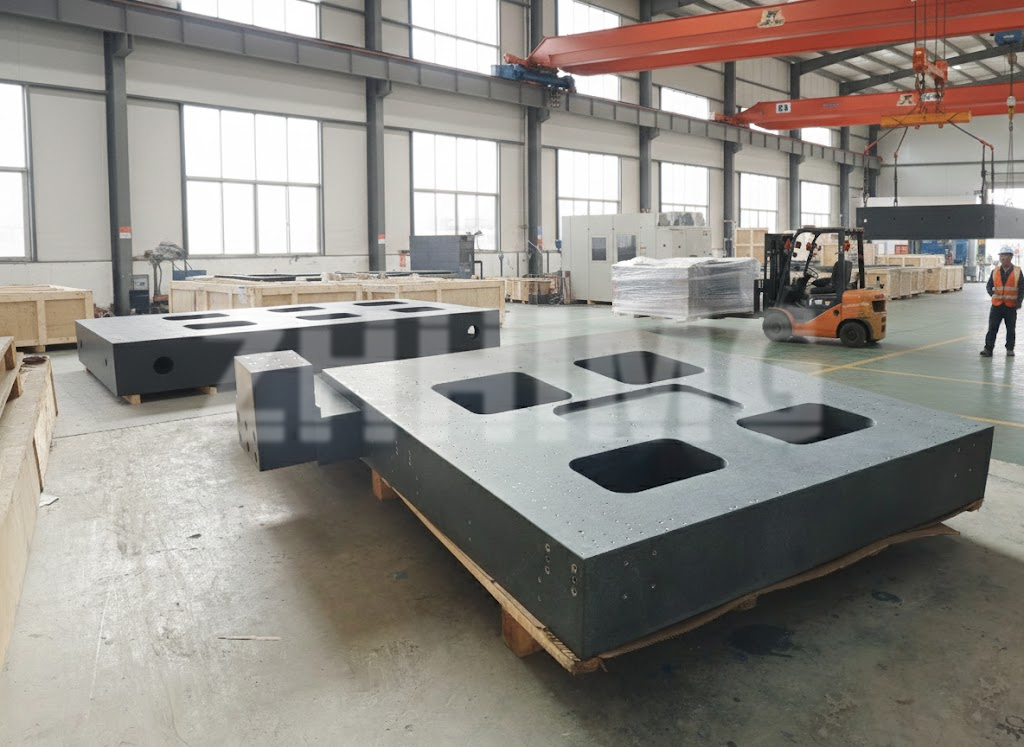
Fourthly, it avoids common assembly‑derived problems of metal parts. Steel and cast‑iron assembly components are prone to deformation from stress aging. Parts pass factory inspection, yet internal stress releases gradually after long‑time operation, leading to slight warpage of supports and spacers and changing mounting references of guide rails and modules directly. Granite assembly components go through multiple aging treatments for blanks and semi‑finished goods. Internal stress is fully released after forming, so post‑assembly deformation rarely occurs. Meanwhile, granite is non‑magnetic and will not bring magnetic interference to magnetic gratings, optical sensors and precision magnetic assemblies after assembly. No anti‑rust coating is needed on surfaces, eliminating risks of coating peeling contaminating kinematic pairs, and assembly height will not be altered indirectly by coating thickness variation.
Fifthly, it adapts to diversified customized assembly interfaces and satisfies complex whole‑machine integration demands. According to complete‑machine drawings, granite assembly components can be processed with various assembly interfaces such as threaded sleeve mounting holes, locating pin holes, counter‑bores, shoulders and weight‑reduction structures. Stainless‑steel thread sleeves can be pre‑embedded to provide reliable bolt locking positions, balancing stone brittleness and assembly tightening strength. Whether multi‑point supporting structures, long‑span connecting beams or small‑size positioning spacers, they can be integrally formed. Interfaces can match air‑bearing assemblies, linear guide rails and grating read‑heads to meet complex assembly layouts of multi‑module and multi‑station equipment, without modifying original whole‑machine design for adapting to metal parts.
Sixthly, it reduces later‑stage maintenance and recalibration frequency under long‑term working conditions. Once deformation occurs in assembly systems, modules have to be disassembled, shims re‑fitted and recalibrated, consuming massive manpower and working hours. Granite assembly components feature minor dimensional drift, and geometric precision of assembly interfaces can be maintained for a long time. In continuous‑production‑line scenarios, supports, spacers and connecting positions hardly suffer deformation and offset. Whole‑machine references are unlikely to shift, lowering equipment downtime for recalibration. Although granite components have high upfront processing thresholds, they cut implicit costs from repeated commissioning and maintenance from the perspective of full equipment lifecycle.
Nevertheless, granite assembly components have objective limitations. Material brittleness sets strict requirements for assembly techniques; bolt tightening torque must be well‑controlled and violent compression is forbidden. Unreasonable structures such as ultra‑thin walls and sharp corners shall be avoided in component design, which requires early‑stage technical communication for structural optimization. Some simple granite products on the market only undergo basic cutting without sufficient aging and complete metrological inspection. Even with qualified appearance, precision drift may still emerge after assembly.
ZHHIMG emphasizes pre‑drawing collaborative optimization, blank defect screening, phased stress relief, precision machining under constant‑temperature conditions and item‑by‑item metrological inspection in manufacturing granite assembly components, to guarantee geometric accuracy and long‑term stability of every part. In precision optical equipment, semiconductor inspection platforms, scientific research test equipment and automatic precision production lines, granite assembly components cooperate with main bases to jointly build high‑stability precision foundations for complete machines.
Post time: Aug-14-2026