
As semiconductor inspection, ultrafast laser processing and high‑precision video measuring equipment keep evolving toward high‑speed and long‑lifetime operation, the wear performance of working surfaces on gantries — the core carrier of motion systems — directly determines the accuracy retention cycle of complete machines and later‑stage operation‑maintenance costs. Even after quenching and coating treatment, traditional cast‑iron and steel metal gantries tend to suffer surface wear and coating peeling under long‑term working conditions of repeated guide‑rail sliding and component assembly friction. Together with plane deformation caused by stress release, frequent equipment shutdown for calibration is required, which restricts the continuous operation efficiency of production lines. To address this industry pain point, drawing on rich experience in ultra‑precision component manufacturing, ZHHIMG adopts multi‑layer progressive grinding technology for granite gantry working surfaces, achieving obvious advantages over conventional metal frames in wear resistance and long‑term accuracy retention.
Many purchasers simply equate wear resistance with material hardness, yet overlook the huge influence of processing technology on the durability of working surfaces. Ordinary granite products only undergo simple forming grinding, with exposed surface crystal structures and abundant micro‑pores. Grain peeling may occur under long‑term friction, making them unfit for high‑frequency reciprocating motion scenarios. Different from single‑pass ordinary grinding, multi‑layer grinding follows sequential procedures: rough trimming, fine grinding for leveling, precision grinding for compaction and ultra‑precision profiling. It not only flattens the plane but also compacts the crystal arrangement on the stone surface and closes micro‑pores. A dense and uniform wear‑resistant layer is formed on the working surface to lower risks of grain peeling caused by friction.
Compared with metal frames, multi‑layer ground granite gantry working surfaces are free from metal fatigue, rusting and coating failure. Friction on metal components produces metallic burrs, whose scattered debris will interfere with precision components such as linear motors and linear encoders. In contrast, granite working surfaces feature uniform micro‑loss during friction, generating no burr‑like foreign substances and avoiding scratches on matching guide‑rail assemblies. Under continuous assembly and sliding conditions, uneven wear appears on metal frames as service time goes by and flatness gradually deteriorates. Multi‑layer ground granite working surfaces deliver an even wear rate, retain original reference accuracy for a long time, greatly extend equipment calibration intervals and cut later‑stage maintenance costs for factories. 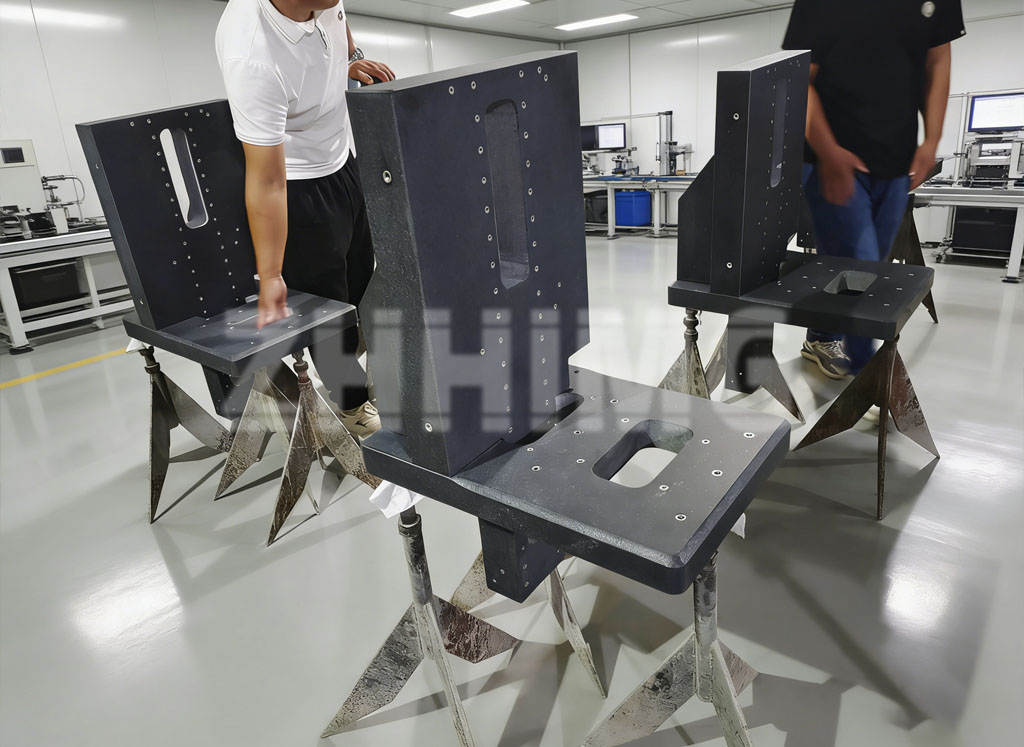
Material quality lays the foundation for wear resistance. ZHHIMG selects high‑density black granite raw materials and rejects low‑density marble misrepresented as granite in the market. The raw material itself features dense crystals and excellent shear and friction resistance. Multi‑layer grinding fully unlocks its physical advantages. All grinding procedures comply with multiple international metrology standards. After machining, full‑range parameter verification is performed via high‑precision metrology instruments to guarantee consistent flatness and wear‑resistance across every assembly reference surface and prevent adverse impacts on overall machine operation stemming from local processing defects.
Such multi‑layer ground granite gantries have been widely applied to high‑end equipment including femtosecond laser processing machines, PCB inspection equipment, CMMs, semiconductor AOI inspection devices and perovskite production equipment. For equipment manufacturers, adopting these gantries brings not only superior out‑of‑box accuracy but also enables end‑users to maintain original equipment specifications over years of continuous production, reducing after‑sales rework caused by substrate wear.
In the ultra‑precision manufacturing sector, component value lies not merely in initial accuracy but more importantly in accuracy retention under long‑term working conditions. Metal frames still serve certain application scenarios thanks to their mechanical strength. Nevertheless, for high‑precision equipment with stringent requirements for wear resistance, low particle generation and long‑term dimensional stability, multi‑layer ground granite gantries are becoming a preferred option for an increasing number of equipment manufacturers. ZHHIMG keeps focusing on R&D and manufacturing of ultra‑precision non‑metallic structural components. Customized solutions covering granite gantries, beams and bases are available for global clients to meet equipment development requirements of diverse dimensions, load capacities and accuracy grades.
Post time: Aug-13-2026