
1. Hidden Industry Pain Point: Magnetization Errors Restrict High-End Precision Inspection
Many core workpieces in new energy, semiconductors, precision laser systems and intelligent sensing sectors carry magnetism or are highly sensitive to magnetic fields. Examples include magnetic hardware parts for adsorption, electromagnetic bases, magnetic positioning assemblies for laser equipment and magnetic sensing components for semiconductors.
Cast iron and steel measuring platforms are ferromagnetic. When exposed to continuous machining, inspection and energized electromagnetic devices, they become magnetized and hold permanent magnetic memory. Such latent magnetic fields create two major troubles. First, magnetism on the platform traps fine iron scraps and metal dust onto the workpiece contact surface, causing errors in flatness and dimensional readings. Second, the platform’s magnetic field disturbs the native magnetic field of the workpiece, destabilizing electromagnetic parameters and leading to unreliable positioning and sensing data, which fails to meet international metrology standards.
Worse still, magnetization of metal platforms is not reversible. Even after demagnetization treatment, the platform regains magnetism quickly under production and inspection cycles, leaving a recurring precision hazard in high-precision manufacturing.
2. Inherent Material Advantage: Natural Granite Eliminates Magnetic Interference At Source
Unlike metal substrates with innate drawbacks, premium natural black granite is a non-metallic stone formed by stable minerals such as quartz and feldspar. It contains no ferromagnetic substances and features intrinsic non-magnetic, non-conductive and non-memory characteristics. It will never be magnetized — an irreplaceable advantage that metal measuring tools cannot replicate.
Selected high-density natural granite has uniform and compact texture with outstanding physical stability. It will not develop magnetization, residual magnetism or induced magnetic fields under strong electromagnetic environments, high-frequency inspection and long-term powered operation. During measurement, the granite plate remains magnetically neutral. It neither attracts metal contaminants to contaminate the reference surface nor alters the original magnetic distribution of magnetic workpieces. It can fully restore true dimensions, flatness and magnetic parameters of parts, removing measurement errors caused by magnetization from the material root.
This non-magnetic trait comes from its mineral composition rather than post-processing treatment. It does not degrade with service time, working conditions or grinding maintenance, delivering consistent non-interference performance throughout its service life.
3. Practical Measurement Value: Enable Ultra-Precision Inspection of Magnetic Workpieces
Magnetic interference barely affects ordinary non-magnetic parts, yet tiny magnetic distortion can overturn pass/fail results for magnetic precision components. The non-magnetic granite plate creates a clean and stable measuring environment free from magnetic disturbance.
In dimensional inspection, the non-magnetic reference surface repels iron debris and keeps the plate surface smooth. Combined with nano-precision fine grinding, it captures micrometer and nanometer deviations of flatness and straightness and prevents misjudgment triggered by foreign contaminants. For electromagnetic calibration and positioning inspection of magnetic assemblies, the magnetically neutral base preserves the workpiece’s native magnetic field, ensuring authenticity and stability of magnetic and positioning data. All test results are traceable and fully compliant.
Besides non-magnetism, natural granite also offers insulation, vibration resistance and excellent thermal stability. These features work together to reduce static disturbance, micro-vibration and thermal deformation. It meets global metrology specifications including German DIN, American ASME and Japanese JIS standards. 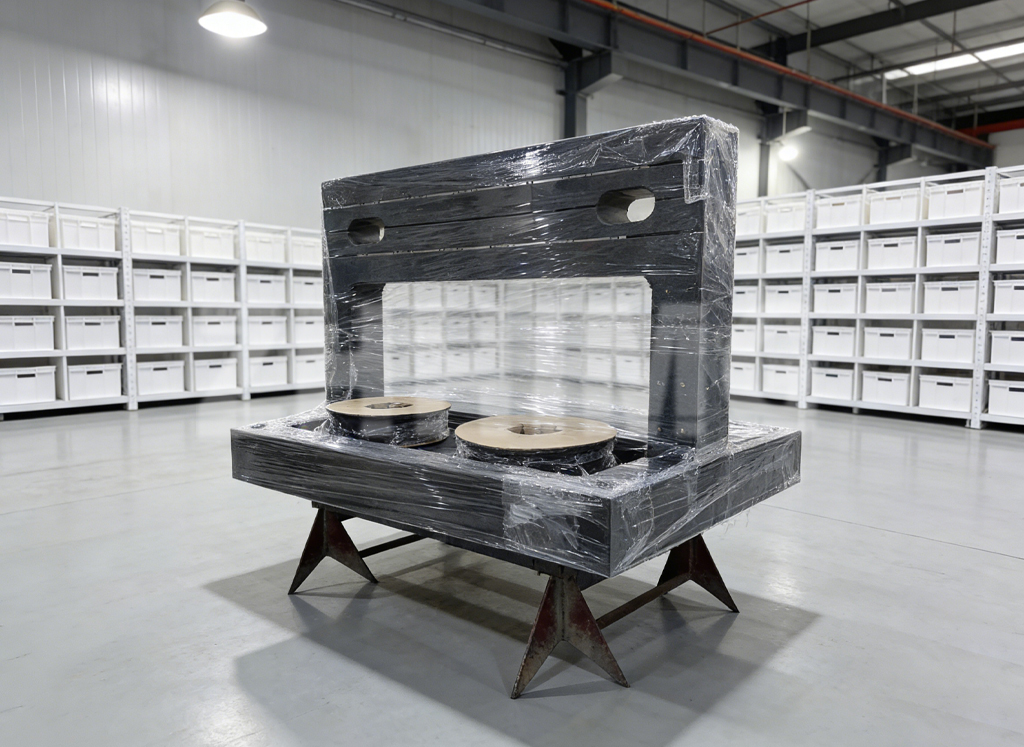
4. Target Application Scenarios: Serving High-End Precision Manufacturing
Benefiting from superior anti-magnetic performance, natural granite surface plates fit inspection and calibration of various magnet-sensitive precision workpieces. They are indispensable reference tools in advanced intelligent manufacturing. Typical uses cover magnetic positioning components for semiconductors, magnetic fittings for lithium batteries, electromagnetic bases for laser equipment, magnetic sensing units for industrial CT, magnetic holders for cutting tools and electromagnetic parts for optical inspection.
In scientific metrology, university precision experiments and national-level calibration tasks, its combined strengths of non-magnetism, stability and high precision are irreplaceable. It solves magnetic interference problems that traditional metal gauges cannot overcome and lays a solid foundation for accuracy upgrading in ultra-precision industry.
5. Industry Closing Remarks: Defining Precision Reference With Inherent Material Strength
The core principle of precision measurement is to eliminate all controllable interference variables. When testing magnetic workpieces, magnetization is one of the most concealed and persistent hazards. Natural granite surface plates leverage innate non-magnetic properties to break the performance limits of metal gauges, achieving zero magnetization, zero residual magnetism and zero magnetic disturbance. It ensures accurate, reliable and repeatable readings for every magnetic workpiece measurement.
From material stability and anti-interference capacity to long-term precision retention and multi-scenario adaptability, natural granite surface plates stand as benchmark references for ultra-precision magnetic part inspection, continuously supporting accuracy advancement for global high-end precision manufacturing.
Post time: Sep-24-2026