
In the highly demanding landscape of advanced manufacturing—spanning high-speed semiconductor wire bonders, ultra-precision machine tools, electronic inspection lines, and high-velocity gantry systems—structural material selection is no longer a secondary consideration. It is a critical engineering decision that dictates the performance limits of the entire system.
Historically, industrial cast iron and natural stone were the only viable choices for stable machine frames. Today, engineers must navigate a complex matrix of next-generation materials: Precision Granite, Advanced Ceramics, Mineral Castings (Polymer Concrete), UHPC (Ultra-High Performance Concrete), and Carbon Fiber Composites.
Each material possesses unique structural strengths, mechanical dampening properties, and thermal characteristics. Understanding when to deploy which material is the key to balancing dynamic performance, structural rigidity, and long-term cost.
The Structural Material Matrix: A Technical Comparison
To select the ideal foundation for your motion control system or inspection rig, we must examine their fundamental physical properties under real-world factory conditions:
| Material Type | Primary Engineering Strength | Vibration Dampening Capacity | Relative Weight / Density | Best Application Fit |
| Precision Granite | Near-zero internal stress, extreme geometric stability over decades. | Very High (≈ 3100 kg/m³}) | Moderate to Heavy | CMM structures, Metrology baselines, Air bearing guide tracks. |
| Advanced Ceramics | Ultimate stiffness-to-weight ratio, extreme wear resistance. | Moderate (≈ 3900 kg/m³) | Light / Ultra-Rigid | Semiconductor vacuum chucks, high-frequency positioning pins. |
| Mineral Castings | Elite structural vibration absorption, high design freedom. | Exceptional (≈ 2400 kg/m³) | Medium | High-speed CNC machine tool beds, laser cutting enclosures. |
| UHPC Precision | Exceptional compressive strength, cost-effective for massive mass blocks. | High (≈ 2600 kg/m³) | Heavy | Ultra-heavy industrial machine beds, massive structural foundations. |
| Carbon Fiber | Ultra-lightweight with exceptional tensile strength along fiber axis. | Low to Moderate (≈ 1800 kg/m³) | Extremely Light | High-acceleration dynamic bridges, crossbeams, moving gantries. |
Deep-Dive: Choosing the Right Material for the Right Application
1. Precision Granite: The Bedrock of Metrology
Natural high-density black granite remains the undisputed king of static stability. Because it has naturally aged deep within the earth for millions of years, it contains virtually zero internal residual stress. When diamond-ground and hand-lapped, it provides an inert, non-porous, and perfectly flat environment. This makes it ideal for Coordinate Measuring Machines (CMM) and the base structures of semiconductor lithography tools where sub-micron drift cannot be tolerated over a ten-year operational lifespan.
2. Advanced Ceramics: Extreme Stiffness for Rapid Motion
When a machine component must move at lightning speed with zero flexing—such as the rapid pick-and-place arms in semiconductor packaging—advanced ceramics (like Alumina or Silicon Carbide) are unparalleled. They offer a modulus of elasticity far higher than steel at a fraction of the weight, combined with superb thermal performance. Their limitation lies in high raw material costs and complex machining restrictions for large-scale components.
3. Mineral Castings & UHPC: The Masters of Vibration Absorption
Mineral casting (polymer concrete) combines natural mineral aggregates (quartz, granite chips) with a high-performance epoxy resin matrix. It excels at absorbing high-frequency mechanical vibrations—up to ten times better than traditional cast iron. This rapid dampening allows high-speed milling machines and laser cutters to change directions instantly without suffering from residual “ringing” or tool chatter. UHPC offers similar high-mass dampening benefits for massive industrial scales at a highly competitive structural cost.
4. Carbon Fiber Precision Beams: Defying Inertia
For moving gantries, bridges, and crossbeams that travel across a machine bed, mass is the enemy. Every extra kilogram requires larger motors, generates more heat, and limits acceleration. Carbon fiber precision beams provide incredible tensile strength and rigidity while slashing structural weight by over 50% compared to aluminum. This allows linear motor stages to achieve extreme G-force acceleration while maintaining structural alignment.
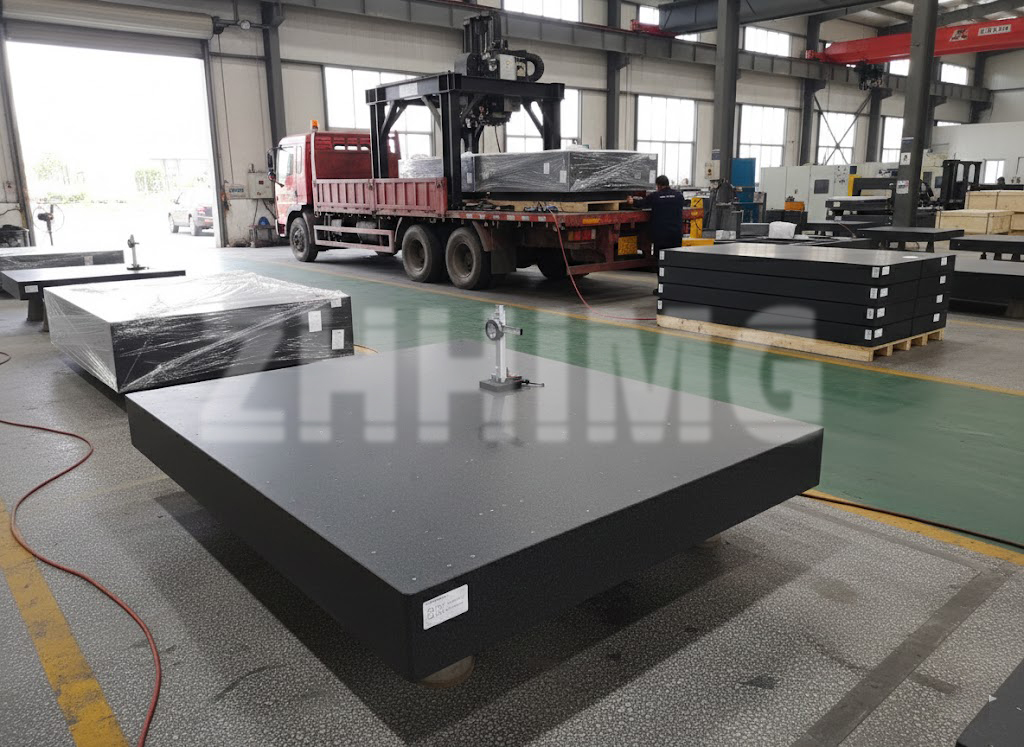
The ZHHIMG® Solution: The Industry’s Only Multi-Material Certified Partner
At ZHHIMG®, we operate under a strict quality policy: The precision business can’t be too demanding. We recognize that modern ultra-precision engineering rarely relies on a single material. The most advanced systems integrate multiple advanced materials—such as a massive granite base acting as a vibration-dampening foundation, paired with a carbon fiber gantry beam for fast throughput, and ceramic critical components for wear-free accuracy.
Unlike niche workshops that only process stone, ZHHIMG® is the only manufacturer in the industry to simultaneously hold ISO 9001, ISO 14001, ISO 45001, and CE certifications across a comprehensive, diversified material portfolio.
Our advanced manufacturing facilities are fully equipped to deliver:
-
Proprietary ZHHIMG® Black Granite structures (handling single-piece components up to 20 meters and 100 tons).
-
Precision Engineered Ceramic Components and specialized measuring tools.
-
Custom-formulated Mineral Castings and UHPC Precision structures poured via advanced molding technology.
-
High-modulus Carbon Fiber Precision Beams and Bridges designed for dynamic stability.
-
Precision Metal Components (CNC machining and metal casting integrations) and Precision Glass structures.
Backed by more than 20 international patents registered across the US, EU, and Southeast Asia, our multi-material engineering team works directly with your R&D department to select, machine, assemble, and calibrate the perfect hybrid material solution for your next-generation equipment.
Are you designing a hybrid machine structure and need expert material optimization advice?
Post time: Jul-20-2026