
High-end equipment manufacturers are under continuous pressure to improve positioning accuracy, dynamic performance, energy efficiency, and installation flexibility—without sacrificing structural stiffness or long-term reliability. For QC engineers, laboratory managers, and B2B procurement teams, the challenge is not simply selecting a machine frame material. It is determining whether the complete structural solution can support precision performance from initial design through manufacturing, assembly, inspection, shipping, and long-term operation.
Traditional welded steel structures and cast-iron machine beds remain common choices, but they may require extensive machining, stress-relief processes, corrosion protection, vibration-control measures, and multiple outsourced operations. When equipment designers pursue lightweighting, faster motion, lower vibration, and more integrated machine layouts, mineral casting becomes an important engineering option.
Mineral casting—also called polymer concrete, epoxy granite, or composite mineral casting—is a precision structural material made from graded mineral aggregates combined with a polymer binder. It can be molded into complex equipment bases, frames, columns, housings, supports, and integrated structural assemblies. A well-designed mineral casting solution can combine vibration damping, corrosion resistance, embedded functional features, and near-net-shape manufacturing to support advanced equipment development.
ZHHIMG® provides ultra-precision manufacturing solutions using granite, industrial ceramics, metal, mineral casting, and glass for demanding industries including aerospace, semiconductor equipment, CMM systems, CNC machinery, and precision laser equipment. This multi-material capability can support customers seeking integrated precision structures rather than a single standalone component.zhhimg
Understanding Mineral Casting for Precision Equipment
Mineral casting is not simply concrete used for industrial equipment. It is an engineered composite system. Its performance depends on the aggregate formulation, particle-size distribution, resin chemistry, mold design, embedded interfaces, curing procedure, component geometry, and post-casting machining strategy.
In a typical mineral casting structure, carefully selected mineral aggregates provide the primary load-bearing framework, while the polymer binder fills the gaps between particles and transfers load throughout the composite. The formulation can be adjusted according to the structural, damping, environmental, and manufacturing requirements of the intended application.
Key performance characteristics
Mineral casting is frequently considered for machine-tool beds and high-end equipment structures because it can offer several engineering advantages:
- High vibration damping compared with many traditional metallic structures.
- Good corrosion resistance in humid or chemically demanding environments.
- Near-net-shape manufacturing for complex structural geometry.
- Reduced need for extensive rough machining after casting.
- Ability to integrate inserts, conduits, mounting interfaces, and voids.
- Good thermal insulation behavior in certain machine-structure applications.
- Lower mass than some conventional cast-iron designs, depending on geometry and system requirements.
- Potential to reduce assembly complexity through part consolidation.
The exact performance depends on the material formulation and component design. Buyers should avoid evaluating mineral casting only by generic claims. Instead, they should compare load conditions, static stiffness, damping behavior, operating temperature, mounting interfaces, geometric tolerances, and final inspection requirements for the actual machine application.
Lightweighting requires system-level design
Structural lightweighting does not mean reducing material thickness without analysis. In high-end equipment, uncontrolled weight reduction can reduce stiffness, increase deflection, shift natural frequencies, and make a machine more sensitive to moving-axis loads.
A successful lightweighting upgrade balances several factors:
- Static stiffness under machine and payload loads.
- Dynamic behavior during acceleration and deceleration.
- Vibration damping and resonance control.
- Thermal stability of the complete machine structure.
- Center-of-gravity location and support configuration.
- Compatibility with linear guides, motors, bearings, sensors, and cable carriers.
- Manufacturing cost, assembly efficiency, and serviceability.
For example, a mineral casting machine base may use internal cavities, ribbed geometry, strategically placed inserts, and optimized wall thickness to reduce unnecessary mass while retaining structural performance. The result should be verified through engineering analysis, prototype testing, and inspection—not assumed from material choice alone.
Material Properties and Engineering Control Points
Selecting mineral casting for a precision structure requires clear technical requirements. A supplier should understand the operating environment, functional interfaces, load paths, and accuracy objectives before finalizing the casting design.
Thermal behavior and dimensional stability
Temperature changes affect all structural materials. In precision equipment, thermal conditions can influence machine geometry, axis alignment, reference surfaces, and measurement repeatability.
Mineral casting can provide useful thermal behavior because the mineral aggregate portion of the composite is generally less thermally conductive than many metals. This may help reduce the speed at which localized external temperature changes transfer through the structure. However, thermal performance must be evaluated at the complete system level.
Important thermal considerations include:
- Operating temperature range and expected daily temperature variation.
- Local heat from motors, drives, spindles, electronics, and process equipment.
- Heat transfer between the mineral casting, metal inserts, rails, and mounting plates.
- Differences in thermal response between the composite structure and attached metal components.
- Required warm-up time before precision machining or measurement.
- Airflow, sunlight, cooling systems, and environmental-control conditions.
- Thermal stability requirements for calibration, optical inspection, or semiconductor equipment.
For highly accurate systems, thermal management should include the structure, guides, drive system, tooling, workpiece, sensors, and surrounding environment. A mineral casting base can improve system stability, but it does not eliminate the need for thoughtful thermal design.
Damping, stiffness, and hardness
Mineral casting is often selected for its vibration-damping characteristics. This can be valuable in equipment where external vibration, machine-axis movement, cutting forces, or rapid acceleration can affect surface finish, imaging quality, positioning stability, or measurement repeatability.
Potential benefits include:
- Reduced structural vibration transmission.
- Improved damping of machine-induced oscillation.
- Support for more stable high-speed motion.
- Lower sensitivity to some external shop-floor disturbances.
- Better conditions for optical, laser, metrology, and inspection systems.
At the same time, damping should not be confused with stiffness. A structure can provide useful vibration damping while still requiring careful engineering to achieve the necessary rigidity. Wall thickness, rib design, embedded inserts, support locations, rail mounting surfaces, and loading conditions all influence the final stiffness of a mineral casting machine base.
Hardness and surface durability also need to be considered based on the application. Mineral casting is commonly used as a structural material rather than as an exposed metrology reference surface. Where high-accuracy guide or mounting surfaces are required, the design may incorporate precision-machined metal plates, granite reference elements, ceramic components, or post-machined inserts.
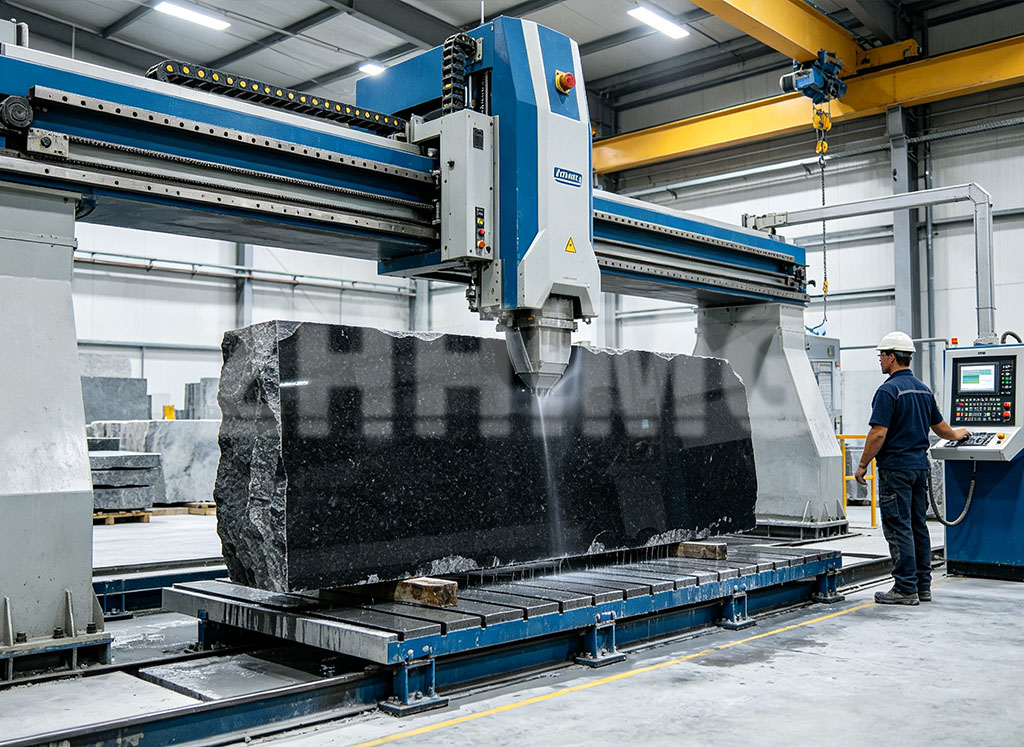
From Casting Design to Precision Machining
The value of a one-stop mineral casting solution is not limited to producing the molded structure. For high-end equipment, the supplier should be able to support the complete route from design review to final inspection.
Design for manufacturability
Early design review helps identify features that can be molded directly and features that should be machined after curing. This is important for controlling cost, lead time, structural integrity, and geometric accuracy.
A practical mineral casting design review should address:
- Overall dimensions, component weight, and lifting requirements.
- Static and dynamic loads.
- Support points and leveling strategy.
- Internal cavities, ribs, cable channels, pneumatic paths, or coolant routes.
- Threaded inserts, anchor points, rails, and mounting interfaces.
- Datum surfaces and assembly reference features.
- Embedded metal structures and their bonding requirements.
- Mold release angles and manufacturability of complex geometry.
- Areas requiring post-casting machining.
- Critical flatness, parallelism, straightness, and perpendicularity requirements.
- Environmental exposure and corrosion-resistance needs.
The supplier and customer should agree on which surfaces are functional precision interfaces. This prevents a common problem in equipment projects: the casting is structurally acceptable, but critical mounting surfaces were not designed with sufficient machining allowance, access, or datum control.
Post-casting finishing and inspection
After curing, selected interfaces may require CNC machining, grinding, lapping, drilling, tapping, insert verification, or assembly fitting. The required process depends on the specified tolerance and the function of each feature.
For precision equipment structures, final quality control may include:
- Overall dimension verification.
- Inspection of mounting surfaces and datum relationships.
- Flatness checks for rail seats, equipment bases, and reference areas.
- Parallelism and perpendicularity verification between key interfaces.
- Position checks for holes, inserts, pins, and threaded connections.
- Surface-condition inspection for voids, chips, cracks, contamination, or incomplete curing.
- Load-interface inspection for embedded anchors and structural inserts.
- Documentation of measuring equipment and calibration status.
- Packaging review for lifting, export transport, and site installation.
When a mineral casting structure supports a measurement system, the final inspection plan should reflect the measurement uncertainty requirements of the complete machine—not only the basic dimensional tolerance of the casting.
Integrating Mineral Casting With Other Precision Materials
Many advanced machines use hybrid structures. Mineral casting may form the primary damping base, while precision granite, ceramic, metal, glass, or carbon-fiber components provide specialized functions.
Typical hybrid equipment architecture
A one-stop manufacturing approach can be useful when a project includes multiple precision materials and interfaces. Typical combinations may include:
- Mineral casting base with precision-machined metal rail seats.
- Mineral casting machine frame with granite measuring reference surfaces.
- Composite base with ceramic wear components or electrical-insulation elements.
- Mineral casting structure with stainless-steel inserts for cleanroom or corrosive environments.
- Damped equipment base with precision glass or optical mounting interfaces.
- Structural casting combined with carbon-fiber beams for lightweight moving assemblies.
- Mineral casting platform integrated with linear motors, air bearings, sensors, and cable-management routes.
ZHHIMG® identifies precision granite, precision metal, industrial ceramics, mineral casting, and precision glass among its ultra-precision manufacturing solutions. The company states that it supports industries including aerospace, semiconductors, CMM, CNC, and precision laser machinery, where multi-material integration and precision structural control are often important.zhhimg
For procurement teams, this can reduce coordination risk. Rather than managing separate suppliers for a granite base, machined inserts, ceramic parts, and structural casting, an integrated project approach can improve interface responsibility, dimensional consistency, and assembly communication.
Conclusion & CTA
Mineral casting offers equipment designers a practical path toward lighter, quieter, more integrated, and more vibration-stable structures for high-end manufacturing systems. Its value is greatest when it is treated as an engineered structural solution—not simply as an alternative casting material.
Successful projects begin with a clear definition of load conditions, dynamic behavior, thermal environment, critical interfaces, geometric tolerances, machining requirements, and inspection standards. The best result is achieved when mineral casting design, precision machining, multi-material integration, and final quality verification are planned together.
For organizations developing machine beds, automation platforms, metrology equipment, semiconductor systems, laser machinery, or custom industrial structures, ZHHIMG® offers mineral casting alongside precision granite, ceramic, metal, and glass manufacturing solutions. Visit www.zhhimg.com to explore the available capabilities or request an engineering discussion for a custom precision structure project.zhhimg
Post time: Sep-07-2026