
Most precision equipment isn’t built from a single material. A coordinate measuring machine base might sit on granite, carry ceramic reference surfaces, and bolt to a machined steel frame — three material disciplines, three different thermal expansion coefficients, and, in a lot of supply chains, three different vendors who rarely talk to each other. That gap between suppliers is where a surprising number of assembly problems originate, and it’s the gap ZHHIMG has been building its production model around.
The Problem With Splitting Materials Across Vendors
Granite, ceramic, and metal each demand distinct processing knowledge. A shop skilled at grinding granite to sub-micron flatness may have limited experience with ceramic’s brittleness during machining, or with the heat distortion risks in precision CNC metal work. So buyers often end up sourcing each material separately: a granite house for the base, a ceramic specialist for wear surfaces, a machine shop for brackets and housings. That’s manageable on paper. In practice, it introduces coordination overhead — mismatched delivery schedules, inconsistent tolerance documentation, and sometimes components that meet spec individually but don’t mate cleanly once assembled, because nobody along the chain owned the interface tolerances end to end.
Thermal behavior compounds this. Granite, ceramic, mineral casting, and metal expand and contract at different rates. When a supplier is only responsible for one material, thermal compatibility across the full assembly becomes the customer’s problem to solve, usually late in the integration process when it’s expensive to fix.
What Combined Manufacturing Actually Changes
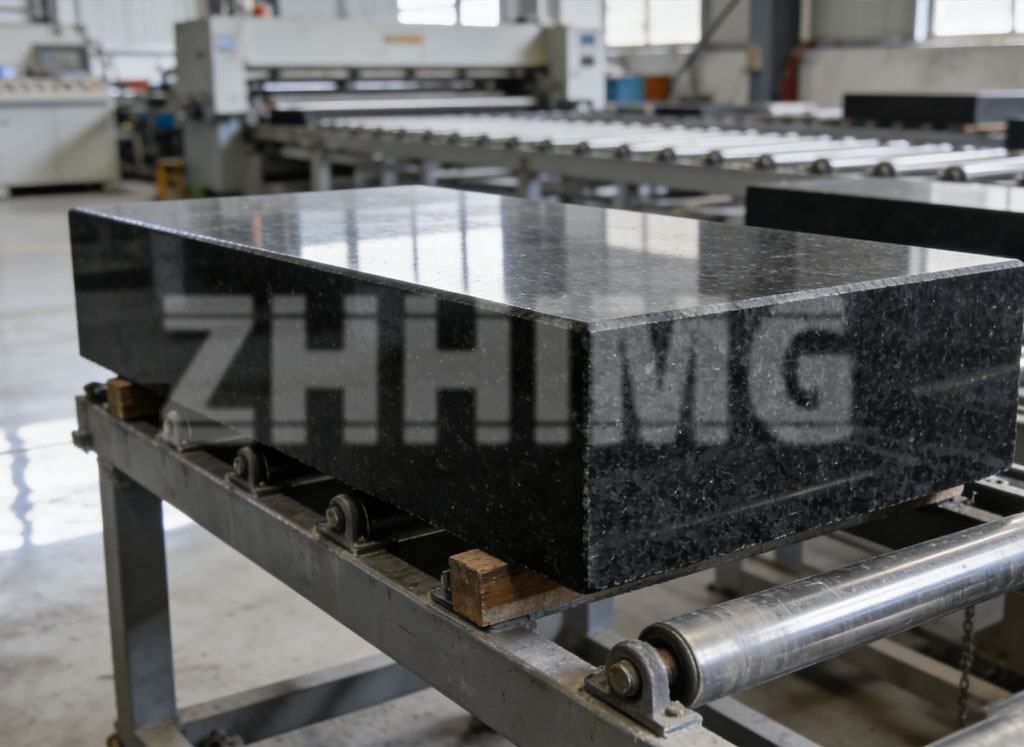
ZHHIMG produces granite components and measuring tools, precision ceramic parts, CNC-machined and cast metal components, mineral casting, UHPC precision parts, carbon fiber precision beams, and 3D-printed precision components within the same operation. Two factories cover roughly 200,000 square meters, with a separate material yard for raw stone stock, and four dedicated production lines running granite precision beds. That scale isn’t the interesting part on its own — plenty of manufacturers are large. What matters more for assembly-critical projects is that tolerance discussions, thermal matching, and delivery scheduling can happen against one production plan instead of three.
Take a typical semiconductor inspection platform: a granite base for vibration damping and dimensional stability, a ceramic wear surface where a probe or stage repeatedly contacts, and machined metal brackets for motor mounts or cable routing. Handled by one manufacturer, the interface tolerances between those three materials get engineered together from the start rather than reconciled after the fact. It doesn’t eliminate the physics — granite and steel will always expand differently under temperature swings — but it does mean someone is accountable for how those differences are managed in the design, rather than discovered during final assembly at the customer’s facility.
Measurement Consistency Across Materials
There’s a quieter benefit too: inspection consistency. When granite, ceramic, and metal components are measured on the same equipment, by technicians trained to the same calibration standards, tolerance reporting tends to be more comparable across the assembly. ZHHIMG’s inspection room runs temperature and humidity control with a reinforced concrete floor and surrounding isolation trenches to limit vibration transfer, and its gauges — German dial indicators, Mitutoyo instruments, Swiss electronic levels, UK laser interferometers — carry calibration traceability through Jinan and Shandong metrology institutes. Running granite, ceramic, and metal parts for the same assembly through that single inspection environment removes one common source of ambiguity: whether a discrepancy at final assembly came from measurement inconsistency or from the parts themselves.
Where This Approach Falls Short
It’s worth being honest that combined manufacturing isn’t a fix for every scenario. Highly specialized ceramic formulations or exotic metal alloys may still be better served by niche specialists with deeper material science depth in that one area. And consolidating suppliers concentrates risk — if one factory has a scheduling problem, it affects every material in the assembly rather than just one. Buyers evaluating a multi-material supplier should still request separate material certifications and independent tolerance reports for each component type, rather than assuming a single quality statement covers everything equally well.
Practical Takeaway for Buyers
For engineering teams designing assemblies that cross granite, ceramic, and metal — CMM structures, semiconductor stages, optical inspection platforms — sourcing from a manufacturer with genuine in-house capability across those materials can reduce the number of interface failures discovered late in integration. It won’t replace careful design review, but it does shift some of the tolerance-matching burden upstream, into the manufacturing plan, instead of leaving it to be resolved on the customer’s assembly floor.
Post time: Aug-27-2026