
Selecting a structural material for ultra-precision equipment is rarely a choice between “good” and “bad.” Precision ceramic and natural granite can both support demanding metrology, semiconductor, optical, laser, and automation applications. They solve different engineering problems.
Granite is often selected for large, stable, vibration-damping reference structures. Precision ceramics are usually specified where electrical insulation, wear resistance, chemical stability, low outgassing, thermal capability, or high hardness is essential. In many advanced machines, the best answer is not ceramic or granite. It is a carefully designed combination of both.
For global engineering purchasers, quality managers, and laboratory technicians, material selection should begin with the component’s actual function. Is it a stationary base, a guideway support, an insulating fixture, a wear surface, a vacuum-adjacent component, an optical support, or a moving mechanical element? The answer determines which material properties matter most.
Granite: A Stable Structural Reference
Precision granite components are commonly used as machine bases, CMM structures, bridge members, guideway supports, air-bearing surfaces, granite measuring tools, optical platforms, and semiconductor inspection frames.
Natural granite offers several properties that are useful for stationary precision structures:
- Low thermal conductivity and relatively low thermal expansion
- Natural vibration damping
- High mass and stable geometry
- Corrosion resistance
- Non-magnetic and electrically insulating behavior
- Precision-ground and lapped reference surfaces
- No foundry-related residual stress
- Suitability for large custom structures and assemblies
A granite machine base can serve as a common mechanical datum for linear guide rails, encoder scales, linear motors, air bearings, optical modules, camera systems, probes, fixtures, and wafer-handling equipment. The ability to machine and lap large reference faces is one reason granite remains important in coordinate measuring machines, vision systems, laser measurement equipment, and precision automation.
Granite components are particularly effective when thermal stability and vibration control are important over a large stationary structure. Machine beds and structural components made from natural granite are widely used in measuring machines, optical equipment, electronic equipment, and special-purpose machinery because of their geometric stability, low thermal conductivity, and damping
Granite is not always the ideal solution. It is heavy, and that mass can limit acceleration if the component must move rapidly. Complex internal channels and thin, highly detailed features can also be more difficult to produce than in molded or sintered materials. Threaded inserts, holes, pockets, slots, and bonded interfaces can be added, but they require careful engineering.
Precision Ceramics: Performance in Harsh Conditions
Precision ceramics include several distinct materials, such as alumina, zirconia, silicon carbide, silicon nitride, aluminum nitride, and glass ceramic. Their performance varies significantly by material grade, purity, porosity, microstructure, and manufacturing method.
Technical ceramics are often selected because they can provide high hardness, wear resistance, electrical insulation, chemical resistance, thermal capability, and low particle generation. These properties are especially useful in semiconductor equipment, vacuum-adjacent processes, high-temperature systems, electrical isolation assemblies, and wear-intensive precision mechanisms.
For example, alumina ceramic components are widely used for insulating fixtures, substrates, guides, and support elements. Zirconia may be selected for applications requiring greater toughness than many other ceramics. Silicon carbide can provide high stiffness, thermal stability, chemical resistance, and wear resistance. Silicon nitride can be appropriate for precision bearings, guides, and components where low thermal expansion and mechanical durability are important.
Precision ceramics are generally specified when granite cannot meet a critical functional requirement. A semiconductor process component may need to withstand plasma exposure, chemical cleaning, vacuum conditions, electrical fields, or elevated temperature. A metrology fixture may need electrical insulation and high wear resistance. A compact moving component may require greater hardness and lower mass than a granite structure can provide.
Industry guidance notes that granite is commonly used for structural and base-level stability, while technical ceramics are more likely to be selected when electrical insulation, extreme wear resistance, low outgassing, or vacuum-adjacent performance is essential.
Thermal Behavior Requires Careful Review
Both granite and ceramics can provide stable thermal behavior, but their performance should never be assumed from the material category alone.
Granite generally responds slowly to short-term heat input because of its low thermal conductivity. This can help reduce rapid structural movement in a large machine base. Its relatively low coefficient of thermal expansion also supports stable reference geometry in controlled metrology environments.
Ceramics vary widely. Some ceramic materials are selected for low thermal expansion. Others are selected for high thermal conductivity, such as aluminum nitride, which is useful for thermal management in electronic assemblies. Silicon carbide may offer very different thermal behavior from alumina or zirconia. The correct selection depends on whether the design priority is thermal insulation, rapid heat removal, low expansion, thermal-shock resistance, or dimensional stability.
For ultra-precision equipment, thermal performance must be evaluated at the component level. A ceramic part may have excellent intrinsic properties but introduce error if it is bonded to a metal structure with a very different expansion rate. A granite base may be thermally stable, but uneven motor heat near one guideway can still affect the system.
The material, mounting method, insert type, heat source, cooling arrangement, sensor position, and operating temperature must be considered together.
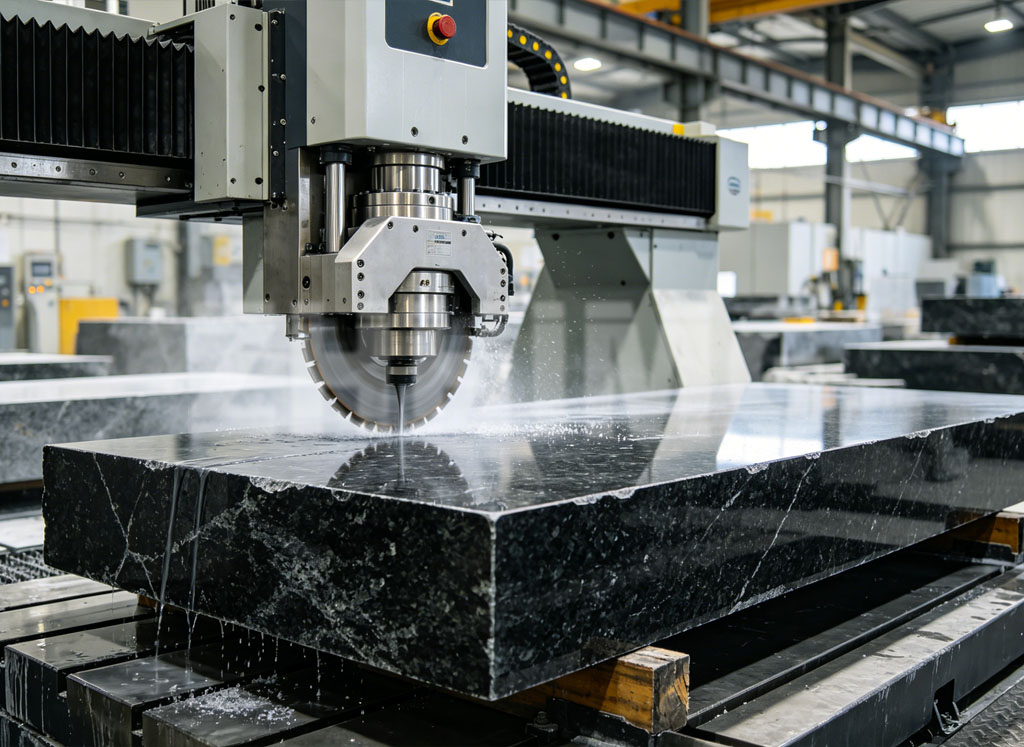
Vibration, Stiffness and Motion
Granite is well known for its natural damping and mass. These properties make it suitable for stationary bases that need to absorb floor vibration, machine-induced disturbance, and motion-system forces. A granite structure can help shorten settling time after a stage move, which is useful for CMM probing, imaging, laser measurement, and semiconductor inspection.
Ceramics are usually not chosen primarily for vibration damping. They are more commonly used for stiffness, wear resistance, insulation, thermal performance, or clean-process compatibility. Certain high-stiffness ceramics can be useful in compact precision structures, but their brittleness and lower damping compared with granite should be considered.
The distinction is important in motion design. A heavy granite base can stabilize a system, while a lightweight ceramic element may be useful for a small moving component, guide, insulator, or wear surface. The two materials can complement each other.
Comparison for Equipment Design
| Selection factor | Precision granite components | Precision ceramic components |
|---|---|---|
| Best structural role | Large stationary bases, bridges, guideway supports and reference structures | Insulators, wear parts, compact guides, vacuum-compatible parts and thermal-control elements |
| Thermal behavior | Low conductivity and relatively low expansion | Varies by ceramic type; may provide insulation, conductivity or low expansion |
| Vibration damping | High natural damping for stationary structures | Usually not the primary selection advantage |
| Electrical properties | Non-conductive and non-magnetic | Often excellent electrical insulation; material dependent |
| Chemical and process resistance | Good general corrosion resistance | Often strong resistance to chemicals, heat and plasma |
| Wear resistance | Good for structural reference surfaces | Often very high, depending on material |
| Complex geometry | Large structures, holes, inserts and bonded assemblies possible | Small, detailed shapes possible but may require specialized machining |
| Main limitation | High mass; complex internal features require planning | Brittle material behavior; machining and tight geometry can be costly |
Design and Manufacturing Considerations
The manufacturing route affects the practical selection.
Granite components are cut, machined, ground, lapped, drilled, and assembled. Large granite bases can include threaded inserts, rail interfaces, air-bearing surfaces, cable passages, optical mounting features, and locating datums. Their strength lies in producing large, stable geometry with precision reference faces.
Ceramic components are often formed, sintered, diamond-ground, lapped, polished, laser-machined, or ultrasonically machined. Sintering shrinkage, edge chipping, thin-wall design, hole geometry, contact stresses, and fastening methods must be carefully controlled. Sharp internal corners and concentrated bolt loads may increase fracture risk.
At ZHHIMG®, precision ceramic components and precision granite components can be considered within the same project. This is useful when a machine requires a granite base for stable geometry and vibration damping, combined with ceramic guides, insulating supports, wear-resistant surfaces, or semiconductor-compatible process components.
The Right Choice Is Often Hybrid
Choose precision granite when your ultra-precision equipment needs a large, stable, low-vibration reference structure. It is well suited for CMM bases, optical systems, semiconductor inspection platforms, granite air-bearing structures, laser equipment, and metrology fixtures.
Choose precision ceramic when electrical insulation, high wear resistance, chemical stability, vacuum compatibility, thermal capability, or compact precision geometry is the critical requirement. It is often the better choice for semiconductor process parts, insulators, guides, bearing elements, fixtures, and specialized measuring components.
For many machine builders, the strongest design uses both. Granite establishes the stable structural datum. Ceramic performs the specialized functional task. The right material selection comes from understanding how every component behaves within the complete ultra-precision system.
Post time: Aug-17-2026