
Precision Ceramic vs Granite: Which Is Better for Measuring Tools and Air-Bearing Parts?
Engineering teams choosing between ceramic straight edges, granite masters and ceramic air-bearing components are not looking for a winner between two materials — they are looking for the material whose weaknesses their application can live with. Both granite and technical ceramics deliver micrometre-class geometry and long-term stability, and both outperform metals for reference applications. But they fail differently, cost differently and are limited by different manufacturing constraints. This comparison covers stiffness, thermal behaviour, weight, wear, size limits and cost for measuring tools and air-bearing parts — with each material’s shortcomings stated plainly, because that is the information a design engineer actually needs.
1. Stiffness and deformation behaviour
Granite’s elastic modulus typically sits in the 50–80 GPa range for dense black varieties; alumina ceramics run roughly three to five times higher. On paper, ceramic wins stiffness decisively. In practice, the working stiffness of a straight edge or a bearing rail depends on the section design as much as the material: a well-proportioned granite edge with generous depth deflects less in use than a slim ceramic bar pushed to the same envelope. Where ceramic genuinely pulls ahead is specific stiffness — stiffness per unit weight — which matters for moving components such as air-bearing carriages, where a lighter slider reduces the load the film must carry and improves dynamic response.
The honest caveat on the granite side: granite’s lower stiffness is real, and for very long, slender reference tools the mass needed to reach equivalent rigidity becomes a handling consideration. The honest caveat on the ceramic side: higher modulus does not rescue poor section design, and ceramic’s brittleness changes how concentrated loads must be managed.
2. Thermal expansion and stability
Both materials are thermally excellent by metal standards. Dense black granite typically expands at roughly 6–8 × 10⁻⁶/K; alumina ceramics near 8 × 10⁻⁶/K; zirconia noticeably higher. For measuring tools and air-bearing stages working near 20 °C, the practical difference between granite and alumina is small — well below what a typical shop temperature swing produces in steel. The differences that matter are elsewhere: granite’s mass gives it thermal inertia (slow to change temperature), which stabilises readings in drifting environments but slows equalisation after a temperature event. Ceramics, being lighter in finished sections, follow ambient changes faster — sometimes an advantage, sometimes not. For mixed assemblies (ceramic on granite, granite with steel inserts), matching expansion coefficients across the interfaces is the design task that decides stability, more than the raw number of either material.
3. Weight and handling
Granite’s density runs around 3,000 kg/m³ for dense black varieties; alumina around 3,900 kg/m³. Counterintuitively, the ceramic is heavier per litre — but ceramic parts can be made with thinner sections thanks to higher strength, so finished ceramic tools often weigh less than a granite equivalent of the same envelope. For a straight edge carried by hand all day, this matters. For a fixed machine base, granite’s mass is an asset: it contributes damping and stability for free. Match the material to whether weight is a cost or a contribution.
4. Wear resistance and failure modes
Here the materials genuinely differ in kind, not degree:
Ceramic: extreme hardness (alumina far harder than any granite) gives outstanding wear life against sliding contact and gauging. Its weakness is brittleness — edge chipping under impact, and sensitivity to point loads and tensile stress. A ceramic edge survives abrasion better and an accident worse.
Granite: strong in compression, forgiving of distributed loads, and damage typically appears as sub-surface craters that do not raise burrs — often tolerable away from functional zones. Its weakness is slower, cumulative wear on heavily used contact zones, which is exactly why resurfacing services exist.
Neither material “wins” wear: the question is whether your application punishes abrasion (favours ceramic) or impact (favours granite’s tolerance of blunt damage).
5. Size limits and manufacturing constraints
This is where the comparison becomes practical and, for many projects, decisive:
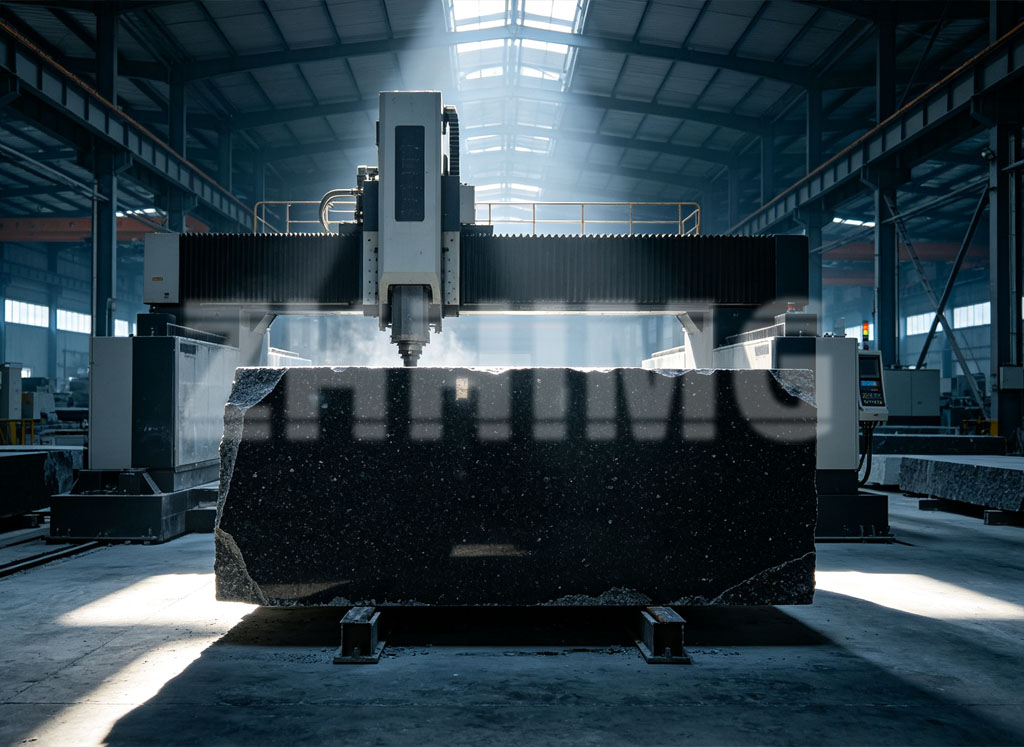
Granite: available in very large blocks — beds and plates weighing many tonnes are routine, and machining capacity (large gantry milling and lapping) sets the practical ceiling, which is metres across. Feature variety (inserts, T-slots, pockets) is mature and economical.
Ceramic: parts are made from fired blanks whose size is limited by kiln and sintering capacity, and hard grinding of large ceramic volumes is slow and expensive. Large ceramic components are possible but the cost grows steeply with size, and design features are more constrained. Thin, hard, small-to-medium parts are ceramic’s natural territory; metre-scale structures are granite’s.
6. Cost structure
Granite raw material is abundant and machining is comparatively fast, so granite is usually the economical choice at equal size — especially for large parts. Ceramic’s fired blanks, diamond grinding and longer process chain make it costlier at small scale, and dramatically costlier as size grows. The premium buys real advantages — hardness, specific stiffness, lighter finished parts — so the comparison is not “cheap versus expensive” but “where does each premium earn itself back”. An engineer who prices both honestly usually finds a crossover related to part size and contact conditions, not a universal winner.
7. Decision table: which material when
| Situation | Better fit | Why |
|---|---|---|
| Large bases, plates and machine structures | Granite | Size availability, cost, mass as an asset |
| Hand-held straight edges and squares | Ceramic (or granite at larger sizes) | Wear life, lighter finished part at small sizes |
| Air-bearing carriages and moving components | Ceramic frequently; granite for large stages | Specific stiffness, light moving mass |
| Large air-bearing guideways and bases | Granite with machined air surfaces | Size, damping, lapping capacity |
| Abrasion-dominated contact (daily gauging) | Ceramic | Extreme hardness |
| Impact-prone environments | Granite | Damage tolerance, no raised burrs |
| Tight budgets at metre scale | Granite | Cost grows gently with size |
| Thin, hard, small precision parts | Ceramic | Strength enables thin sections |
For air-bearing parts specifically, note that the bearing design dominates performance more than the substrate choice — see our ceramic air bearing product page and the earlier discussion of granite versus ceramic designs, where the gap structure and manufacturing quality matter more than the material label.
8. How we state our capability honestly
We machine and lap both granite and ceramic, and we quote them against each other only when the application data supports a recommendation. What we will not do is promise one universal accuracy for every material at every size: achievable tolerances depend on the part, the feature and the process, and each quotation is backed by the inspection methods we can actually run. Engineers are welcome to send both candidate designs and let the manufacturability review decide — that review costs nothing and usually saves a redesign.
Ready to compare on your real part? Send your drawing to ZHHIMG® and we will return a material recommendation with quotations for both routes where applicable — and browse our ceramic air-floating rulers and granite reference products to see finished examples of each material.
Frequently asked questions
Is ceramic always more accurate than granite?
No. Both materials routinely achieve micrometre-class and sub-micrometre flatness on appropriate features; accuracy is set by the manufacturing process and verification, not by the material family. The choice should follow stiffness, wear, size and cost — not an accuracy assumption.
Why are large ceramic parts so much more expensive?
Fired ceramic blanks are limited by sintering equipment, and hard grinding scales poorly with volume — material removal on ceramics is slow with diamond tooling. Granite blocks are large and abundant and machine faster, so cost curves favour granite as size grows.
Can ceramic and granite parts be combined in one assembly?
Yes — ceramic bearing pads or inserts on granite bases are common. The design work is at the interfaces: expansion matching, insert fixing methods and load introduction must be engineered for both materials, which is a normal part of our design review.
Which material lasts longer on a straight edge?
For abrasion from daily gauging, ceramic’s hardness gives it a longer wear life. For an edge that is occasionally knocked or clamped hard, granite’s damage tolerance can give a longer useful life in practice. Usage pattern decides, not hardness alone.
What data should I provide for a material recommendation?
The part’s envelope and critical features, contact and wear conditions, temperature range, weight limits if the part moves, accuracy requirements on named faces, and annual quantity. With that, both routes can be quoted honestly instead of guessed.
Post time: Oct-20-2026