
Choosing the base material for a high-accuracy machine is not a simple question of strength. A machine base must preserve geometry while supporting guideways, motors, encoder scales, probes, optics, fixtures, workpieces, and moving axes. It must also remain stable when exposed to heat, vibration, repeated motion, coolant, and normal factory activity.
Precision granite and cast iron are both proven materials for machine bases. Cast iron remains central to conventional CNC machine tools, grinders, lathes, and heavy-duty production equipment. Precision granite is widely used in CMMs, optical inspection machines, semiconductor systems, laser equipment, air-bearing platforms, and precision motion assemblies.
For global engineering purchasers and quality managers, the correct material depends on the machine’s error budget, operating environment, load condition, dynamic behavior, and long-term maintenance requirements. Granite can provide clear advantages where thermal stability and vibration damping are critical. Cast iron remains highly effective where complex geometry, stiffness, and heavy cutting loads are the main design priorities.
High Accuracy Depends on Structural Stability
A high-resolution encoder cannot correct every mechanical error. A probe, camera, laser head, or spindle can only perform reliably if the base structure maintains the intended relationship between machine axes.
Several factors determine whether a machine base is stable enough for precision work:
- Static deflection under machine weight, workpiece load, and fixture load
- Guideway straightness, parallelism, and mounting-plane flatness
- Thermal expansion and local temperature gradients
- Vibration transmission from the floor, motors, spindles, pumps, and adjacent equipment
- Settling time after axis acceleration, deceleration, or direction reversal
- Residual internal stress and long-term dimensional change
- Corrosion, surface damage, and maintenance requirements
Material selection influences every one of these factors, but no material can compensate for poor structural geometry, inadequate support, incorrect rail installation, poor thermal management, or uncontrolled assembly procedures.
A precision machine base must be designed as a complete system.
Thermal Stability: Granite’s Key Advantage
Temperature change is one of the most common causes of measurement drift in high-accuracy equipment.
Heat may come from motors, bearings, linear drives, electronics, lighting, coolant, compressed air, direct sunlight, or variations in room temperature. When one section of a machine base becomes warmer than another, the structure can expand unevenly. This may change rail alignment, scale position, probe location, spindle geometry, or the relationship between a workpiece and its measuring reference.
Precision granite generally has a lower coefficient of thermal expansion than cast iron. Typical granite values are often cited in the range of approximately 4.6–8.0 × 10⁻⁶/°C, while cast iron is commonly reported around 10–12 × 10⁻⁶/°C. Actual values vary by granite source and cast-iron grade, so material-specific data should be used for final design decisions.zhhimg+1
For a 1,000 mm base, a uniform 1°C change may result in roughly 4.6–8.0 µm of expansion in granite and approximately 10–12 µm in cast iron. In real applications, the more important issue is often not uniform expansion but uneven heating. Granite’s low thermal conductivity slows the movement of localized heat through the structure, which can help reduce rapid geometry changes.planolith+1
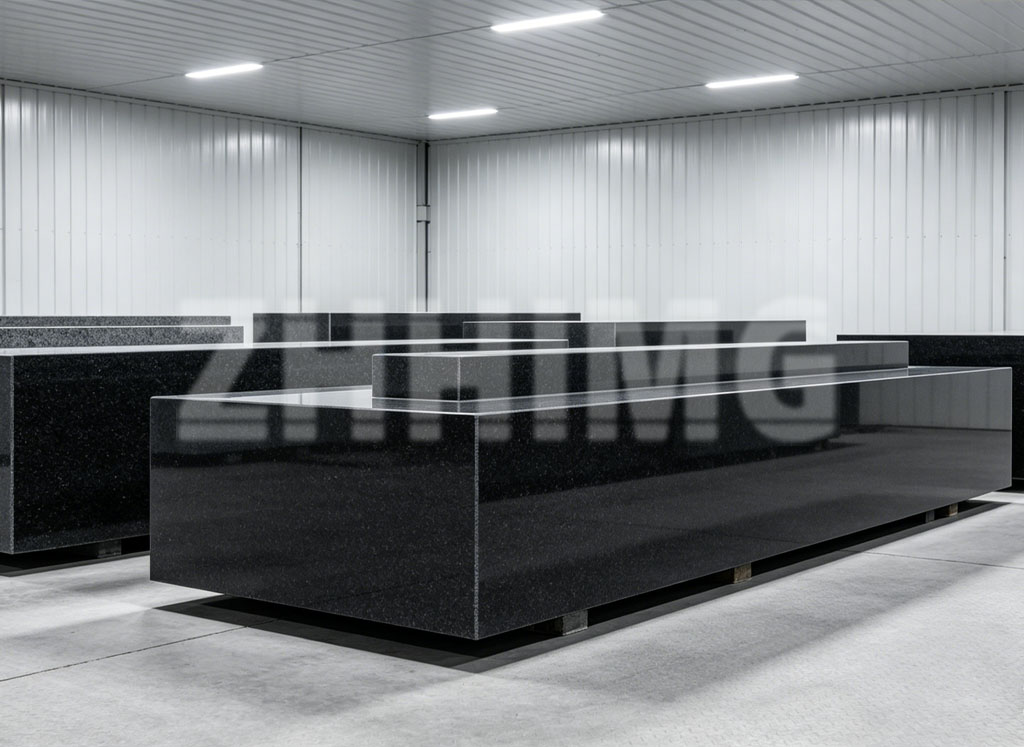
This behavior makes a granite machine base particularly attractive for CMMs, optical measuring systems, wafer inspection platforms, laser metrology equipment, and other machines where micron-level geometry must remain stable over extended inspection cycles.
Vibration Damping and Settling Time
A stiff base resists deflection. A well-damped base dissipates vibration. High-accuracy machines need both.
Cast iron provides useful damping, especially grey cast iron with its graphite microstructure. It performs much better than a simple welded steel frame in many machine-tool applications. Its mass and ribbed geometry can also provide robust support for heavy machining operations.
Granite offers higher natural vibration damping in many stationary precision applications. Its dense mineral structure helps absorb vibration energy from nearby machinery, axis movement, floor disturbance, and process forces. This can shorten the time required for a measuring probe, camera, laser head, or optical sensor to settle after movement.
The practical benefit is not merely lower vibration amplitude. It can also support faster inspection cycles, more repeatable readings, cleaner optical images, and more stable positioning. Granite is therefore frequently used in metrology and precision-motion structures where dynamic settling behavior is important.planolith+1
The exact machine result depends on more than base material. A granite base with poorly designed rail interfaces, loose fasteners, an unbalanced moving axis, or unsuitable floor support may still perform poorly. Equally, a properly designed cast-iron base can provide excellent stability in many machining environments.
Granite vs Cast Iron Comparison
| Selection factor | Precision granite machine base | Cast iron machine base |
|---|---|---|
| Thermal expansion | Generally lower; material dependent | Generally higher than granite |
| Thermal conductivity | Low; slower response to localized heat | Higher; heat spreads more quickly |
| Vibration damping | High natural damping for stationary precision structures | Moderate to good, particularly grey cast iron |
| Corrosion resistance | Naturally corrosion-resistant | Requires protective coatings or maintenance |
| Magnetic behavior | Non-magnetic | Magnetic |
| Residual stress | Natural stone has no foundry-related residual stress | Requires controlled casting, aging or stress relief |
| Complex internal geometry | Requires machining, bonding, inserts or assembly | Can be cast with ribs, cavities and internal forms |
| Reference surfaces | Can be ground and lapped to precision geometry | Requires precision machining after stabilization |
| Typical applications | CMMs, optics, semiconductor, laser and metrology systems | CNC machining centers, lathes, grinders and heavy machine tools |
Granite is also resistant to rust and does not form raised burrs in the same way as a damaged metal reference surface. This can be useful in measuring environments where surface condition affects calibration or setup.regattagranitesindia+1
Where Cast Iron Remains Strong
Cast iron should not be treated as an outdated material. It remains a strong choice for many high-performance machines.
A cast iron machine base can be designed with complex ribs, deep cavities, integrated gearbox housings, coolant channels, chip-management features, motor mounts, and other functional shapes that are difficult to create in natural granite. Foundry production can also be economical when machine volumes are high and the casting pattern is already established.
For heavy-duty machining centers, large lathes, grinding machines, and equipment exposed to substantial cutting forces, a carefully designed and properly stress-relieved cast iron base can offer high stiffness and excellent load-bearing capability.
Cast iron is especially useful when the design needs complex monolithic geometry and the machine operates in a controlled environment with appropriate thermal compensation or cooling. The material is also familiar to many machine builders, service teams, and end users.
Granite Components Need Engineering Detail
A precision granite base should not be specified as a simple stone block.
For reliable machine performance, the design must define the reference datums, rail mounting faces, insert positions, threads, locating holes, surface tolerances, supported loads, lifting method, assembly interfaces, and inspection requirements. Granite can be machined with holes, pockets, slots, stainless-steel inserts, bonded components, air-bearing faces, and custom structures, but these features must be planned before manufacturing.
At ZHHIMG®, custom precision granite components can include bases, bridges, columns, guideway supports, granite air-bearing parts, surface plates, square boxes, and assembled metrology structures. The manufacturing discussion normally starts with the customer’s drawing and functional requirements: travel range, rail type, moving load, working temperature, critical datums, inspection method, and packaging conditions.
This approach matters because the quality of the guideway and mounting interfaces often has more influence on final machine performance than the overall size of the granite base.
Making the Right Choice
Precision granite is usually the stronger option when the machine requires a stable stationary reference, low thermal sensitivity, natural vibration damping, corrosion resistance, and non-magnetic behavior. It is well suited to CMMs, semiconductor inspection equipment, optical platforms, laser measurement systems, air-bearing assemblies, and high-accuracy automation.
Cast iron is often the better choice when the structure must withstand heavy cutting loads, incorporate complex internal geometry, and support high-volume production machine designs. It remains highly competitive for CNC machine tools, grinders, lathes, and large industrial equipment.
Many advanced machines use a hybrid solution. A granite base may carry precision rails and metrology references, while lighter metal or carbon-fiber members handle moving axes. Cast iron may provide the main machine bed, with granite components used for stable measuring surfaces or calibration fixtures.
The best material is the one that controls the largest errors in the complete machine. For high-accuracy systems where thermal drift and vibration are the dominant risks, precision granite often provides a more stable foundation.
Post time: Aug-17-2026