
Your surface plate is lying.
No, it didn’t consciously decide to mislead you. But if it’s cast iron and you’ve been running that 5-axis all morning with coolant splashing everywhere, there’s a good chance the reading you’re getting isn’t what you think it is.
Here’s what actually happens: cast iron absorbs moisture, reacts with water-based coolants, and starts rusting from the moment you stop oiling it. Even in relatively dry shops, temperature swings cause it to expand and contract constantly. Put a precision part on that plate at 8 AM when the shop is cool, then check the same part at 2 PM after the machines have been running for hours—the numbers might not match. And if you’re wondering why your CMM keeps failing capability studies despite seemingly identical conditions, your reference surfaces might be the silent culprit.
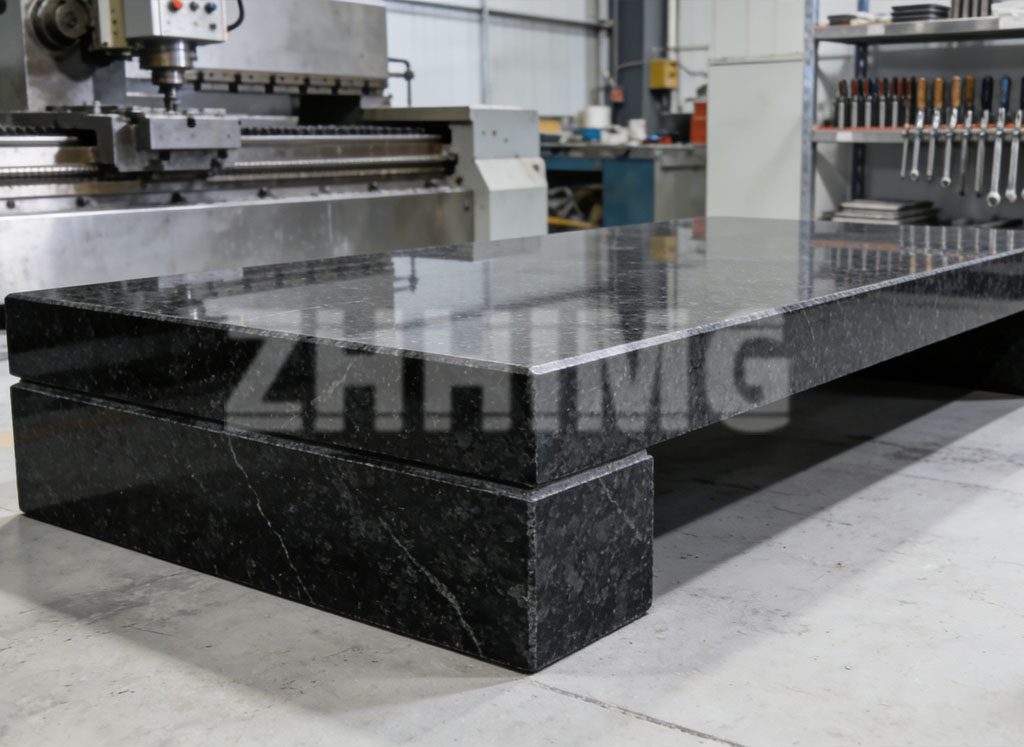
Granite measuring tools don’t have this problem.
Not because they’re magic. But granite’s coefficient of thermal expansion sits around 4.5 × 10⁻⁶/°C—roughly one-third that of cast iron. Over a 600mm span, a 5°C swing introduces maybe 0.001mm of dimensional change on granite versus 0.012mm or more on cast iron. In precision machining where you’re fighting for 0.005mm tolerances, that difference between pass and scrap.
One shop I heard about switched their primary inspection surface from cast iron to granite and immediately noticed their scrap rate dropped—not because their machines got better, but because their measurement system finally told the truth.
The cool thing about granite, and this is less talked about, is how it handles damage.
Drop a gauge block on a cast iron plate? You might get a raised burr. That tiny deformation sits proud of the surface, and now every piece you check against that area is measuring wrong. There’s no warning, no visible sign—just quietly accumulating error.
Hit the same gauge against granite? You’ll get a chip. Maybe a small pit. But here’s the thing—the rest of the surface is still flat. You can use the undamaged area with full confidence. The error is localized and obvious, not hidden and spreading.
This matters more than people think in production environments where surface plates take abuse day after day.
Thermal drift is the quiet killer in precision machining.
Picture this: you’re running a job on a Monday morning. Shop temperature is 18°C. Your setup guy checks all the critical dimensions, everything looks good, parts are running. Then Friday afternoon hits, and suddenly the QC tech is flagging parts that were fine all week. What changed? The machines didn’t change. The operators didn’t change. But the ambient temperature did—by maybe 4 or 5 degrees as the HVAC system struggles against weekend conditions, or as the sun shifts and heats one side of the building.
Cast iron plates will expand and contract with these swings. Granite won’t.
This is why high-end metrology labs have used granite exclusively for decades. It’s not tradition—it’s that granite gives you a reference that doesn’t drift with the environment.
One more thing that gets overlooked: vibration damping.
Modern machining centers vibrate. Spindles at 15,000 RPM, rapid traverses, hydraulic equipment—all generate mechanical energy that transmits through the machine bed, through the floor, into your measurement setup. On a cast iron surface, those vibrations persist. Your dial indicator needle trembles. Your digital readouts fluctuate. You’re trying to read 0.001mm when your whole setup is shaking.
Granite absorbs that energy. Its natural damping coefficient runs about ten times higher than cast iron. It’s like putting your measurement setup on a shock-absorber. The numbers stabilize faster, readings are repeatable, and you can actually trust what you’re seeing.
If you’re wondering about actual applications, here’s what you’re probably dealing with:
Surface plates for inspection and layout—checking flatness, parallelism, squareness. Most shops need at least one good reference plate for their setup area.
Master squares for checking your CNC’s axis perpendicularity. If your machine is out of square, every part you make carries that error. Running a tri-square check weekly takes five minutes and catches problems before they become part problems.
V-blocks for holding cylindrical parts during inspection. Round stock is tricky to measure consistently—V-blocks solve that.
Straight edges for checking machine ways and large surfaces where you can’t physically put a plate.
Parallels for elevating workpieces so you can access features that would otherwise be hidden.
Getting specific on grades: most precision machining operations need Grade 00. That gives you flatness tolerance around 1.5 micrometers per meter. Grade 0 is looser at maybe 4 micrometers—fine for rough inspection but not for tight work. Grade 000 is the lab-grade stuff, 0.5 micrometers or better, and frankly overkill unless you’re in optics or aerospace calibration work.
The rule I use: your reference equipment should be one or two grades more accurate than the tolerances you’re trying to hold. If your worst process tolerance is ±0.02mm, a Grade 0 plate (tolerance around 0.004mm/m) gives you comfortable margin.
Maintenance is simple and honestly, granite is forgiving.
Keep it clean. Wipe it down after use, especially if you’ve been running any kind of cutting fluid. Use a proper granite or surface plate cleaner, not random shop chemicals. Support large plates properly on stands designed for them—improper support creates deflection at the edges and corrupts your flatness readings.
Get them recertified periodically. Annual recertification for high-usage plates, every couple years for lower-volume stuff. It’s not expensive, and it gives you documented proof your references are still good.
Here’s a practical starting point if you want to make the switch:
Identify your most critical reference surface—the one you use for final inspection on your tightest tolerance parts. That’s where granite makes the biggest difference.
Then look at your inspection workflow. Where are you losing time fighting inconsistent readings? Where do you suspect measurement error but can’t prove it? Those are your candidates for the second and third granite tools.
You don’t have to replace everything at once. But swapping one or two key plates will tell you quickly whether granite is worth the investment in your specific operation.
Most shops that switch don’t go back.
Post time: May-22-2026