
Large granite machine bases are widely used in precision inspection systems, semiconductor equipment, laser platforms, CMM assemblies, CNC equipment, and automated manufacturing lines. The granite structure may provide the primary geometric reference, but its final performance depends heavily on how it is installed and supported.
A shock absorber bracket assembly—also described as an anti-vibration support assembly, leveling mount bracket, or vibration isolation mounting system—connects the granite base to the floor, frame, or machine foundation. Its function is not simply to hold the stone in place. It must distribute load correctly, maintain the intended support geometry, allow leveling where required, and reduce the transfer of unwanted floor vibration into the precision system.
For a large granite machine base, the bracket assembly should be treated as part of the precision structure. A well-machined granite component can still show unstable measurement results if the support brackets are unevenly loaded, incorrectly positioned, over-constrained, or installed on a weak foundation.
Define the Function Before Inspection
The term “shock absorber” can be misleading in precision equipment. Some installations use elastomer pads, spring isolators, pneumatic isolators, leveling mounts, rigid brackets, or a combination of these components. Each solution responds differently to static load, dynamic excitation, horizontal forces, and environmental conditions.
A rigid support bracket is intended to carry load and preserve position. An isolator is intended to reduce transmitted vibration. A leveling mount may perform both functions within defined limits. The inspection standard should therefore begin with the approved machine layout and design intent.
Before assembly, the project team should confirm:
- Total granite-base mass and expected operational load
- Number and location of designed support points
- Static load assigned to each bracket or isolator
- Required leveling range and final machine elevation
- Permitted horizontal movement or restraint requirement
- Type of vibration source near the installation area
- Floor condition, concrete thickness, anchoring requirement, and foundation stiffness
- Inspection instruments and acceptance criteria
In practical machine assembly, a common problem is selecting mounts based only on total machine weight. This overlooks load distribution. A long granite base may carry motors, stages, electrical cabinets, tooling, or moving equipment that shift the center of gravity away from the geometric center. The bracket design must account for the actual load map, not only a nominal total mass.
Inspection of Brackets and Interfaces
Inspection starts before the granite base is lifted into position. The bracket assembly should be checked for material condition, machining quality, thread integrity, fastener grade, coating condition, and dimensional conformity with the approved drawing.
The key inspection items include:
| Inspection item | What to verify |
|---|---|
| Bracket location | Matches approved support layout and centerline dimensions |
| Support-face condition | Clean, burr-free, flat, and free from welding spatter or paint buildup |
| Contact interface | Full and stable contact at the designed bearing areas |
| Fasteners | Correct specification, torque requirement, locking method, and thread engagement |
| Isolator orientation | Installed vertically or in the specified direction without side loading |
| Load distribution | No visibly unloaded, overloaded, or collapsed support point |
| Leveling range | Adjustment screws remain within the designed operating range |
| Granite clearance | No unintended contact with floor, frame, guards, or adjacent structures |
| Anchor condition | Anchors installed and tightened only where the design requires them |
| Safety features | Anti-slip, travel-limit, or lateral-restraint features installed as specified |
For isolator-supported systems, the mounting stud should remain centered in the bracket opening where the design requires free movement. A stud touching the edge of a top plate can create a rigid vibration path and reduce the isolation effect. Installation guidance for spring isolators similarly emphasizes vertical alignment, correct washer positioning, and avoiding unintended contact between the stud and isolator top plate
Support Geometry Matters
Large granite bases should never be treated like ordinary steel frames. Stone is strong in compression but should not be forced into an uneven support condition.
For metrology-grade granite surfaces, a three-point kinematic support arrangement is often used to avoid over-constraint, although the correct arrangement for a large machine base depends on its structure, load distribution, and engineering drawing. Adding extra supports without a controlled leveling procedure can introduce stress or distortion rather than improve stability. Guidance for granite surface plate installation also identifies stable foundations, uniform support loading, correct three-point layouts where applicable, and precision leveling as essential installation controls.
Where more than three brackets are necessary because of machine size or dynamic load, the support system should be engineered so that each point carries a controlled share of the load. Load cells, feeler-gap checks, dial indicators, electronic levels, or deflection measurements may be used during commissioning, depending on the required accuracy.
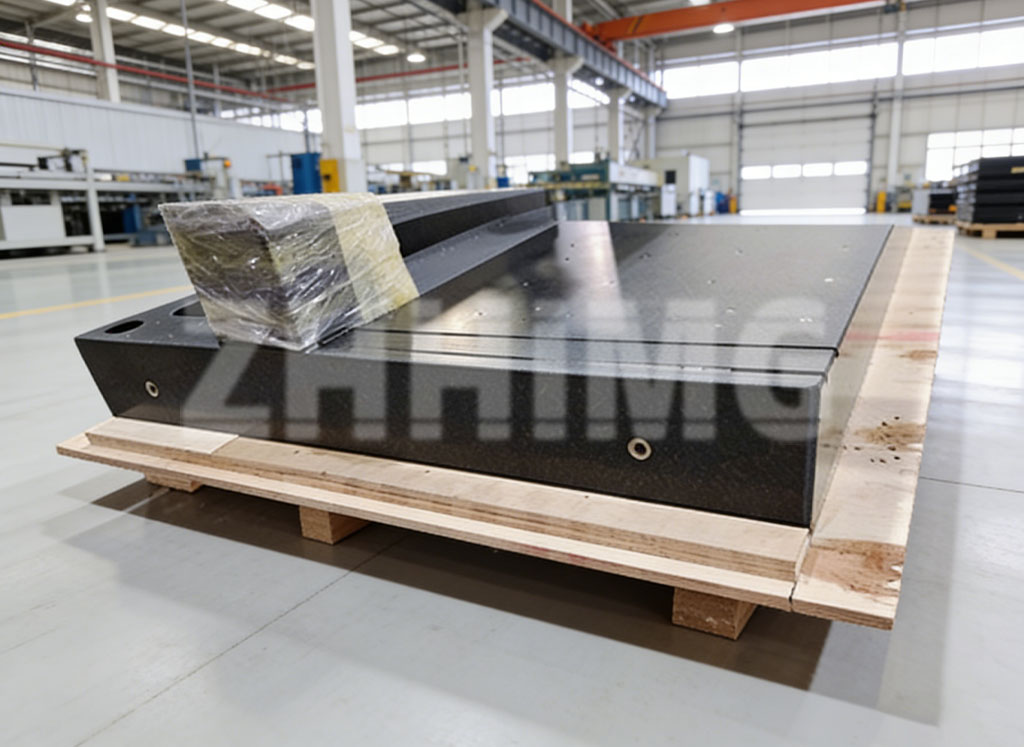
Leveling and Final Verification
After the granite base is placed on the bracket assembly, leveling should be performed gradually. Adjustments made aggressively at one point can transfer load unexpectedly across the structure. Technicians should work through the specified sequence, measuring in longitudinal, transverse, and diagonal directions.
A typical final inspection includes:
- Verification of base level using a calibrated electronic level
- Confirmation of bracket position and isolator compression
- Review of fastener torque records
- Inspection for unintended rigid contact points
- Measurement of critical granite reference surfaces after stabilization
- Functional vibration measurement if required by the equipment specification
- Photographic record of the completed support assembly
- Signed installation and inspection report
The machine should be allowed to settle after initial leveling, particularly when elastomeric or pneumatic elements are used. A final geometry check after stabilization is more meaningful than a measurement taken immediately after lifting and adjustment.
Practical Considerations for Purchasers
For global purchasers, the best request for quotation is not simply “supply shock absorbers for granite base.” Provide the granite-base drawing, total weight, center-of-gravity estimate, operating frequency or vibration concern, floor layout, required machine height, and preferred inspection standard.
At ZHHIMG®, granite base projects are reviewed together with the intended support arrangement, mounting interfaces, precision requirements, and installation environment. Our experience with large granite components and metrology-oriented assemblies shows that bracket inspection is not a minor mechanical task. It is a direct part of protecting the accuracy designed into the granite base.
A reliable assembly leaves the base stable, level, properly loaded, free from unintended restraint, and ready for final calibration.
Post time: Aug-11-2026