
In the high-stakes world of precision manufacturing, the difference between a profitable run and a costly scrap pile can be measured in millionths of an inch. Machining errors are an inevitable part of production, but the most successful machine shops do not merely react to defects—they prevent them. A critical, yet often overlooked, strategy for error reduction lies not in the cutting tool or the CNC program alone, but in the foundational platforms upon which workpieces rest. Cast iron and granite surface plates serve as the “zero reference” for all dimensional metrology. By understanding how these platforms influence thermal behavior, vibration, and geometric accuracy, engineers can systematically solve and prevent the errors that erode quality.
The Hidden Variables: How the Foundation Affects the Final Product
Before diving into corrective actions, it is essential to understand that a machining error rarely has a single cause. It is usually the result of a chain reaction. The stability of the reference platform is the first link in this chain. If the foundation is compromised—by thermal expansion, deflection, or vibration—every subsequent measurement and machining operation will inherit that error.
1. Thermal Stability: The Silent Saboteur Temperature variation is the nemesis of precision. Both cast iron and granite react differently to thermal changes, and selecting the wrong material for a specific environment can introduce significant dimensional drift.
●
Cast Iron and Thermal Conductivity: Cast iron has a higher thermal conductivity than granite. In a stable environment, this allows the plate to acclimate to room temperature relatively quickly. However, this is a double-edged sword. If a shop experiences temperature fluctuations, the cast iron plate will expand and contract more rapidly than granite. For instance, if a heavy cast iron plate is brought into a warm shop, it may take hours to stabilize, leading to inaccurate measurements during the warm-up phase. To solve thermal errors, shops using cast iron must implement strict temperature control protocols and allow for longer soak times before critical inspections.
●
Granite and Thermal Inertia: Granite has a lower thermal conductivity but a higher specific heat capacity. This means it changes temperature very slowly. While it may take longer to reach equilibrium initially, once stable, a granite slab is less susceptible to minor ambient fluctuations. This makes granite ideal for environments where temperature control is difficult to maintain perfectly. By using granite, shops can mitigate “phantom” errors caused by the sun hitting a window or a door opening, as the mass of the stone absorbs these transient changes without significantly altering the reference plane.
2. Vibration Damping: Eliminating Signal Noise Vibration is another primary source of machining error, particularly in surface finish and fine dimensional accuracy. When a machine tool or measuring instrument is subjected to vibration, it introduces “noise” into the system.
●
Cast Iron’s Damping Capacity: Cast iron has superior internal damping capacity. The graphite microstructure within the iron absorbs vibrational energy, preventing it from propagating across the surface. In a shop filled with heavy milling machines and presses, a cast iron surface plate will remain remarkably still. This solves errors related to “chatter” marks on parts or inconsistent readings on dial indicators caused by ambient floor vibrations.
●
Granite’s Rigidity: While granite is less effective at absorbing high-frequency vibrations than cast iron, its extreme rigidity prevents the transmission of low-frequency structural movements. When mounted correctly on kinematic supports, a granite plate provides a rigid, non-yielding base. To solve vibration-related errors on granite, the focus must shift from the material itself to the isolation system. Using pneumatic stands or elastomeric pads beneath the granite plate can effectively decouple it from the floor, solving the issue of vibration transmission.
Geometric Stability and Wear: Maintaining the True Plane
Over time, all surfaces wear. How a material wears directly impacts the types of errors a machinist will encounter.
1. Cast Iron: The Issue of Galling and Rust Cast iron is a composite of iron and graphite. While durable, it is susceptible to two specific failure modes that cause machining errors:
●
Rust Pitting: Exposure to moisture or acidic fingerprints causes oxidation. Even microscopic rust pits on a surface plate translate directly to high spots on a workpiece when using height gauges. The solution is rigorous maintenance. Using non-acidic cleaners and immediate application of rust preventative oil after use is non-negotiable for error prevention.
●
Galling: When two ferrous surfaces slide against each other (such as a magnetic chuck on a cast iron plate), they can cold-weld or gall. This destroys the flatness. To solve this, shops should use non-ferrous or coated inserts between moving parts and the plate surface.
2. Granite: The Issue of Abrasive Wear Granite is harder and more corrosion-resistant than iron, but it is not immune to wear.
●
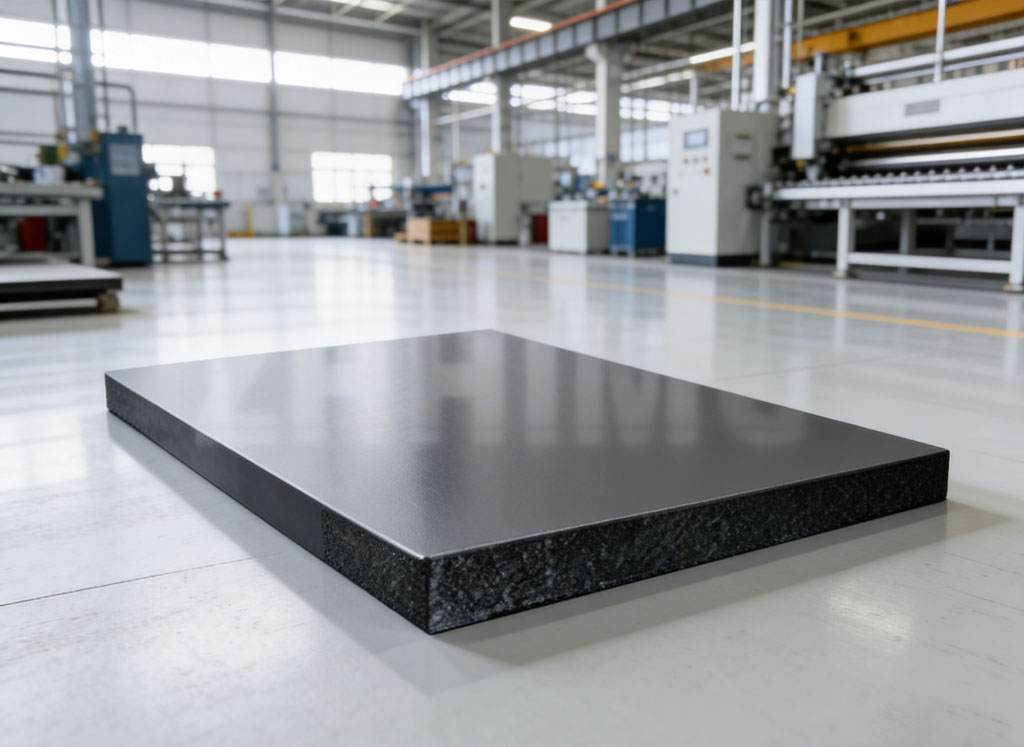
Erosion from Swarf: The primary enemy of a granite surface plate is abrasive swarf—specifically aluminum or cast iron particles. Because these materials are nearly as hard as the granite binder, dragging them across the surface acts like sandpaper. This leads to “witness marks” and loss of flatness. The solution lies in cleanliness. Unlike cast iron, which can be re-scraped relatively easily, granite is difficult to repair. Therefore, solving errors related to granite wear requires a proactive approach: never place unclean parts directly on the surface, and always use protective covers when the plate is not in use.
Practical Applications: Diagnosing and Correcting Common Errors
Understanding the theory is one thing, but applying it to solve real-world problems is where the value lies. Here are common machining errors and how the choice of platform can provide the solution.
1. Solving Repeatability Issues If a machinist is experiencing inconsistent measurements on the same part, the first suspect should be the reference platform.
●
The Scenario: A part measures within tolerance in the morning but out of tolerance in the afternoon.
●
The Diagnosis: This is a classic thermal expansion error.
●
The Solution: If the shop uses cast iron, verify that the shop temperature has not fluctuated. If fluctuations are unavoidable, consider switching to a granite platform for critical inspections, as its thermal inertia will buffer the part from these changes.
2. Solving Surface Finish Defects While surface finish is primarily a function of the cutting tool, the setup can influence the result.
●
The Scenario: A part exhibits a waviness or chatter that cannot be explained by the spindle speed or feed rate.
●
The Diagnosis: Vibration transfer during the machining setup.
●
The Solution: If the inspection is done on a granite plate that is not isolated, floor vibrations from nearby equipment may have affected the setup. Ensure the granite plate is on anti-vibration pads. Conversely, if the shop uses cast iron and is still experiencing chatter, the issue may be the lack of mass. Ensure the cast iron plate is heavy enough and properly supported to dampen the specific frequency of the vibration source.
3. Solving Angular and Parallelism Errors When features are not square or parallel, the reference plane must be flawless.
●
The Scenario: A part is measured as parallel on the shop floor but fails inspection in the lab.
●
The Diagnosis: The shop floor plate (often cast iron) has developed a slight warp or twist due to improper storage or temperature gradients, while the lab uses a high-grade granite master plate.
●
The Solution: Standardize the reference surfaces. For high-tolerance work, use master granite plates for calibrating height gauges and squares used on the shop floor. This ensures that the “zero” on the shop floor matches the “zero” in the lab.
The Strategic Integration of Both Platforms
No single material is perfect for every situation. The most effective strategy for solving machining errors often involves using both cast iron and granite platforms in their respective domains of excellence.
1. The Shop Floor: Cast Iron for the Grind The production floor is a harsh environment. It is dirty, wet, and subject to heavy impacts. Cast iron thrives here. Its ability to be repaired, its magnetic properties for workholding, and its vibration damping make it the ideal “workhorse.” Use cast iron plates for:
●
Daily layout work.
●
Setting up machine tools.
●
Rough inspections where extreme cleanliness cannot be guaranteed.
By utilizing cast iron here, you protect your high-precision granite from the abuse of the shop floor, preventing unnecessary wear and tear that would lead to costly recalibration.
2. The Metrology Lab: Granite for the Truth The inspection room or quality control lab is where the truth is told. This is the domain of granite. Its resistance to corrosion, superior long-term stability, and ease of maintenance make it the “gold standard.” Use granite plates for:
●
Final inspection of critical components.
●
Calibration of gage blocks and precision instruments.
●
Master references for setting up shop floor equipment.
By segregating the tasks, you create a hierarchy of accuracy. The granite plate in the lab defines the standard, and the cast iron plates on the shop floor are regularly verified against this standard. When an error is detected on the shop floor, it can be traced back to the master granite reference, ensuring that the entire operation is aligned to a single, unchanging truth.
Conclusion: The Foundation of Quality
Machining errors are expensive, but they are also educational. They point to weaknesses in the process chain. By recognizing that the surface plate is not just a table but a critical component of the measurement system, shops can leverage the distinct properties of cast iron and granite to solve these errors at their source. Cast iron offers resilience and damping for the dynamic shop floor, while granite offers purity and stability for the critical inspection lab. By strategically deploying these platforms and maintaining them according to their specific needs, a machine shop transforms its approach from reactive troubleshooting to proactive error prevention. In the relentless pursuit of zero defects, the foundation you choose is the first step toward perfection.
Post time: May-09-2026