
For overseas buyers of precision granite components, supplier qualification is no longer limited to checking price, dimensions, and delivery time. Quality engineers, laboratory managers, and procurement teams increasingly need evidence that a manufacturer can control quality, environmental responsibility, workplace safety, product documentation, and export compliance throughout the entire supply chain.
This is especially important when sourcing granite surface plates, granite straightedges, granite squares, granite machine bases, granite air-bearing structures, and custom precision granite components. These products may become measurement references or functional foundations for CMMs, semiconductor equipment, laser systems, PCB drilling machines, optical inspection platforms, and high-precision automation equipment.
ZHHIMG® positions its manufacturing system around ISO 9001, ISO 14001, ISO 45001, and CE-related conformity documentation. The company’s published materials state that it holds these certifications and presents them as part of its quality and operational management framework. ZHHIMG also publishes certificates and related information on its website.
For international buyers, the most valuable part of this approach is not a logo on a brochure. It is the operating discipline behind the certifications: documented processes, controlled inspection, corrective action, traceable measurement, transparent communication, and a clear commitment not to mislead customers about materials or product capability.
Why Certification Matters in Precision Granite Purchasing
Precision granite is often selected because it provides a stable, non-magnetic, corrosion-resistant reference material for measurement and machine construction. However, the quality of a finished granite component depends on much more than the raw stone.
A granite base for a CMM or semiconductor platform may require controlled flatness, straightness, parallelism, perpendicularity, insert position, hole location, surface integrity, and thermal performance. A granite surface plate may need to meet a specified accuracy grade. A granite straightedge may be used to align machine guideways where small geometric errors can affect an entire motion system.
The buyer therefore needs confidence that the supplier can control each stage of the process.
This includes raw-material selection, cutting, machining, grinding, lapping, insert installation, cleaning, inspection, packaging, shipping, and final documentation.
For a precision granite supplier, an effective management system can support better process consistency in several ways:
- Customer drawings and technical requirements are reviewed before production.
- Critical tolerances and inspection points are identified in advance.
- Measuring instruments are calibrated and managed.
- Nonconforming products are controlled and investigated.
- Corrective actions are recorded and followed up.
- Supplier and material records are maintained.
- Production processes can be reviewed and improved over time.
- Quality reports can be connected to the delivered component or order.
ISO certification does not automatically prove that every individual granite component will meet every customer requirement. The component must still be inspected against its own drawing, tolerance specification, and acceptance criteria. However, a properly implemented management system provides an important foundation for repeatable quality control. ZHHIMG itself emphasizes that ISO certifications are necessary but not sufficient, and that product performance must still be verified for the relevant precision application.
What ISO 9001, ISO 14001, and ISO 45001 Mean
The three ISO management-system standards address different areas of industrial operations. Together, they can help buyers evaluate whether a supplier has established structured controls beyond the final inspection stage.
ISO 9001: Quality Management System
ISO 9001 is the best-known international quality management standard. It focuses on how an organization manages quality-related processes, customer requirements, documented procedures, risk, performance monitoring, corrective action, internal audits, and continual improvement.
For a precision granite manufacturer, ISO 9001 is relevant to the practical details of order execution. These may include drawing review, process planning, inspection planning, handling of nonconforming material, final quality records, and customer feedback.
For buyers of custom granite machine bases and measurement tools, ISO 9001 should be supported by product-level evidence such as:
- Approved drawings and revision control.
- Defined geometric tolerances.
- Inspection reports for critical surfaces and features.
- Calibration status for relevant measurement instruments.
- Material information where required.
- Records for inserts, threads, bonded interfaces, or special assemblies.
- Packaging and shipment requirements for large or delicate granite components.
A quality system is most useful when it connects the customer’s functional requirements to measurable inspection results.
ISO 14001: Environmental Management System
ISO 14001 addresses environmental management. It provides a framework for organizations to identify environmental aspects, establish objectives, manage operational controls, monitor environmental performance, and meet applicable compliance obligations.
For industrial buyers, ISO 14001 can be relevant when evaluating the supplier’s approach to material use, waste management, cutting and grinding processes, water use, dust control, energy consumption, and environmental risk management.
Precision granite manufacturing includes operations such as cutting, grinding, lapping, cleaning, packing, and material handling. These activities should be managed responsibly, particularly in a large-scale manufacturing environment.
An environmental management system does not change the physical properties of a granite base. However, it can show that the supplier has a structured approach to identifying and reducing the environmental impacts associated with production.
ISO 45001: Occupational Health and Safety
ISO 45001 is an occupational health and safety management standard. It focuses on identifying hazards, assessing risks, establishing controls, preparing for emergencies, investigating incidents, and involving workers in safety management.
This matters in the production of large granite components because heavy stone handling, cranes, precision grinding equipment, machining operations, lifting fixtures, and export packaging all involve operational risk.
A supplier capable of producing large granite machine bases must manage safety as part of production control. Safe lifting plans, stable support methods, trained operators, controlled work areas, and documented procedures can help protect both employees and product quality.
For buyers, strong safety management can also reduce supply risk. A serious safety incident can disrupt production, delay delivery, damage workpieces, and create uncertainty in the supply chain.
CE Marking Requires Product-Specific Evaluation
CE marking is often discussed together with ISO certification, but buyers should understand that it is not an ISO standard or a general company-quality badge.
According to the European Commission, CE marking indicates that a product has been assessed to meet the applicable EU safety, health, and environmental protection requirements. By affixing the mark, the manufacturer declares compliance with all legal requirements that apply to that product. However, CE marking is required only for product categories covered by relevant EU legislation; it is not appropriate for every industrial product.
For European customers, the key question is therefore not simply whether a supplier says it has “CE certification.” The question is whether the specific product being supplied falls within the scope of applicable EU rules and, if so, whether the manufacturer can provide the correct technical file, conformity assessment, and Declaration of Conformity.
For a precision granite component, CE applicability may depend on whether the product is supplied as a passive mechanical component, part of a machine assembly, or a complete product covered by relevant European legislation.
Buyers should confirm the following before requesting CE documentation:
- Whether the delivered product is within the scope of a CE-marking directive or regulation.
- Which EU legislation applies to the specific product.
- Whether the supplier is providing a component, a partly completed machine, or a complete machine.
- Whether a Declaration of Conformity is required.
- Whether technical documentation and risk assessment are applicable.
- Whether installation instructions, safety information, or labeling are needed.
This product-specific approach helps prevent a common compliance mistake: treating CE marking as a universal certificate that applies to all granite products. It does not. Proper CE compliance requires a clear assessment of the specific product and applicable legislation.
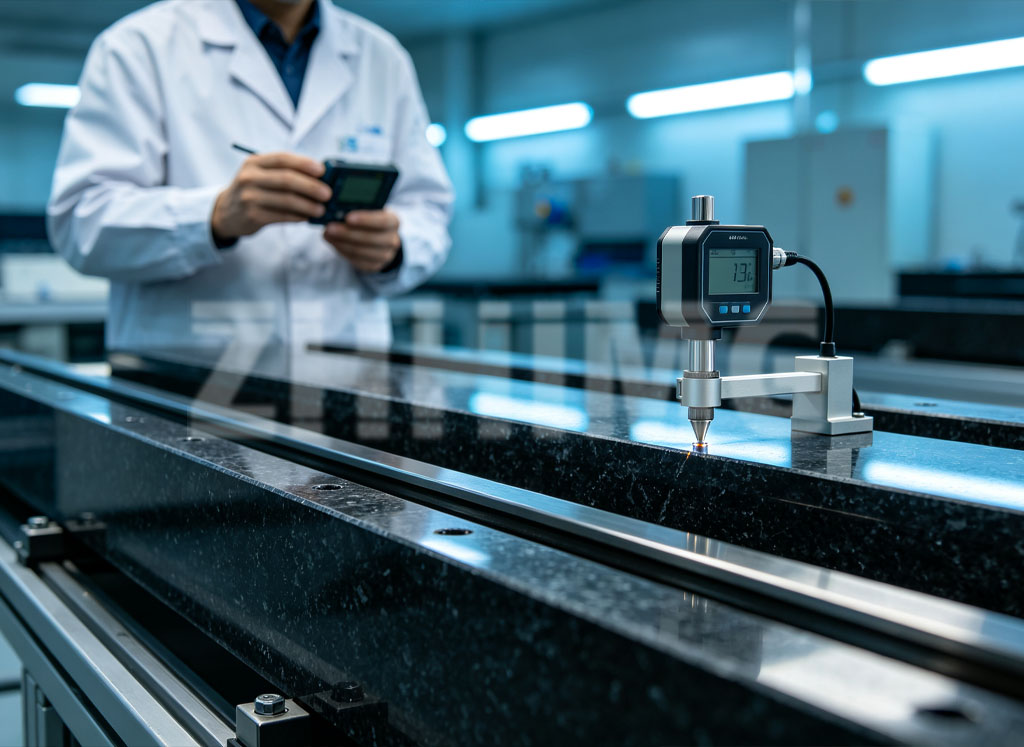
“No Cheating” Means Transparent Technical Communication
ZHHIMG’s stated customer commitment is “No cheating, no concealment, no misleading.” For industrial buyers, this principle should translate into practical and verifiable behavior.
In precision granite sourcing, transparency is especially important because the buyer may not be able to inspect every manufacturing step in person. The supplier must communicate clearly about material selection, manufacturing limits, achievable tolerances, inspection methods, and delivery conditions.
A transparent supplier should be willing to discuss the difference between general decorative stone and precision granite. It should not make unverified claims about flatness, density, thermal stability, or standards compliance. It should also identify where a tolerance may depend on part size, geometry, support arrangement, inspection conditions, or customer assembly requirements.
For example, a buyer ordering a granite surface plate should specify the applicable DIN 876 grade, dimensions, support arrangement, inspection method, and final calibration report. DIN 876 is commonly used for granite surface plates and relates to flatness grades, but it should not be used as a vague marketing statement. The purchase specification should define the actual performance requirement.
Similarly, a buyer ordering a granite machine base should clearly identify critical mounting surfaces, straightness requirements for rail pads, parallelism between functional faces, insert locations, hole patterns, and environmental conditions. If thermal behavior is critical, the buyer should request material-specific data for the selected granite grade rather than relying on generic values.
ZHHIMG’s published product information states that its granite surface plates and related products can be manufactured to standards including DIN, ASME, JIS, GB, and Federal specifications, depending on the customer’s requirement.
International Trademarks and Buyer Confidence
A registered trademark is not a substitute for product verification, but it is an important part of brand accountability. A manufacturer that invests in trademark registration and international market development has a stronger incentive to protect its name through consistent customer service, documentation, and product quality.
For buyers in the European Union and United States, a recognizable and legally protected brand can simplify supplier identification, reduce confusion with unauthorized sellers, and support long-term sourcing relationships. It also gives customers a clearer point of accountability when they require technical support, quality records, replacement components, or repeat orders.
ZHHIMG states that it has obtained international trademark and patent registrations in overseas markets. Before using trademark or patent claims in formal tender documents, customer presentations, or compliance filings, buyers should request the relevant registration number, jurisdiction, owner name, and current legal status for verification.
The same principle applies to all supplier claims. Certificates, test reports, calibration records, and trademark documents should be treated as part of a documented supplier-qualification process.
Conclusion
For precision granite buyers, certification should be viewed as evidence of management discipline, not as a shortcut around engineering verification. ISO 9001 supports quality-process control. ISO 14001 supports environmental management. ISO 45001 supports occupational health and safety. CE marking, where applicable, concerns product-specific conformity with relevant EU requirements.
Together, these systems can help establish confidence in a supplier’s ability to manage risk, documentation, inspection, and operational consistency. But the final decision should still be based on the specific granite product, its technical drawing, its applicable standards, its inspection report, and its suitability for the intended machine or metrology application.
ZHHIMG presents ISO 9001, ISO 14001, ISO 45001, and CE-related documentation as part of its precision manufacturing framework, alongside its precision granite, ceramic, metal, glass, and mineral casting product capabilities.
To learn more about ZHHIMG precision granite surface plates, granite rulers, granite machine bases, granite air-bearing structures, and custom components, visit www.zhhimg.com. For a technically meaningful quotation, provide the drawing, required tolerances, applicable standards, inspection requirements, and intended operating conditions.
Post time: Sep-14-2026