
When evaluating a supplier of precision granite components, buyers encounter a familiar set of certification logos: ISO 9001, ISO 14001, ISO 45001, CE marking. These symbols appear on datasheets, company websites, and exhibition booth banners across the industry. But what do they actually mean? What do they tell a procurement engineer about a supplier’s real capability — and what do they not tell them?
This article examines each of these certifications in the context of precision granite manufacturing, explains what the certification process requires and verifies, and offers a practical framework for using certification information as part of a broader supplier qualification process.
The short version: ISO certifications are necessary but not sufficient. A supplier holding all three ISO certifications and CE marking has cleared a meaningful quality baseline — but the certifications alone do not guarantee the product performance that precision manufacturing applications require. Understanding what the certifications cover, and what questions to ask beyond them, is what separates an informed buyer from one who is simply checking boxes.
ISO 9001: Quality Management Systems
ISO 9001 is the world’s most widely recognized quality management system (QMS) standard. The current version, ISO 9001:2015, is published by the International Organization for Standardization and has been adopted by organizations in virtually every industry and country. It specifies requirements for a quality management system that an organization must meet to demonstrate consistent ability to provide products and services that satisfy customer and applicable regulatory requirements.
For a precision granite manufacturer, ISO 9001 certification means that the organization has implemented and maintains a documented quality management system covering: leadership commitment and quality policy, risk-based thinking in process design, documented processes for all quality-relevant activities, systematic measurement and monitoring of product and process characteristics, management of nonconforming products, internal auditing, and management review.
Crucially, ISO 9001 is audited by an accredited third-party certification body — not self-declared. The certification body sends trained auditors who examine documented procedures, interview employees, review records of product inspection, and verify that the QMS is actually implemented (not just documented). Certificates are issued for three-year periods with annual surveillance audits.
What ISO 9001 tells a buyer about a precision granite supplier: the supplier has systematic quality processes, measures their own performance, manages nonconformances systematically, and is regularly audited by a third party. What it does not tell you: whether the supplier can actually achieve specific product tolerances. ISO 9001 certifies the management system, not the product specification. A company can hold ISO 9001 and still produce surface plates with 10 μm flatness when their customers need 1 μm.
ISO 14001: Environmental Management Systems
ISO 14001:2015 specifies requirements for an environmental management system (EMS) — a framework for managing an organization’s environmental impacts. For a granite manufacturer, this covers energy consumption in processing, water use in grinding and cooling operations, handling and disposal of grinding swarf and polishing compounds, management of lubricants and chemical coolants, and the environmental impact of quarrying and raw material sourcing.
ISO 14001 certification requires organizations to: identify environmental aspects and impacts of their activities, establish environmental objectives and targets, implement operational controls to reduce significant impacts, monitor and measure environmental performance, and respond to compliance obligations and corrective actions.
Like ISO 9001, ISO 14001 is third-party audited. The certification demonstrates that the organization has a structured approach to environmental responsibility — but the specific environmental targets and performance levels are set by the organization itself, not prescribed by the standard. The standard requires continual improvement but does not define specific emissions, waste, or energy targets.
For buyers, ISO 14001 certification from a granite supplier signals several things: the supplier manages their environmental footprint systematically, they are likely to meet export requirements in environmental regulations that increasingly affect supply chains in Europe, the United States, and elsewhere, and they have the management discipline to handle regulatory compliance systematically. In some markets and industries, supplier ISO 14001 certification is a contractual requirement for doing business.
ISO 45001: Occupational Health and Safety Management Systems
ISO 45001:2018 replaced the previous OHSAS 18001 standard as the international benchmark for occupational health and safety (OH&S) management systems. For a granite manufacturing environment — where workers operate heavy machinery, handle large stone components, work with grinding and polishing compounds, and are exposed to dust, noise, and vibration — occupational safety is not a peripheral concern.
ISO 45001 requires organizations to systematically identify OH&S hazards and risks, implement controls to eliminate or reduce them, establish emergency response procedures, investigate incidents and near-misses, maintain compliance with applicable safety regulations, and involve workers in safety management. The standard emphasizes proactive risk management — identifying and addressing hazards before they cause harm — rather than reactive incident response.
For a precision granite manufacturer, specific safety considerations under ISO 45001 would typically include: crystalline silica dust exposure from granite grinding (a serious occupational health hazard requiring engineering controls, personal protective equipment, and health monitoring); hearing protection in high-noise grinding environments; mechanical safety for crane and heavy material handling operations; chemical safety for coolants and polishing compounds; and ergonomic risk management for repetitive or heavy manual tasks including hand-lapping.
A supplier holding ISO 45001 certification has demonstrated that they manage these risks systematically. Beyond the ethical dimension — workers in a safe environment are more engaged and productive — buyers from regulated markets may find that supplier OH&S practices increasingly feature in their own supply chain due diligence requirements, particularly under European Corporate Sustainability Due Diligence Directive (CSDDD) obligations.
CE Marking: European Conformity
CE marking is not an ISO standard — it is a European regulatory requirement. The “CE” mark (from the French “Conformité Européenne”) indicates that a product meets the requirements of applicable European Union directives and regulations, allowing it to be placed on the market in the European Economic Area.
For precision granite products, applicable EU directives may include the Machinery Directive (if the product includes moving parts or is integrated into machinery), the Low Voltage Directive (if electrical components are included), and specific product safety directives. The applicable directives depend on exactly what is being supplied and how it is used.
CE marking requires the manufacturer to conduct a conformity assessment, compile a technical file demonstrating compliance, and issue a Declaration of Conformity. For some product categories, third-party notified body involvement is required; for others, manufacturer self-declaration is permitted with appropriate technical documentation.
From a buyer’s perspective, CE marking on precision granite components confirms that the supplier has conducted the regulatory analysis required for EU market access, maintains technical documentation demonstrating product compliance, and takes regulatory compliance seriously enough to invest in the CE marking process. For customers shipping precision equipment into European markets, components with appropriate CE marking simplify their own compliance burden.
Holding All Four: What It Signals Beyond Each Individual Certification
A precision granite manufacturer holding ISO 9001, ISO 14001, ISO 45001, and CE marking simultaneously is making a significant statement. Not because any one of these certifications is individually difficult to obtain, but because the combination demonstrates management commitment and organizational discipline across multiple dimensions: product quality, environmental responsibility, worker safety, and regulatory compliance.
More importantly, the maintenance of multiple certifications over time — with regular third-party surveillance audits across all standards — requires a sustained investment of management attention and resources. Organizations that treat certification as a one-time marketing exercise typically find that surveillance audits expose the gap between documented procedures and actual practice. Maintaining valid certifications year after year requires that the management systems are genuinely operational, not just documented.
In the precision granite industry, where many suppliers — particularly smaller operations — hold no third-party certifications at all, a manufacturer with this full certification suite is demonstrably more likely to have the management infrastructure needed to consistently supply high-quality products with documented process controls and traceable inspection records.
Beyond Certifications: What Else to Verify
Certifications establish a quality baseline but do not replace product-level qualification. For precision granite applications, buyers should supplement certification verification with: product flatness data from actual calibration certificates (traceable to national standards); material density verification; references from existing customers in comparable applications; understanding of the supplier’s measurement equipment and its calibration status; factory audit or site visit findings; and sample testing under actual application conditions.
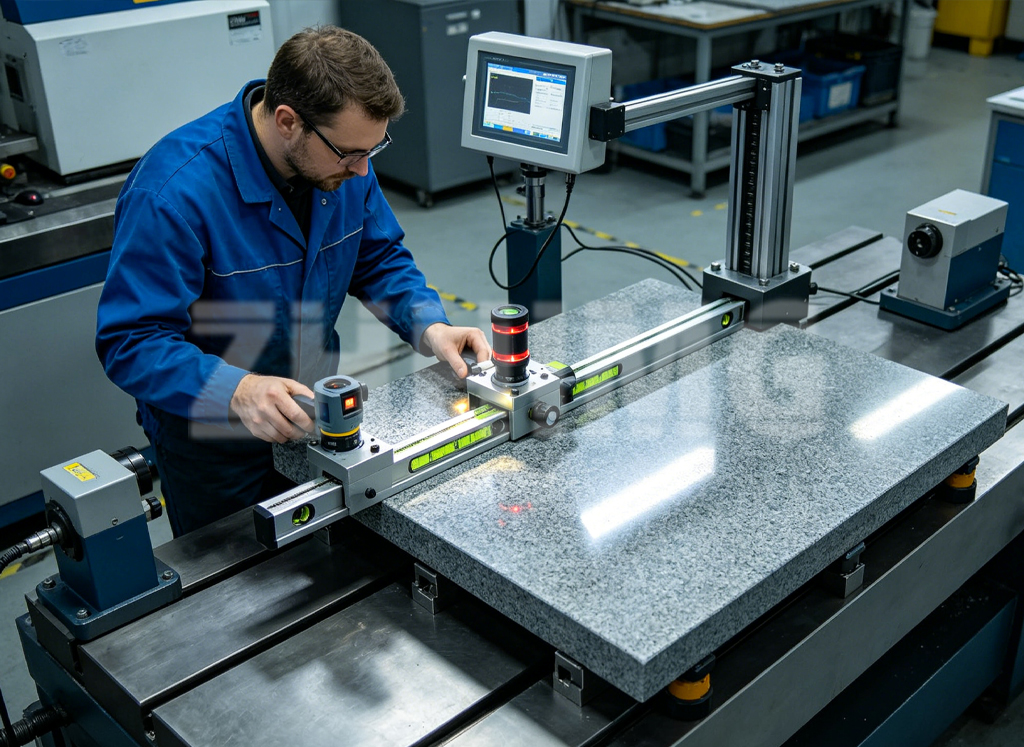
Asking a supplier for calibration certificates for their key measurement instruments — electronic levels, laser interferometers, surface roughness testers — is entirely reasonable. A supplier that cannot produce traceable calibration documentation for their measurement equipment cannot credibly claim to achieve the flatness tolerances they advertise.
Similarly, asking for process controls on incoming granite material — density verification, visual and non-destructive testing for internal flaws — reveals whether a supplier actively manages material quality or simply assumes that raw material meets specification.
Conclusion
ISO 9001, ISO 14001, ISO 45001, and CE marking collectively represent a meaningful quality signal in the precision granite market. They indicate management discipline, regulatory compliance, and systematic process control. They are necessary markers of a serious precision manufacturer and, in many industries and markets, they are minimum requirements for supplier qualification.
But they are not the complete picture. Certifications audit systems and processes; product performance must be verified through product data and — where stakes are high enough — independent testing. The best supplier qualification process uses certifications as the first filter, then goes deeper into product-level evidence, measurement traceability, and customer references.
For buyers of precision granite in demanding applications — semiconductor equipment, national metrology laboratories, precision laser systems — the combination of a comprehensive certification portfolio and documented product performance data, with traceable measurement records, provides the confidence needed to make an informed sourcing decision. Accepting one without the other leaves important questions unanswered.
Post time: Jun-30-2026