
The semiconductor industry operates at the physical limits of what is measurable and manufacturable. Modern integrated circuits feature transistors with gate lengths below 3 nanometers — dimensions at which a single silicon atom represents a meaningful fraction of the critical feature size. The lithography systems, wafer inspection tools, and metrology equipment that create and verify these structures must achieve positioning accuracy, vibration isolation, and dimensional stability that would have seemed impossible just two decades ago.
Yet within these rooms full of extraordinary technology, one of the most important structural materials is something ancient: granite. Precision-machined, thermally controlled black granite forms the structural backbone of many of the world’s most advanced semiconductor equipment platforms. Understanding why — and why not all granite is equal — illuminates a critical and often overlooked aspect of semiconductor equipment engineering.
The Semiconductor Equipment Environment: What the Base Must Survive
A photolithography exposure system (scanner or stepper) operates in a cleanroom environment where airborne particle counts are controlled to Class 1 or Class 10 levels — meaning fewer than 1 or 10 particles per cubic foot of air at 0.5 μm or larger. The equipment itself must achieve stage positioning repeatability below 1 nanometer, overlay accuracy below 2 nanometers, and focus uniformity across a 300 mm wafer within a few nanometers.
The wafer stage that accomplishes this moves at speeds exceeding 1 meter per second, accelerates and decelerates at rates exceeding 10 g, and repeats this cycle thousands of times per hour — every hour, every day, for years. The granite base supporting this stage must not flex, creep, or resonate in ways that corrupt the stage’s position measurement. It must remain dimensionally stable across the equipment’s thermal operating range. And it must do all of this reliably for the system’s operating lifetime, which may be a decade or more.
These are not gentle operating conditions. They make extreme demands on every component — including the seemingly passive granite base.
Vibration Isolation and Damping: Granite’s Physical Advantage
Semiconductor facilities invest enormously in vibration isolation — from the building foundations (which may be mounted on arrays of pneumatic isolators) to equipment-level active vibration cancellation systems. But these systems have limits. They cannot eliminate all vibration, and they cannot respond instantaneously to all frequencies. The granite machine base provides the final passive stage of vibration isolation.
The physics of vibration damping favors materials with high mass and specific damping capacity. High-density black granite — with its crystalline microstructure of interlocked quartz, feldspar, and mica crystals — provides excellent internal damping of mechanical vibrations through a combination of mass effects and grain boundary friction. Vibrations that enter the base through the floor or through the moving stage’s reaction forces are absorbed and dissipated within the granite before they can propagate back to the sensitive measurement systems.
Granite outperforms steel in this regard, despite steel’s higher tensile strength. The reason lies in the crystalline microstructure: granite’s polycrystalline grain structure scatters and absorbs vibrational energy at grain boundaries, while steel’s ordered crystalline structure conducts vibration more efficiently. Cast iron is better than steel for damping, which is why it was historically used for precision machine tool bases — but precision granite is better still.
Thermal Stability: The Foundation of Nanometer Repeatability
At the nanometer scale, thermal stability is the dominant factor governing dimensional repeatability. A 1°C temperature change in a 1-meter steel component causes approximately 11.7 micrometers of thermal expansion — 11,700 nanometers. In granite, the equivalent expansion is typically 6–8 micrometers, about half that of steel. In ultra-low expansion glass ceramics (such as Zerodur or ULE), it is only 0–0.02 micrometers per degree — but these materials are far more expensive and difficult to process in the large sizes required for machine bases.
For semiconductor equipment bases, the granite’s thermal expansion behavior must be not only low but predictable. Designers use the known CTE of the granite to engineer thermal compensation into the stage’s position measurement system. An unpredictable or spatially varying CTE — which can occur in lower quality or improperly selected granite — makes compensation impossible and leads to temperature-dependent position errors that cannot be calibrated out.
This is one reason why the specific source and specification of granite matters in semiconductor equipment applications. The material must be characterized for thermal behavior — not just specified generically as “black granite” — and it must meet consistent density and homogeneity requirements that ensure its thermal behavior is uniform throughout the component.
Air Bearing Granite Surfaces: The Moving Interface
Many semiconductor equipment motion systems use air bearings — thin films of pressurized air that allow stages to move over a reference surface with effectively zero friction and zero contact wear. Air bearings offer sub-nanometer motion smoothness, no stick-slip behavior (which would corrupt nanometer-scale positioning), and no lubrication contamination that could compromise the cleanroom environment.
The performance of an air bearing is critically dependent on the surface over which it rides. Flatness errors in the bearing surface become stage positioning errors. Surface roughness affects the air film stability. The material must be hard enough to resist wear if the air film collapses momentarily during operation. And the material must be thermally compatible with the stage and the air supply system to avoid differential expansion that changes the air gap.
Precision granite, lapped to flatness better than 1 μm over the bearing travel distance and polished to Ra below 0.1 μm, meets all of these requirements. The combination of high hardness (resisting wear), low surface roughness (supporting stable air films), and dimensional stability (preserving flatness over time) makes granite the material of choice for air bearing reference surfaces in demanding semiconductor applications.
Granite in Wafer Inspection and Metrology Equipment
Beyond lithography, granite plays equally important roles in the suite of equipment used to inspect and measure semiconductor wafers. Scanning electron microscopes (SEMs), focused ion beam (FIB) systems, optical defect inspection tools, and overlay metrology systems all rely on stable, vibration-free bases to achieve their required measurement accuracy.
A critical dimension scanning electron microscope (CD-SEM) measuring gate widths of 3 nanometers must image with sub-nanometer accuracy. Any vibration between the sample and the electron beam during image acquisition blurs the image and introduces measurement uncertainty. The granite base isolates the sample stage from floor vibrations, providing the quiet mechanical environment in which atomic-scale measurements become possible.
Similarly, optical scatterometry systems and wafer geometry tools use granite bases and reference surfaces to maintain the geometric relationships between measurement beams and the wafer surface. The measurement accuracy of the entire tool — which determines whether a wafer passes or fails inspection — rests ultimately on the dimensional stability of the granite beneath it.
Industry Applications: A Partial Map of Granite in Semiconductor Manufacturing
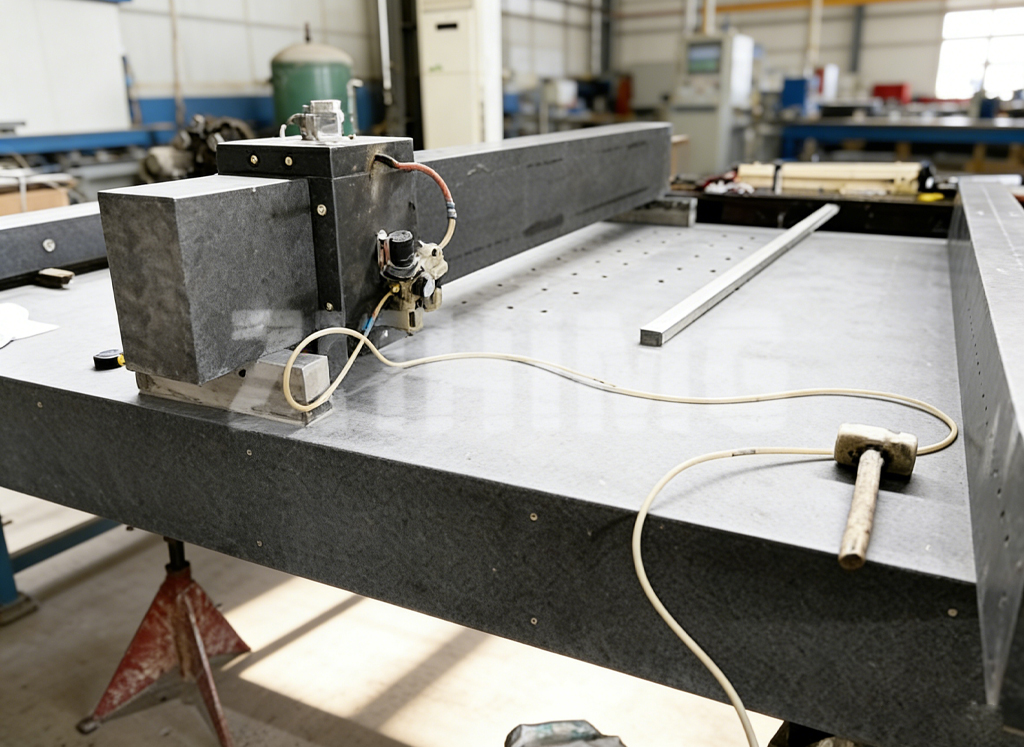
To appreciate the breadth of granite’s role in semiconductor manufacturing, consider the equipment types where precision granite components are routinely found: photolithography scanners and steppers (wafer stage bases, reticle stage bases, reference frames); chemical mechanical planarization (CMP) equipment (conditioning disc reference surfaces, measurement stages); wafer inspection systems (stage bases, reference mirrors, vibration isolation platforms); metrology equipment including scatterometers, ellipsometers, and interferometric overlay tools; wafer handling and transport systems where dimensional stability prevents wafer damage; electron beam inspection and lithography systems; and ion implantation equipment where beam positioning stability is critical.
In each of these applications, granite is not a commodity input but a critical precision component whose performance specification directly determines system capability. The difference between a granite component manufactured to ±10 μm flatness and one manufactured to ±0.5 μm flatness is not a 20× improvement — it may be the difference between a tool that achieves its specification and one that fundamentally cannot.
Sourcing Precision Granite for Semiconductor Applications
Given the performance demands of semiconductor applications, the selection and qualification of a granite supplier is a significant engineering decision. Beyond the basic material specifications — density, thermal expansion coefficient, flatness grade — buyers need to evaluate the supplier’s actual measurement capability (can they verify what they claim to achieve?), their experience with semiconductor equipment applications, their quality management system’s robustness, and their ability to maintain consistency across production batches.
The semiconductor industry’s supply chain is unforgiving: a precision component that fails to meet specification can delay equipment delivery, corrupt production data, or necessitate costly field retrofits. The cost of a precision granite base that meets specification is trivial compared to the cost of one that does not.
Conclusion
Granite’s role in semiconductor equipment is invisible to most observers — hidden beneath the more glamorous technologies of lasers, electron beams, and nanoscale optics. But it is foundational. The nanometer-scale accuracy and repeatability of semiconductor manufacturing equipment rests on the dimensional stability, vibration damping, and surface quality of precision granite components.
As the semiconductor industry continues pushing transistor dimensions below current limits, the demands on every component in the equipment — including the granite base — will only increase. The manufacturers who can supply granite components that meet these evolving requirements, with verified measurement data to prove it, will play an essential role in enabling the next generation of semiconductor technology.
Post time: Jun-30-2026