In the landscape of modern precision manufacturing, coordinate measuring machines stand as indispensable instruments that ensure components meet exacting specifications. From aerospace components to medical devices, from automotive assemblies to semiconductor manufacturing, CMMs provide the dimensional verification that guarantees quality, interchangeability, and performance across virtually every industry that demands precision. These sophisticated measurement systems have evolved dramatically since their introduction in the 1960s, incorporating advanced technologies in probing, software, motion control, and environmental compensation. Yet despite these technological advances, one fundamental material has remained remarkably consistent in CMM construction: natural granite. This article explores why natural granite has become and remained the material of choice for the structural components of precision measuring machines, examining its properties, applications, and the engineering considerations that make it essential for achieving and maintaining measurement accuracy over time.
The foundational importance of structural materials in coordinate measuring machines cannot be overstated. Unlike many precision instruments where the measurement process occurs in a controlled environment isolated from the instrument structure, CMMs must physically position their probing systems in three-dimensional space while maintaining thermal equilibrium with the workpiece being measured. The machine structure must provide exceptional rigidity to minimize deflection under probe forces, excellent vibration damping to isolate measurement from environmental disturbances, outstanding thermal stability to prevent dimensional drift, and long-term dimensional stability to ensure measurement consistency over years of operation. These requirements have led manufacturers to carefully evaluate and select materials that can provide optimal combinations of these properties, with natural granite emerging as the preferred choice for the critical structural elements that define the machine’s measurement volume and provide the reference geometry against which all measurements are ultimately referenced.
Natural granite finds application throughout CMM construction, appearing in the components that most directly influence measurement performance. The main base and worktable represent the most visible applications, serving as the reference plane upon which workpieces are placed for measurement and providing the primary thermal mass that helps buffer temperature variations. In many CMM designs, particularly bridge-type machines, the base also incorporates the precision guideways that define the Y-axis of motion. The moving bridge or crossbeam, which carries the Z-axis assembly and probe head, often incorporates granite structural elements that provide thermal and mechanical stability during the measurement process. Column structures, whether supporting overhead components in gantry designs or providing reference surfaces in horizontal arm machines, frequently utilize granite for its combination of damping and stability properties. The consistent application of granite throughout these critical load-bearing and reference surfaces ensures that the entire machine structure behaves as a homogeneous, thermally stable unit rather than an assembly of dissimilar materials with varying thermal and mechanical properties.
The selection of granite over other engineering materials stems from its exceptional combination of physical properties, each contributing to measurement performance in specific ways. Thermal stability represents perhaps the most critical advantage that granite provides in precision metrology applications. Granite exhibits a remarkably low coefficient of thermal expansion, typically ranging from 5 to 8 parts per billion per degree Celsius depending on granite type and composition. This property proves essential in manufacturing environments where temperature variations are inevitable, as even small temperature changes can cause significant measurement errors in precision components. When a CMM structure expands or contracts with temperature changes, the dimensional relationship between the machine’s reference geometry and the workpiece being measured shifts, introducing errors that may exceed acceptable tolerances for precision components. Granite’s low thermal expansion coefficient means that the machine structure changes dimensions very slowly and predictably with temperature, allowing compensation algorithms to correct for thermal effects and enabling the machine to maintain accuracy across typical manufacturing facility temperature ranges. Furthermore, granite’s thermal conductivity, while not exceptional, allows the material to reach thermal equilibrium relatively quickly compared to materials with lower conductivity, enabling machines to stabilize and achieve rated accuracy after environmental temperature changes.
Vibration damping characteristics distinguish granite from many other stiff materials commonly used in precision engineering. While materials like aluminum alloys provide excellent stiffness-to-weight ratios, they tend to exhibit poor internal damping, meaning vibrations persist longer once excited. This characteristic proves problematic in manufacturing environments where machinery, floor traffic, and HVAC systems continuously introduce vibrations that can compromise measurement quality. Granite, as a natural polycrystalline material, exhibits significantly superior damping properties, absorbing vibrational energy and preventing its propagation through the machine structure. This damping action effectively filters out high-frequency vibrations that could introduce noise into measurement data, contributing to the stable, repeatable readings that quality-focused manufacturers require. The combination of high stiffness with effective damping makes granite structures less susceptible to dynamic distortion during measurement cycles, where rapid probe movements could otherwise excite resonant vibrations in the machine structure.
Long-term dimensional stability represents another critical advantage that has secured granite’s position in CMM construction. Unlike materials that may undergo aging effects, stress relief, or gradual dimensional changes over time, properly selected and processed granite maintains its dimensions essentially indefinitely under normal operating conditions. This stability stems from granite’s crystalline structure and the absence of internal stresses that could relax over time. Once a granite CMM component has been machined to its final precision geometry and stabilized, that geometry remains essentially unchanged throughout the machine’s operational life. This characteristic proves invaluable for manufacturers who depend on measurement traceability and consistency, as CMMs often serve as primary dimensional references for quality systems. The stability of granite structures contributes to reduced uncertainty in measurement systems and simplifies the establishment and maintenance of measurement traceability chains.
Corrosion resistance further enhances granite’s suitability for CMM applications. Manufacturing environments often contain cutting fluids, cleaning solvents, and atmospheric contaminants that could corrode metallic machine structures. Granite, as a silicate-based igneous rock, resists attack from virtually all common manufacturing chemicals and atmospheric constituents. This resistance ensures that granite surfaces maintain their geometry and surface quality indefinitely without protective coatings that might wear, delaminate, or require maintenance. The natural beauty of polished granite also projects an image of precision and quality that aligns with the expectations for high-value measurement equipment.
When evaluating granite against alternative materials, manufacturers and design engineers must consider the trade-offs inherent in each option. Cast iron, the traditional material for machine tool bases, offers good damping and thermal stability but with higher thermal expansion coefficients than granite. Iron structures also require careful attention to stress relief and aging to achieve dimensional stability, and the machining of cast iron generates concerns regarding surface texture and chip recovery. Aluminum alloys provide excellent stiffness-to-weight ratios and are easily machined, but their high thermal expansion coefficients and poor damping properties make them unsuitable for the most demanding precision applications without extensive compensation and isolation measures. Advanced ceramic materials offer exceptional hardness and low thermal expansion but tend to be brittle and expensive, limiting their application to specialized components rather than full machine structures. Granite composite materials, consisting of natural stone particles bonded with epoxy or resin matrices, have emerged as alternatives that aim to combine the properties of natural granite with improved consistency and reduced weight. While these materials offer advantages in some applications, they may exhibit different long-term aging characteristics than natural granite and typically cannot match the damping performance of solid natural stone.
Different CMM configurations incorporate granite structures in ways that address their specific structural requirements and performance objectives. Bridge-type CMMs, the most common configuration in general-purpose metrology applications, typically employ granite bases that integrate Y-axis guideways with worktables large enough to accommodate typical workpieces. The moving bridge structure, often constructed from granite in premium machines, provides the X-axis motion while supporting the Z-axis column and probe assembly. This configuration benefits from granite’s thermal stability in both the fixed base and moving bridge, ensuring consistent reference geometry throughout the measurement volume. Gantry or portal CMMs, designed for larger workpieces, often feature extensive granite construction in their overhead structures and crossbars, where the material’s damping properties help control the dynamic behavior of larger, potentially more flexible components. Cantilever CMMs, with their vertical column designs, rely on granite foundations and precision guideways to maintain accuracy despite the cantilever loading that tends to deflect less massive structures. Horizontal arm CMMs, commonly used in automotive body inspection and large assembly verification, incorporate granite bases and columns that provide stable reference geometry while accommodating the measurement requirements for large, complex workpieces.
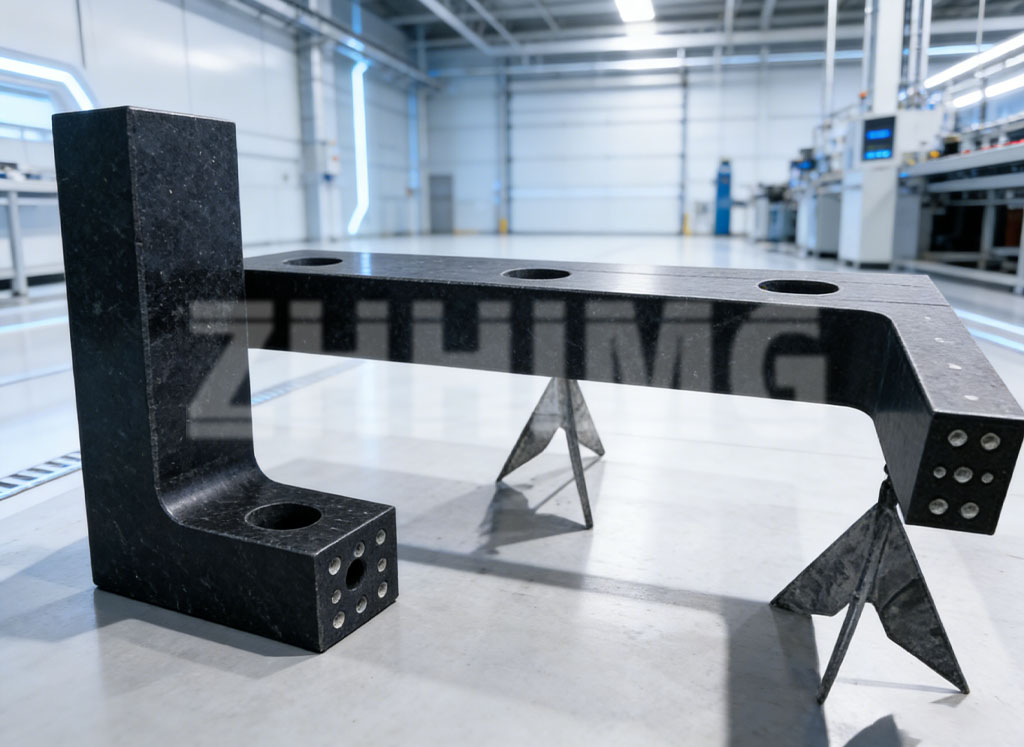
Design engineers working with granite CMM components must balance multiple considerations to optimize machine performance. Structural optimization involves carefully distributing material to maximize rigidity in load paths while minimizing weight where it does not contribute to performance. Ribbed construction, internal webs, and carefully designed geometries allow granite CMM manufacturers to achieve optimal stiffness-to-weight ratios while maintaining the material’s inherent damping and stability properties. The relationship between component mass and machine accuracy proves particularly important in applications where the CMM must track moving production or where machine placement requires consideration of floor loading. Advances in finite element analysis have enabled designers to optimize granite geometries with unprecedented sophistication, identifying areas where material can be removed without compromising performance and regions where additional mass improves thermal buffering or damping characteristics.
Manufacturing precision granite components for CMM applications demands specialized machining capabilities and quality assurance procedures. CNC grinding operations, rather than conventional milling, typically provide the final precision surfaces on granite CMM components, as grinding minimizes surface damage and produces the exceptionally flat and straight surfaces required for guideways and reference geometries. Diamond cutting tools and abrasives provide the only practical means of shaping granite, as conventional cutting tools cannot penetrate the material’s hardness. Machining parameters must be carefully controlled to avoid introducing subsurface damage that could affect long-term stability or surface texture that might compromise the cleanability or appearance of the finished component. Quality assurance for granite CMM parts includes coordinate metrology to verify dimensional accuracy, interferometric measurement to establish flatness and straightness of critical surfaces, and thermal monitoring to ensure components have reached equilibrium before final inspection. Some manufacturers subject critical components to extended thermal soaking periods to accelerate any minor aging effects, ensuring dimensional stability before the parts enter assembly.
Looking toward future developments, granite’s role in CMM construction continues to evolve as manufacturers explore new applications and material variants. Granite composite materials, incorporating natural granite particles in polymer matrices, offer potential advantages in reduced weight and improved consistency while maintaining many of the beneficial properties of natural stone. These materials may enable larger CMM components that would be impractical with solid granite due to weight constraints, potentially expanding the application range for granite-structured machines. Research into surface treatments and bonding techniques may further enhance granite’s already excellent properties, improving damping characteristics or enabling new joint configurations that maximize structural performance. As measurement requirements continue to tighten in advanced manufacturing sectors, the fundamental properties that have made granite indispensable in precision metrology will ensure its continued importance in CMM design and construction.
The enduring presence of natural granite in coordinate measuring machine construction reflects more than tradition or convention; it represents an optimal material choice that addresses the fundamental requirements of precision dimensional measurement. In an industry characterized by rapid technological change and continuous improvement, granite has proven itself as a material that delivers precisely what demanding measurement applications require. Its combination of thermal stability, vibration damping, long-term dimensional accuracy, and corrosion resistance provides the foundation upon which modern CMM performance depends. As manufacturing tolerances continue to tighten across all sectors, natural granite will remain central to the quest for measurement confidence, providing the stable, reliable reference geometry that engineers and quality professionals depend upon to ensure their products meet the specifications that define modern manufacturing excellence. The material that ancient civilizations used to build monuments meant to last millennia now enables the precise measurement that defines 21st century manufacturing quality.
For engineering teams specifying new CMM systems and for manufacturers establishing metrology capabilities, understanding the role of granite in machine construction provides valuable context for equipment selection and application. The investment in granite-structured precision machines reflects an understanding that measurement confidence begins with structural integrity, and that the foundation upon which measurements are made deserves the same attention to quality and precision as the components being measured. Quality managers should recognize that the granite base and structure represent a significant portion of the machine’s total cost, but one that delivers ongoing value through decades of reliable service without degradation of performance. Many CMMs remain in production service for twenty years or more, and the granite components that were accurate when the machine was first installed typically remain accurate today, demonstrating the exceptional value proposition that natural granite provides in precision metrology applications.
Metrology professionals evaluating CMM options should consider not only the initial accuracy specifications but also the long-term stability and service requirements that will affect the total cost of ownership. Machines built with alternative materials may offer advantages in initial cost or shipping weight, but the ongoing requirements for environmental compensation, periodic recalibration due to material aging, and potential concerns about long-term dimensional stability should factor into the procurement decision. The thermal compensation systems required by aluminum-structured machines, for example, add complexity and ongoing calibration requirements that are unnecessary in granite-structured alternatives. Similarly, machines using polymer composite materials may require periodic inspection to verify that aging effects have not compromised structural stability.
Beyond the technical considerations, the selection of granite-structured CMMs often reflects organizational values regarding quality and precision. Companies that specify granite-structured measurement equipment signal to their customers and regulatory bodies that dimensional quality is taken seriously throughout the organization. The substantial, precise appearance of granite CMMs reinforces this message, creating confidence in measurement capabilities that extends throughout the supply chain. In industries where measurement uncertainty must be documented and controlled, such as aerospace, medical device manufacturing, and automotive safety components, the inherent stability of granite structures simplifies the demonstration of measurement system capability that regulatory compliance requires.
The future of granite in precision metrology extends beyond traditional CMM applications. Emerging technologies in additive manufacturing, micro-machining, and semiconductor fabrication are creating new requirements for dimensional verification that will push measurement tolerances to previously unimaginable levels. At the same time, the integration of CMMs with production processes, through in-process measurement and real-time quality control systems, places new demands on machine stability and environmental robustness. Natural granite, with its proven combination of properties, is well-positioned to meet these challenges, providing the stable foundation that the next generation of precision measurement systems will require. As manufacturing continues its evolution toward higher precision, tighter tolerances, and more demanding quality requirements, natural granite will remain the material of choice for those who understand that measurement confidence begins with structural excellence.
The remarkable story of natural granite in precision metrology illustrates a broader truth about engineering materials: the best choice is not always the newest or most exotic, but rather the material that most effectively addresses the fundamental requirements of the application. In the case of coordinate measuring machines, granite provides exactly the combination of properties that precision dimensional measurement demands, delivered in a form that can be machined to extraordinary precision and will maintain that precision for generations of use. This combination of immediate performance and long-term stability has secured granite’s place at the heart of precision metrology, and that position will surely endure as measurement technology continues to advance toward ever more demanding applications.
Post time:
Apr-24-2026
