
A granite surface plate is the foundation of dimensional measurement. It’s the primary reference plane against which all other measurements are compared. But not all surface plates are created equal—and not all standards are the same. If you’re specifying a surface plate for a metrology lab, inspection department, or calibration facility, understanding the differences between DIN, ASME, and JIS standards isn’t just academic. It’s the difference between buying a plate that meets your requirements and buying one that doesn’t.
The Standards Landscape
Several international standards govern the accuracy and calibration of granite surface plates. The most widely referenced include:
- DIN 876 (German standard), covering surface plates for inspection and measurement
- ASME B89.3.7 (American standard), which superseded the former Federal Specification GGG-P-463C
- JIS B 7513 (Japanese standard), covering surface plates for precision measurement
- GB/T 20428 (Chinese standard)
- BS 817 (British standard)
Each standard defines different accuracy grades, test methods, and acceptance criteria. A plate that meets DIN 876 Grade 00 might not meet ASME B89.3.7 Grade AA—and vice versa.
Understanding Accuracy Grades
The accuracy of a granite surface plate is typically expressed in terms of flatness tolerance over the plate’s working surface. Here’s a general comparison:
| Grade | Typical Flatness Tolerance | Common Application |
|---|---|---|
| DIN 876 Grade 00 | ±0.001 mm/m | Laboratory reference, high-precision metrology |
| DIN 876 Grade 0 | ±0.002 mm/m | Inspection, calibration |
| ASME B89.3.7 Grade AA | ±(1.0 + L/250) μm | High-precision measurement |
| ASME B89.3.7 Grade A | ±(2.0 + L/250) μm | General inspection |
| JIS Grade 0 | ±0.003 mm/m | Precision measurement |
| JIS Grade 1 | ±0.006 mm/m | Workshop inspection |
L = diagonal length of the plate in mm
The key takeaway: a plate that’s “Grade 00″ under DIN isn’t necessarily equivalent to “Grade AA” under ASME. The test methods differ, the measurement points differ, and the acceptance criteria differ.
What to Look for in a Quality Surface Plate
Beyond the accuracy grade, several factors determine whether a surface plate will perform as expected over its service life:
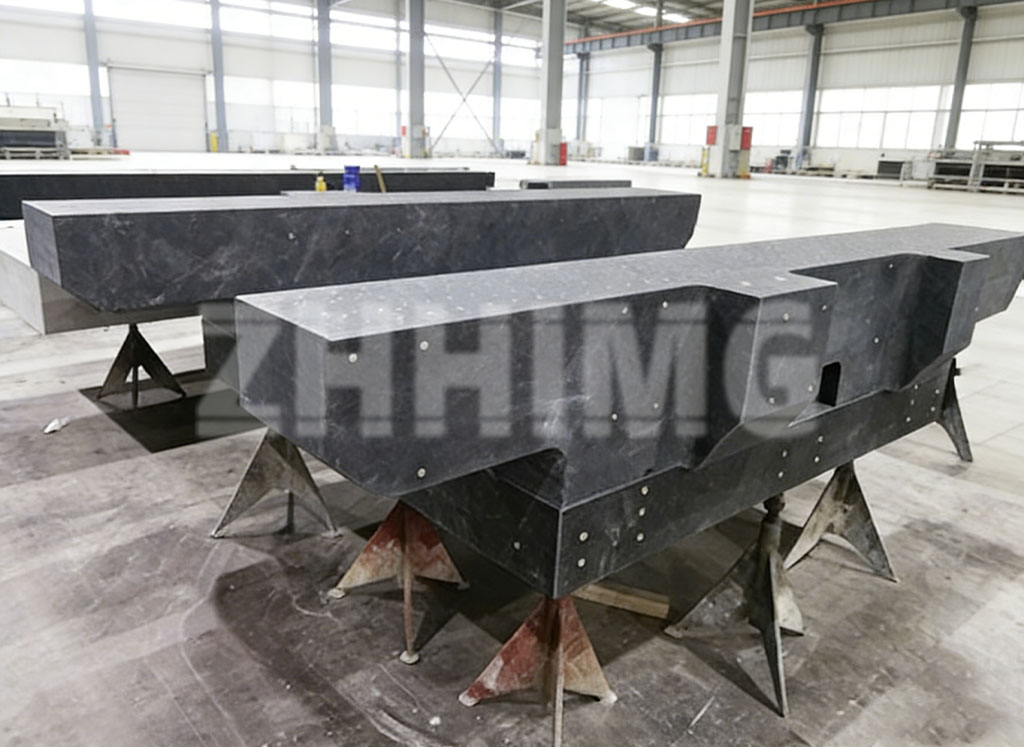
Material Quality. The granite should be fine-grained, free from defects, and of uniform density. Low-quality granite can contain micro-fractures that affect long-term stability. At ZHHIMG®, we use ZHHIMG® black granite with a density of ≈3100 kg/m³—higher than most European and American black granites—ensuring superior stability and wear resistance.
Hardness and Wear Resistance. A surface plate should resist scratching and wear from repeated use. Our granite achieves Mohs hardness of 6–7, providing excellent wear resistance for decades of daily use.
Thermal Stability. The CTE of the granite should be as low and predictable as possible. Our ZHHIMG® black granite offers exceptional thermal stability, maintaining flatness across temperature variations that would cause metal plates to warp。
Calibration and Traceability. The plate should come with a calibration certificate that traces measurements back to a national metrology institute. At ZHHIMG®, every surface plate is calibrated using instruments certified by the Jinan Institute of Metrology and the Shandong Institute of Metrology, with traceability to the National Institute of Metrology of China.
The Role of Skilled Craftsmanship
Even the best granite is useless without proper finishing. The manufacturing of a granite surface plate involves two primary stages: blank preparation and precision machining。The blank is rough-cut from a quarried block, then precision-ground to approximate flatness. But the final step—achieving the specified flatness grade—requires skilled hand lapping。
Skilled technicians carefully adjust the plate surface to achieve the required flatness and smoothness。 Every piece must pass strict inspection to confirm it meets the specified grade。 At ZHHIMG®, our master grinders have over 30 years of hand-lapping experience, achieving micrometer-level flatness through tactile sensitivity that no machine can replicate.
Practical Advice for Buyers
When comparing quotes from different manufacturers, don’t rely on the material name alone. Request:
- The actual density of the granite (not just “granite” but the specific type and density)
- The CTE (coefficient of thermal expansion) measured at 20°C
- The flatness tolerance achieved and the standard it’s measured against
- The calibration certificate and traceability documentation
- The service life guarantee and resurfacing policy
If a supplier can’t provide these details, that’s a red flag. Many small manufacturers use cheap marble instead of true granite—a deceptive practice we firmly oppose. Marble is softer, less stable, and more prone to wear than proper granite. The difference isn’t minor; it’s the difference between a surface plate that holds its accuracy for decades and one that drifts out of spec within years.
Maintenance and Recertification
A granite surface plate isn’t a “set it and forget it” investment. Even the best plates require periodic recertification to ensure they haven’t drifted out of tolerance. ASME B89.3.7 covers new certification, recertification in the field, and recertification after resurfacing。DIN 876 and JIS B 7513 have similar provisions.
Regular maintenance—cleaning with appropriate solvents, protecting the surface from impact, and using proper covers when not in use—extends the service life of a surface plate significantly. And when a plate eventually wears beyond its specified tolerance, resurfacing by a qualified technician can restore it to like-new condition.
At ZHHIMG®, we don’t just manufacture surface plates. We provide the full lifecycle support—from initial specification and calibration through recertification and resurfacing—because we understand that a surface plate isn’t just a tool. It’s the foundation of your entire measurement system.
Post time: Jul-08-2026