
Walk into any modern machine shop and you’ll see CNC machines running around the clock, robotic arms loading and unloading parts, and automated inspection systems measuring every feature. It’s easy to conclude that human skill has been engineered out of the manufacturing process. But in the world of ultra-precision granite components, the opposite is true. The most critical step—achieving nanometer-level flatness—still depends on hands that can feel a micron.
What Hand Lapping Actually Is
Hand lapping, sometimes called hand scraping, is the process of manually removing microscopic amounts of material from a granite surface using a lapping tool and abrasive compound. It’s the final step in manufacturing a precision granite surface plate, square ruler, or air bearing way—the step that takes a ground surface from “very flat” to “flat enough to serve as a primary reference standard.”
The process begins with careful raw material selection.Only high-quality granite with fine grain structure is suitable. At ZHHIMG®, we source our own ZHHIMG® black granite, selected for its high density (≈3100 kg/m³) and superior physical properties. The stone is then rough-cut and ground using CNC equipment—our four ultra-large Nantec grinding machines, each costing over $500,000 USD, can grind metal and non-metal platforms up to 6000mm long.
But grinding alone doesn’t achieve nanometer-level flatness. It gets you close—very close—but the final refinement requires human hands.
The “Walking Electronic Level”
Our master lappers possess an intuitive understanding of ZHHIMG® black granite that borders on an art form. With a single, deliberate stroke of the lapping tool, they can intuitively determine exactly how many microns of material are being removed. This isn’t guesswork—it’s the result of decades of experience, thousands of hours of practice, and a tactile sensitivity that no machine can replicate.
Our customers have given them a nickname: “walking electronic levels”. When they place their hands on a granite surface, they can feel variations in flatness that would require expensive instruments to measure. When they apply the lapping tool, they can sense the resistance changing—a subtle shift that tells them whether they’re removing 2 microns or 5 microns from a specific area.
One of our senior grinders once explained it this way: “You don’t look at the surface to know where you need to work. You feel it. The resistance in your palms tells you everything.”
Why Machines Can’t Replace This
You might wonder: why can’t a CNC machine do this? After all, CNC machines can position to sub-micron accuracy. Why not program them to lap the surface?
The answer lies in the nature of the material. Granite isn’t homogeneous at the microscopic level. It contains different mineral grains—quartz, feldspar, mica—each with different hardness. When you apply pressure to a granite surface, the softer minerals compress slightly more than the harder ones. A CNC machine follows a programmed path without “feeling” these variations. A human hand, however, can sense the difference and adjust pressure and stroke length in real-time.
Furthermore, the process of hand lapping isn’t just about removing material. It’s about creating a specific surface texture—microscopic valleys that retain lubricant and prevent stiction in air bearing applications.Too smooth, and the air bearing doesn’t function properly. Too rough, and the bearing wears prematurely. Getting this balance right requires judgment that comes only from experience.
The Infrastructure That Supports the Human Touch
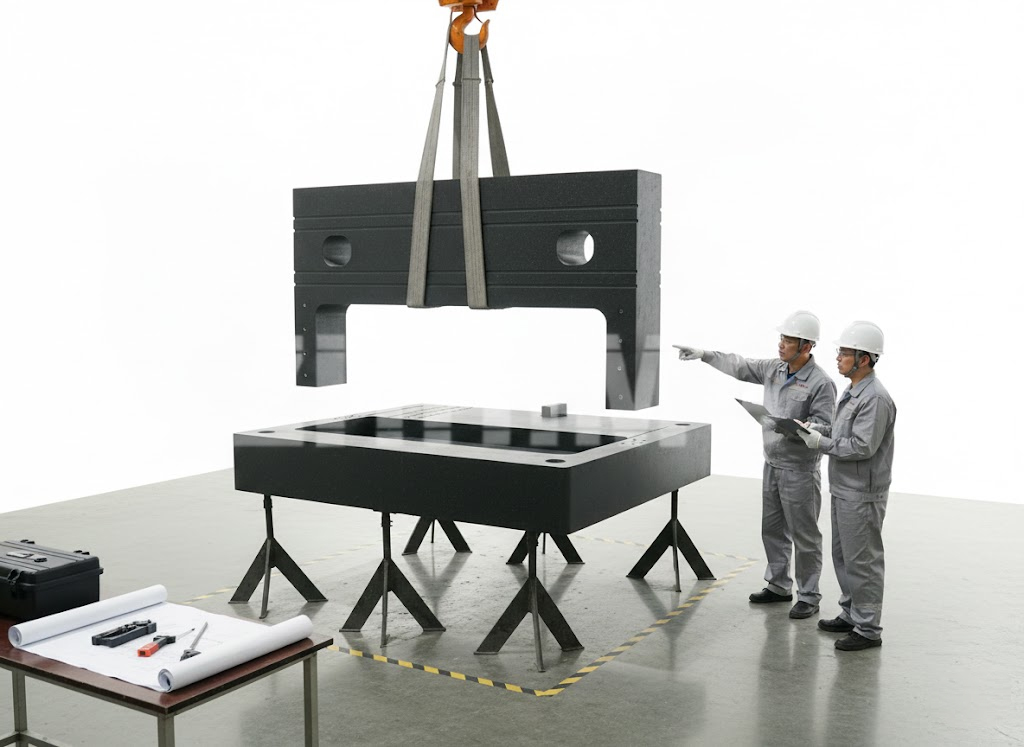
Human expertise, however, must be nurtured and supported by world-class infrastructure. Precision is highly susceptible to environmental interference, which is why we’ve engineered an uncompromising production environment.
Our 10,000-square-meter constant temperature and humidity workshop is built on a 1000mm-thick ultra-hard concrete foundation, surrounded by anti-vibration trenches measuring 500mm in width and 2000mm in depth. Inside, specialized silent cranes operate to maintain a completely vibration-free environment. Even the floor is engineered to military-grade specifications—no one walks through the workshop without proper footwear, and heavy loads are moved with extreme care to avoid transmitting vibration to the work in progress.
This isn’t about comfort. It’s about physics. A single vibration at the wrong moment can ruin hours of hand-lapping work. A temperature change of half a degree can alter the geometry of a large granite surface plate enough to require starting over.
The Results
The combination of world-class infrastructure and irreplaceable human skill produces components that define industry standards. Our granite surface plates achieve nanometer-level flatness. Our granite rulers achieve 1 μm accuracy for equipment assembly and precision calibration. Our granite air bearings provide the frictionless, non-contact motion required for semiconductor lithography and wafer inspection.
But perhaps the most telling measure of our craftsmen’s skill is this: when we train new apprentices, it takes years—not months—before they’re trusted to work on customer orders. The first two years are spent learning to “feel” the material. The next three years are spent learning to trust that feeling. And only after that do they begin working on production components.
Because in the precision business, as our quality policy states, “The precision business can’t be too demanding”. And sometimes, the most demanding precision work can only be done by human hands.
Post time: Jul-08-2026