
UHPC (ultra-high performance concrete) lets machine builders cast large, heavy, stiff bases and columns in near-net shape, with inserts and other features cast in place. It only performs at precision-equipment level when the mix, reinforcement and curing are engineered for it. This guide explains what UHPC is, which properties matter, how it compares with granite, mineral casting and cast iron, and what to specify when you request a quote.
What Is UHPC, and Why Use It for Machine Bases?
UHPC is a cement-based composite with a very dense, fine-grained structure. It is made with a low water-to-binder ratio, fine powders, high-range water reducers and, in most mixes, short steel fibers. The result is much higher compressive strength and durability than ordinary structural concrete. You may also see it called RPC (reactive powder concrete) in machine-building literature.
Machine builders look at UHPC for three practical reasons:
- Mass and stiffness. A heavy, rigid base resists the forces from moving axes and keeps the structure stable under load.
- Shape freedom. UHPC is cast, so ribs, pockets, cable channels and mounting features can be formed in place rather than machined out of a solid block.
- A different material mix. It can be combined with steel frames or cast iron parts, so one machine can use each material where it works best.
UHPC is already used in commercial machining centers. One European manufacturer builds the columns and long beams of its gantry mills from UHPC and quotes a compressive strength of at least 150 MPa, about six times that of C20/25 structural concrete (TRIMILL machine listing). Another machine-bed supplier describes its UHPC as self-compacting, so no extra vibration energy is needed to fill the mold (RAMPF Machine Systems).
Key Properties That Matter for Precision Equipment
Compressive strength is the headline number for UHPC, but a machine base is judged on stiffness, stability and repeatability. Ask for measured data on each of the properties below rather than relying on a strength figure alone.
| Property | Why it matters for a machine base | What to ask the supplier |
|---|---|---|
| Compressive strength | Carries static load from heavy axes, tools and payloads, and supports high clamping forces at inserts. | Test method, specimen age and the actual strength of the batch used for your part |
| Elastic modulus (stiffness) | Sets how much the base deflects under load, which affects accuracy. | Measured modulus for the mix, not a generic handbook value |
| Damping | Determines how quickly vibration from drives and motion dies out. | Measured damping ratio or frequency-response data for the actual structure |
| Thermal expansion | Drives drift when the shop temperature changes, and decides how well the base matches steel parts bolted to it. | Coefficient of thermal expansion for the mix |
| Shrinkage and creep | Cast parts can change dimension during curing and under long-term load. | Curing procedure, aging time before final machining and the dimensional check plan |
| Fiber content and distribution | Steel fibers add tensile and flexural capacity, and their bond to the matrix affects damping. | Fiber type, dosage and how pours are controlled |
| Surface and flatness capability | A cast surface is not a measuring surface. Reference faces usually need machining, grinding or a bonded insert or plate. | Which faces are finished, by what process, to what tolerance and how it is verified |
UHPC is not a drop-in copy of stone or iron. It is an engineered material, so the supplier’s mix design, casting control and finishing process matter as much as the material name.
Vibration Damping: What to Expect and What to Verify
Damping is the main reason designers consider concrete-based materials for machine structures. A KAIST study on precision machine tool beds notes that conventional high-stiffness metals have low damping, so stiffness and damping are hard to get together in a metal bed (KAIST / Springer). Machine builders therefore use mineral-based materials, or fill steel and cast-iron structures with them, to add damping without losing stiffness.
Three points keep the claims honest:
- Manufacturer claims are not test data. UHPC machine-tool suppliers describe strong vibration damping, but that is a supplier statement. Ask for measurements on your structure.
- Damping depends on the mix. University of Southampton researchers report that the weak bond between steel fibers and the cement matrix limits damping in UHPC, and that chemically treating the fibers improves it (Southampton). Fiber type and surface treatment are therefore worth asking about.
- Do not borrow figures from resin-bonded materials. The large damping advantages often quoted for “mineral casting” belong to epoxy- or polyester-bonded polymer concrete. A Turkish study, for example, measured the critical damping ratio of polyester polymer concrete at roughly 4 to 7 times that of cast iron (TUBITAK). UHPC is cement-bonded, so those numbers do not transfer to it.
A practical way to compare materials is to specify a test for the finished structure, such as an impact (tap) test with frequency-response measurement, and agree acceptance criteria before production. A UHPC machine-bed producer makes the same point: no bed material is best for every job, so the choice has to follow the requirements (RAMPF Machine Systems).
UHPC vs Granite, Mineral Casting and Cast Iron
No single material wins on every requirement. The table gives general, qualitative guidance for choosing a machine base material. Actual performance depends on the grade, geometry and mix, so treat it as a starting point for discussion with your supplier.
| Material | Shape freedom | Damping | Reference-surface precision | Typically chosen when |
|---|---|---|---|---|
| UHPC | High: cast in near-net shape with inserts and channels in place | Depends on mix and fibers, so verify by test | Needs machining, grinding or a bonded plate or insert on reference faces | Large, heavy structures such as columns, beams and bases where mass and cast-in features matter |
| Natural granite | Limited to machined shapes cut from stone | Good, and consistent for a given stone grade | Excellent: faces can be ground and lapped to very high flatness | Metrology, CMM and semiconductor equipment where the base is the reference |
| Mineral casting (polymer concrete) | High: cast with inserts | Very high, from the resin-bonded matrix | Usually needs steel plates or ground faces | High-speed machines with demanding damping needs |
| Cast iron | High for castings, and good machinability | Moderate | Good once scraped or ground | Established designs, and where tensile strength and repair by machining matter |
If your application depends on a lapped granite reference surface, granite is hard to replace. If you need a large cast structure with embedded features, UHPC and mineral casting are the closer comparison. For a deeper look at the three materials most buyers shortlist, see our guide to granite vs mineral casting vs cast iron machine bases.
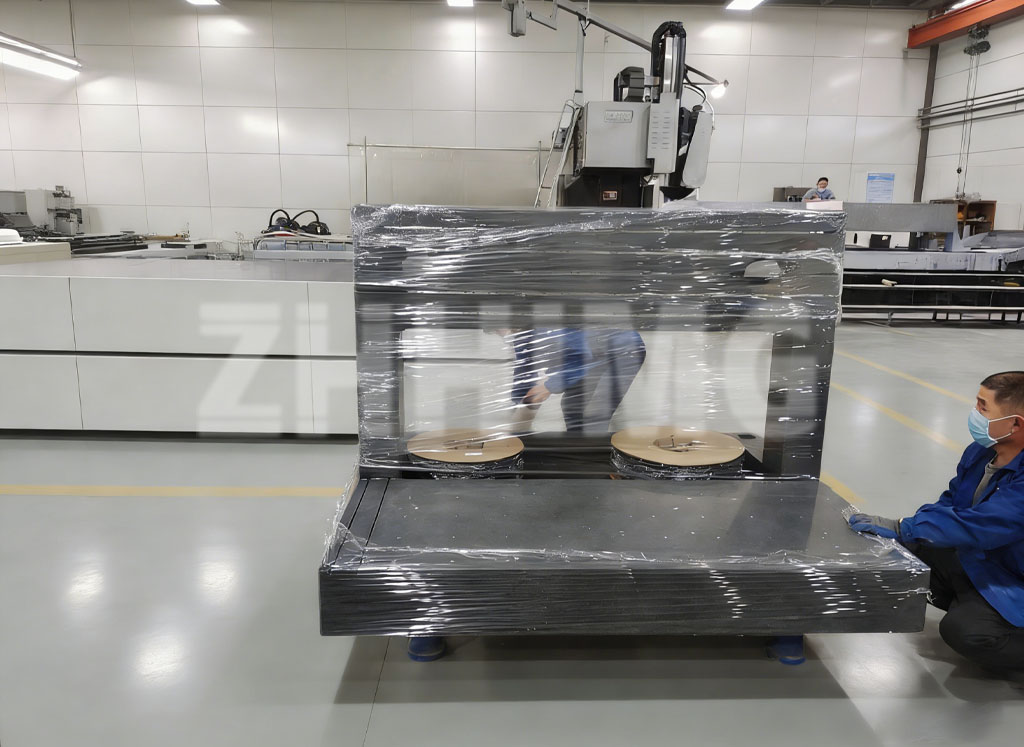
Typical Applications
UHPC suits large structures where mass, stiffness and cast-in features count more than a lapped stone surface.
- Machining centers and gantry mills. Columns, long beams and side walls, as in the commercial gantry machines mentioned above. These parts are large and heavy, and a cast shape can include internal ribs.
- Machine beds for milling, turning, grinding and eroding. A machine-bed producer lists these machine types as typical uses for its UHPC beds (RAMPF Machine Systems).
- Hybrid structures. UHPC or similar fill compounds poured into welded steel frames or cast-iron beds to add mass and damping. A machine-materials supplier describes this approach for large gantry machining centers and grinding machines (TOMITA).
- Large machine bases and frames for automation and test equipment, where the structure must be heavy and rigid and the design calls for many mounting points.
For equipment that needs a measuring-grade reference surface, such as CMMs, optical inspection and semiconductor metrology, a granite base is usually the safer choice. A hybrid design can also pair a cast structure with a separate granite or ceramic reference element.
Design and Manufacturing Considerations
Most problems with cast machine bases come from details that were not specified, not from the material itself. These are the points to settle with the supplier before production.
- Reference faces. Decide which surfaces are datum and guideway surfaces. A cast surface is not enough for these, so plan for machining, grinding or bonded steel or stone elements, and state the flatness and parallelism you need on the drawing.
- Inserts and mounting points. Define thread sizes, positions, pull-out loads and whether inserts are cast in or installed afterward. Cast-in inserts need a clear load path into the structure. Our note on threaded inserts in machine bases covers the main questions, and our insert range shows the standard and custom options.
- Reinforcement and fibers. Agree whether the part uses steel fibers only, or fibers plus rebar or an embedded steel frame, and where lifting points sit.
- Curing and aging. Shrinkage and residual stress settle over time. Ask how the part is cured (some UHPC mixes are heat-cured), how long it rests before final machining, and whether the dimensions are rechecked afterward.
- Wall thickness, weight and handling. UHPC parts are heavy. Check lifting, transport and floor loading early, and confirm minimum wall thickness for the mold.
- Inspection. Agree how flatness, straightness, squareness and hole positions will be measured, with which equipment, and how the instruments are calibrated and traceable.
The more of this that is on the drawing and in the purchase specification, the fewer rounds of questions come before a quotation.
How to Specify a UHPC Machine Base: RFQ Checklist
Send the items below with your enquiry and a supplier can usually quote in one round. If you also need a granite or ceramic part, our custom machine base RFQ checklist follows the same logic.
- 2D drawing and 3D model, with revision number
- Overall dimensions and target weight
- Load cases: payload, moving mass, accelerations and mounting points
- Datum and guideway faces, with flatness, parallelism and squareness tolerances stated on the drawing
- Insert positions, thread sizes and pull-out requirements
- Required damping or vibration performance, and how it will be tested
- Operating temperature range and environment
- Steel frame, plates or other hybrid elements, if any
- Inspection method, instruments and report format
- Quantity, delivery schedule and packaging or shipping requirements
- Applicable standards and certificates
FAQ
Is UHPC the same as mineral casting?
No. UHPC is bonded with cement, while mineral casting (polymer concrete) is bonded with epoxy or other resins. Both are cast, but their damping, curing and finishing behavior differ, so each needs its own test data.
Can a UHPC base replace a granite base?
It depends on the role of the base. If the base is the measuring reference and needs a lapped surface, granite is normally preferred. If it is a large structural part with cast-in features, UHPC can be a strong candidate.
Does UHPC damp vibration better than cast iron?
The published evidence for strong damping mostly concerns resin-bonded polymer concrete. For UHPC, damping depends on the mix and the steel fibers, so ask for measured data on your own structure instead of relying on general claims.
Can UHPC parts be machined?
Yes. Reference faces and bores can be machined or ground, but the material is hard, so the process and tooling need to be planned for it. Confirm the finishing route and the tolerances it can reach with your supplier.
What drawings does a supplier need to quote a UHPC machine base?
A dimensioned drawing with tolerances, the insert layout, load and environment information, and the inspection requirements. The checklist above lists everything in one place.
Work With ZHHIMG on a UHPC Machine Base
ZHHIMG makes custom precision structures in granite, ceramic, metal, mineral casting and UHPC, so we can help you compare materials for your design instead of pushing a single one. Send us your drawing and requirements and our engineers will tell you which material and process fit, and which details to fix before quotation.
- See our UHPC solutions, tailor-made UHPC (RPC) and UHPC machine bed pages.
- Read the UHPC FAQ and our mineral casting page if you are weighing the two.
- Our quality system is certified to ISO 9001, ISO 14001 and ISO 45001, and our inspection instruments carry calibration certificates traceable to national standards.
Request a quotation: email info@zhhimg.com, message us on WhatsApp at +86 199 6999 1659, or use the contact page. Please include your drawing, tolerances and quantity.
Post time: Oct-22-2026