
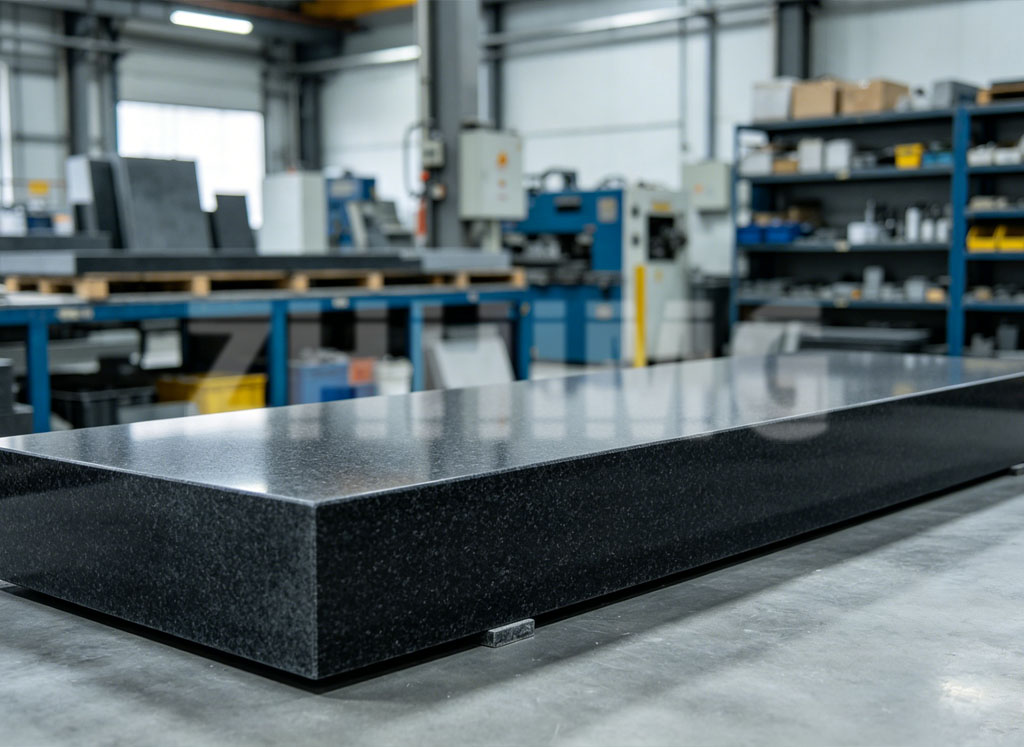
When a quality engineer orders a granite surface plate rated to “Grade 0″ or “Grade 00,” they are purchasing more than a flat piece of stone. They are purchasing a documented, certified, and traceable reference — one whose accuracy underpins every measurement made against it. But what do these grade designations actually mean? How is flatness at the sub-micron level measured and verified? And why do the standards issued by Germany’s DIN committee, the American Society of Mechanical Engineers, Japan’s JIS, the British Standards Institution, and other national bodies differ in their specifications — even when they are all trying to define the same physical property?
These are not merely academic questions. For a procurement engineer selecting a surface plate for a calibration laboratory, an equipment designer specifying a CMM datum table, or a quality manager auditing a supplier, understanding the substance behind the certification marks is essential. A grade designation without understanding what it means, how it was measured, and against which standard it applies is not a quality guarantee — it is a label.
What “Flatness” Actually Means in Precision Metrology
Flatness, in the context of precision surface plates, has a specific technical definition that differs from colloquial usage. A surface is defined as flat to a specification if all points on that surface fall within two parallel reference planes separated by the specified flatness tolerance.
This definition has important implications. First, it is a global specification — it applies to the entire surface, not just selected points. A surface plate that is perfectly flat in its center but curves slightly toward the edges fails a global flatness specification, even if any local region appears flat when checked with a short test indicator sweep. Second, the tolerance value specifies the width of the zone between the two bounding planes, not the deviation from a nominal dimension. Third, the measurement methodology used to verify flatness must itself be traceable — meaning the measurement instruments used have calibration certificates linking their accuracy back through an unbroken chain to a primary national or international measurement standard.
At the level of precision required for grade 00 surface plates (sometimes called laboratory grade), tolerances fall in the range of 1–3 micrometers over the working surface. Achieving measurements at this level of accuracy requires laser interferometry, electronic autocollimators, or precision electronic levels — conventional dial gauges or test indicators are not capable of resolving these tolerances reliably.
The Major International Standards for Granite Surface Plates
DIN 876 (Germany)
The German Institute for Standardization (Deutsches Institut für Normung) published DIN 876 as the specification governing precision surface plates used for testing and measuring purposes. This standard defines four accuracy grades:
- Grade 3 (Workshop Grade): The least precise grade, intended for general workshop use where moderate accuracy is sufficient.
- Grade 2 (Workshop Grade): Intermediate precision for workshop inspection and layout work.
- Grade 1 (Inspection Grade): High accuracy suitable for quality control and inspection laboratories.
- Grade 0 (Precision Grade): Very high accuracy for precision measurement and calibration work.
- Grade 00 (Reference Grade): The highest grade, reserved for calibration laboratories, standards rooms, and applications where a surface plate serves as a primary measurement reference.
DIN 876 specifies flatness tolerances as a function of the plate’s nominal dimensions, with tolerances tightening for larger plates (since maintaining uniform flatness over a larger area is geometrically more demanding). It also specifies requirements for surface finish, edge quality, material (granite must meet specified density and hardness criteria), and the environmental conditions under which measurement must be performed.
DIN 876 is widely used throughout European industry and is accepted as a reference standard in many non-European markets as well. Many international suppliers of precision equipment specify DIN 876 grades when defining surface plate requirements in their equipment documentation.
ASME B89.3.7 (United States)
The American Society of Mechanical Engineers standard B89.3.7 is the primary U.S. standard for granite surface plates. It defines three grades:
- Grade Laboratory: Highest accuracy, equivalent to approximately DIN Grade 00.
- Grade Inspection: Intermediate accuracy, approximately equivalent to DIN Grade 0–1.
- Grade Tool Room: Lower accuracy for production floor inspection use.
ASME B89.3.7 differs from DIN 876 in several methodological details. It uses the “repeat reading” method for flatness measurement — where an electronic level or autocollimator is traversed across the surface in a specific pattern of lines, and the readings are mathematically processed to reconstruct the surface form. The standard specifies the exact traversal pattern and data processing method, making measurements according to ASME B89 reproducible between different laboratories and measurement systems.
ASME B89.3.7 also addresses measurement uncertainty explicitly, requiring that the uncertainty of the flatness measurement itself be demonstrated to be a sufficiently small fraction of the tolerance being verified. This requirement prevents the common error of using measurement instruments that are themselves too imprecise to meaningfully verify the specification being checked.
JIS B 7513 (Japan)
The Japanese Industrial Standard JIS B 7513 follows a grade structure (Grade 0, Grade 1, Grade 2, Grade 3) with flatness tolerances that are broadly comparable to the DIN 876 system. Japanese industrial practice places particular emphasis on measurement repeatability and the qualification of measurement personnel, reflecting a manufacturing culture where process consistency and human skill are both considered critical quality factors.
JIS B 7513 is widely referenced by Japanese equipment manufacturers including THK, HIWIN, NSK, and Mitutoyo — companies whose linear guides, precision bearings, and measuring instruments are distributed globally. Equipment designers working with components from Japanese suppliers will often encounter JIS B 7513 surface plate specifications in assembly and calibration documentation.
BS 817 (United Kingdom)
British Standard BS 817 was published by the British Standards Institution and governs surface plates and tables for engineering purposes. Like DIN 876, it defines multiple grades and specifies both flatness tolerances and material requirements. BS 817 is referenced in aerospace and defense manufacturing contexts in the UK and in countries that retain strong historical ties to British standards frameworks.
GOST 10905 (Russia)
The Russian federal standard GOST 10905 specifies granite and cast iron surface plates for general-purpose measurement and inspection. It is the primary reference in Russian industry and in the engineering sectors of countries that historically adopted Soviet-era industrial standards. For suppliers working with Russian or Eastern European customers, GOST certification can be a formal procurement requirement.
GB/T 4167 (China)
China’s national standard GB/T 4167 specifies surface plates and tables for general measurement purposes. The grade structure and tolerance values are largely harmonized with the major international standards, reflecting China’s integration into global manufacturing supply chains.
How Flatness Is Actually Measured: Methodology in Practice
Specifying a flatness grade is one thing; verifying it through actual measurement is another. Several measurement methods are used in practice, each with different capabilities and limitations.
Electronic Level Grid Method
The most common method for verifying surface plate flatness in production settings uses a high-precision electronic level (such as those manufactured by WYLER of Switzerland or Mahr of Germany) traversed across the surface in a grid pattern. Readings are taken at defined intervals along a series of lines crossing the surface in both directions, as well as along the diagonals. The resulting dataset is mathematically processed — using techniques such as least-squares plane fitting — to determine the minimum zone that contains all surface points.
This method is practical, relatively fast, and can be performed with instruments that are themselves traceable to national standards through a clear calibration chain. Electronic levels with resolutions of 0.1 arcsecond (corresponding to approximately 0.05 μm/m sensitivity) can resolve flatness variations at the sub-micron level. This is the standard method specified in ASME B89.3.7 and is widely accepted under most other national standards.
Laser Interferometry
For the highest accuracy applications — laboratory grade plates and precision component surfaces used in semiconductor or optical equipment — laser interferometry provides the most accurate flatness measurement. A laser interferometer projects a highly coherent light beam across the surface being measured. Variations in surface height create path-length differences in the reflected beam that produce interference fringes, which can be analyzed to reconstruct a detailed height map of the entire surface.
Modern laser interferometers used in precision metrology — such as those manufactured by Renishaw (UK) — can achieve measurement uncertainties well below 100 nanometers. This capability is essential for verifying the flatness of surfaces used as reference elements in semiconductor lithography equipment, where measurement uncertainties must be small enough that they do not contribute meaningfully to the total error budget of the system.
Autocollimator Method
An autocollimator projects a beam of light onto a mirror target placed on the surface being measured, and detects the angular orientation of the mirror (and hence the local slope of the surface) by analyzing the return beam. By traversing the mirror target across the surface in a systematic pattern and integrating the slope readings, a surface height profile can be reconstructed. Autocollimators with resolution in the range of 0.01 arcseconds provide a practical alternative to interferometry for measuring flatness over large surface areas.
The Measurement Environment: Why Controlled Conditions Matter
One of the most overlooked aspects of surface plate flatness measurement is the environmental control required to obtain valid results. A granite surface plate is not an inert solid block — it is a thermal system that responds to heat inputs from its surroundings, from contact with other objects, and even from the body heat of the person measuring it.
A 1-meter granite plate with a CTE of 7 × 10⁻⁶ /°C will expand by 7 micrometers in length for each 1°C rise in temperature. If one part of the plate is 0.5°C warmer than another — for example, because one end is closer to an HVAC supply vent — the resulting thermal gradient will distort the surface by several micrometers, masking or mimicking actual geometric errors.
Serious precision metrology laboratories address this through strict environmental control:
- Temperature stabilized to ±0.1°C or better around a reference value of 20°C (the international reference temperature for dimensional measurement per ISO 1)
- Humidity controlled to prevent moisture absorption or evaporation from the granite surface
- Vibration isolation to prevent floor vibrations from coupling into the measurement system
- Prohibition of direct contact between the surface plate and any object not at thermal equilibrium with the room
The standard ASME B89.6.2 specifically addresses environmental conditions for precision measurement and should be consulted alongside B89.3.7 when setting up a metrology environment.
Anti-vibration trenches surrounding the measurement facility — filled with appropriate damping materials and designed to interrupt the propagation of ground-borne vibration — further protect the measurement environment. Facilities conducting the most critical measurements also specify silent-running overhead cranes that do not transmit mechanical impulses to the floor structure when operating.
Calibration Traceability: The Chain That Validates Everything
A surface plate certification is only as meaningful as the calibration chain behind the instruments used to measure it. This concept — traceability — is fundamental to modern metrology and is codified in international standards such as ISO/IEC 17025, which governs the competence of testing and calibration laboratories.
Traceability works as follows: the electronic level or laser interferometer used to measure a surface plate must itself have been calibrated against a reference standard that is more accurate than the instrument. That reference standard must in turn have been calibrated against a yet more accurate standard — and so on, up through a chain that terminates at a primary measurement standard maintained by a national metrology institute (NMI), such as PTB in Germany, NIST in the United States, NPL in the UK, or NIM in China.
Each link in this chain is documented with a calibration certificate that specifies what was measured, the result, the measurement uncertainty, and the reference standard used. A complete traceability chain allows any measurement result — including the flatness certification of a surface plate — to be connected, through documented evidence, to primary physical standards that define the meter and other SI units.
For buyers of precision granite components and surface plates, verifying this traceability chain is not bureaucratic formality — it is the technical validation that the grade designation on a certification document corresponds to a real, measurable property of the component, verified by instruments whose accuracy is itself verified.
Practical Implications for Equipment Designers and Procurement Engineers
Understanding flatness standards has direct practical implications for those specifying precision granite components:
Match the grade to the application. A grade 0 surface plate is more than adequate for most production inspection tasks. Specifying grade 00 for an application that doesn’t require that level of accuracy adds cost without adding measurement capability. Conversely, specifying grade 1 for a CMM datum table in a precision calibration laboratory creates a systematic measurement error that will invalidate all work performed on that machine.
Specify the standard explicitly. “Grade 0 granite surface plate” is an incomplete specification if the applicable standard is not named. DIN 876 Grade 0 and ASME B89 Grade Inspection have similar but not identical flatness tolerances. For international supply chains, always specify which national or international standard governs the grade designation.
Require complete calibration documentation. A certificate should identify the measurement method used, the environmental conditions during measurement, the specific instrument used and its calibration certificate number, and the calculated flatness value with measurement uncertainty. A certificate that states only “meets Grade 0″ without this supporting information does not demonstrate traceability.
Consider measurement interval. Granite surface plates are not permanently stable — they can develop wear in heavily used areas, and their flatness should be periodically re-verified. ASME B89.3.7 provides guidance on re-qualification intervals based on frequency of use and the criticality of measurements performed.
Conclusion: Standards as a Foundation for Trust
Flatness standards for precision granite surface plates are ultimately a system of trust — a shared technical language that allows a buyer in Singapore and a manufacturer in Germany (or China) to agree on exactly what a specification means, how it was verified, and what measurement uncertainty it carries. Understanding this language — the grades, the standards, the measurement methods, and the traceability chain — is what transforms a procurement decision from a leap of faith into an engineering judgment supported by documented evidence.
For applications where measurement accuracy determines product quality, this foundation is not optional. It is the invisible infrastructure on which precision manufacturing rests.
Post time: Jun-26-2026