
For semiconductor production lines, the requirements for AOI optical inspection go far beyond simple appearance defect identification. In processes such as chip packaging and wafer inspection, AOI systems continuously capture micron and even sub-micron defects. As the carrier benchmark for the entire optical system, the overall performance of the base directly determines inspection yield and long-term equipment reliability. After comparing various base materials including cast iron, aluminum alloy and mineral castings during material selection, many semiconductor equipment manufacturers finally choose ZHHIMG® granite for AOI equipment bases. Its strengths do not lie in one outstanding indicator alone, but form a comprehensive precision assurance system tailored to the special working conditions of semiconductor production lines.
Semiconductor workshops feature 24/7 continuous equipment operation, with densely arranged automation equipment that constantly generates minor disturbances. The stability of many materials can only meet standards under short-term, ideal laboratory conditions, and weaknesses emerge after long-term operation. ZHHIMG® black granite undergoes thorough stress relief treatment. Its dense and uniform internal structure avoids the internal stress rebound commonly seen in metals. When the AOI equipment carries optical lenses and linear motor modules under load year-round, the base will not slowly warp or deform. The reference plane can maintain its original precision for a long time, which is critical for continuous production in semiconductor factories.
Optical inspection is most vulnerable to “coupled errors” of the reference benchmark. Many people only focus on vibration reduction while ignoring compound deviations caused by the superposition of thermal disturbance and vibration. Although semiconductor production lines are equipped with constant-temperature workshops, heat generated by moving equipment and local airflow fluctuations still create tiny temperature differences. Metal bases have a high thermal expansion coefficient. Minor temperature changes lead to dimensional shifts. Once the reference surface deforms, the vibration suppression effect will be greatly compromised. ZHHIMG® granite features low thermal expansion, isolating benchmark drift caused by temperature fluctuations. It ensures vibration control and optical calibration results will not be offset by thermal deformation, preventing two types of errors from interfering with image capture at the source.
Assembly adaptability is another underrated advantage of granite bases for semiconductor AOI applications. The optical brackets, XY motion platforms and light source modules inside AOI equipment have complex structures, requiring numerous special-shaped grooves, dowel holes and countersunk holes machined into the base. Supported by large CNC machining equipment and senior lapping teams, ZHHIMG Group can perform integrated custom processing according to semiconductor equipment drawings. After machining, full verification is carried out with traceable metrology tools such as laser interferometers and electronic levels to ensure hole positions, flatness and perpendicularity meet assembly requirements simultaneously. Uniform stress on installed optical components reduces extra shaking induced by assembly stress and stabilizes the optical path.
Dust-free cleanliness is a mandatory requirement for semiconductor workshops, another major benefit of granite over metal bases. During long-term reciprocating vibration and component friction, steel and aluminum alloys produce tiny metallic debris. Once these particles drift onto optical lenses and image sensors, they create image stains and trigger massive false detections. Granite boasts stable chemical properties. It will not rust or easily generate particulate contaminants, fully compatible with semiconductor cleanroom environments. Even after long-term use in clean workshops, it will not contaminate the core optical components of AOI devices and reduces equipment cleaning and maintenance frequency. 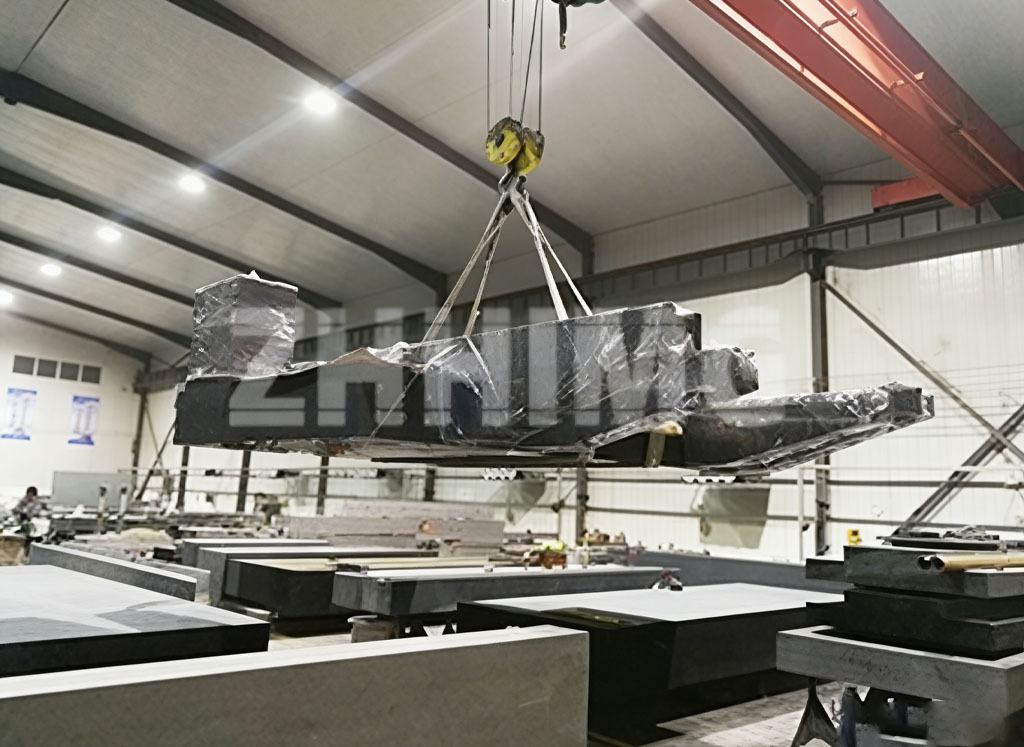
Granite bases are also competitive in terms of full-lifecycle costs. The precision of ordinary metal bases degrades noticeably after a period of service, requiring engineers to stop production lines frequently for recalibration and reference surface rework, which occupies valuable production time in semiconductor plants. ZHHIMG granite has excellent wear resistance. Its reference surface suffers minimal precision degradation over time, greatly cutting downtime for calibration. For semiconductor factories, less maintenance downtime means higher production capacity utilization.
The core value of granite bases for semiconductor AOI equipment is far more than serving as a high-rigidity load-bearing foundation. With long-term dimensional stability, low thermal deformation, contamination-free performance and customizable ultra-precision machining, ZHHIMG® granite adapts to the harsh 24/7 continuous operating environment of semiconductor workshops. It provides a stable and reliable geometric benchmark for sub-micron optical defect inspection and stands as the preferred base solution for high-end semiconductor AOI equipment.
Post time: Oct-12-2026