
In equipment such as semiconductor inspection machines, coordinate measuring systems and linear motor platforms, granite support blocks undertake critical functions including load‑bearing, leveling and reference positioning. Many buyers focus heavily on product selection and procurement yet overlook post‑delivery maintenance. Even with premium base materials, improper operation and poor maintenance may trigger precision drift and edge chipping, shortening the service life of components. Drawing on abundant overseas project experience, ZHHIMG sorts out full‑cycle maintenance tips for granite support blocks from a practical perspective, helping customers preserve reference accuracy of equipment and maximize component service value.
Boasting high hardness and outstanding compression resistance, granite support blocks still feature micro‑pores inside the stone matrix and brittle edges. Improper operations may cause irreversible damage. Daily maintenance mainly covers five key dimensions: surface cleaning, working‑condition environment control, regular inspection of supporting points, handling & storage protection, and troubleshooting for common faults. Each item directly affects the long‑term stability of support blocks.
Surface cleaning lays the foundation of maintenance. The core principle is to avoid scratches and corrosive agents. Before operation, remove dust and metal debris with dust‑free soft brushes or dust‑free cloths. Fine particles, when rubbed against working surfaces, will generate invisible micro‑scratches that gradually impair flatness of reference surfaces. For oil stains, apply neutral stone‑specific cleaner or anhydrous alcohol onto dust‑free cloth for gentle wiping. Thoroughly wipe off residual liquid right after cleaning. Do not allow liquid to linger on stone surfaces, or water spots and whitening may occur due to liquid penetration into micro‑pores. Steel wool, sandpaper and hard scrapers are forbidden for surface treatment. Strong acids, alkalis and bleaching detergents must also be avoided, as these chemicals erode stone crystal structures and lead to permanent precision loss.
Environmental control serves as an invisible safeguard to slow precision degradation of granite support blocks. Stable temperature is preferred for working conditions. Sudden local temperature changes shall be avoided. Keep components away from welding heat sources and direct high‑temperature work‑piece radiation; local high temperature will induce thermal stress and hidden deformation risks. Keep clear of strong vibration sources, for continuous vibration impacts supporting points and alters stress distribution. Ventilate and prevent moisture in humid environments, since high humidity accelerates rusting of matched metal leveling parts and indirectly changes stress status of support blocks. Superior material performance does not mean tolerance for harsh operating conditions. A stable environment greatly cuts down re‑calibration frequency.
Periodic inspection of supporting points is frequently neglected by end‑users. Granite support blocks realize uniform force distribution via leveling bases and shock‑absorbing pads. Long‑time equipment operation with vibration may loosen locking nuts and displace gaskets, resulting in suspended single‑point loading. Sustained local stress will gradually produce internal micro‑cracks inside stone and modify overall equipment reference status. Set inspection cycles according to on‑site conditions: monthly checks for heavily‑vibrating production lines and quarterly re‑verification for ordinary laboratories. Confirm even force on all supporting points without clearance or displacement. Re‑level timely once deviation appears. Do not drill or grind support blocks arbitrarily. Non‑factory processing breaks internal stress balance of stone and ruins original precision. 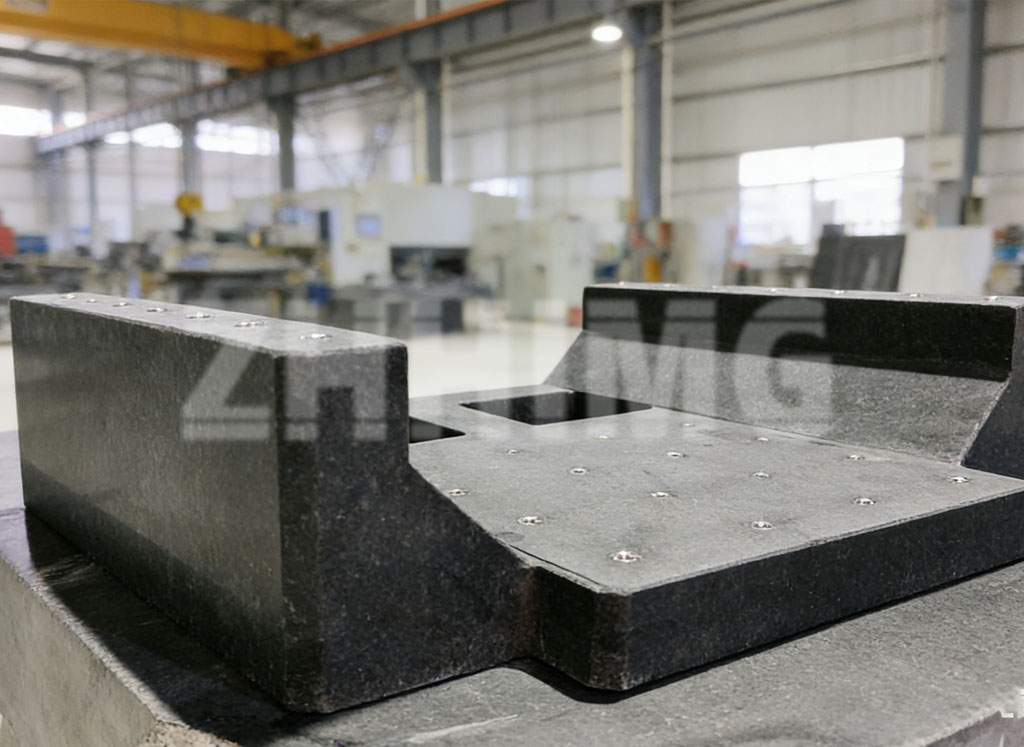
Protection during handling and storage also matters greatly. Granite edges are brittle and prone to chipping upon collision. Never drag or strike edges during disassembly and transportation. Ensure even force in hoisting operations and prevent single‑point impact. For short‑term idle storage, clean surfaces thoroughly and cover with dust‑proof shields on flat dry platforms. For long‑term storage, stay away from damp ground. Do not place components directly on wet floors. Avoid long‑term heavy‑weight local compression which may cause performance shift from uneven stress.
Treat minor on‑site faults properly. Wipe oil contamination promptly before penetration. Do not polish or grind surfaces by yourself when shallow micro‑scratches emerge. Once chipping, cracks or out‑of‑tolerance flatness occur, refrain from on‑site self‑repair. Contact the original manufacturer for factory‑return grinding service to prevent further damage caused by improper handling.
Many users regard granite components as maintenance‑free parts and ignore after‑sales care after purchase. In fact, the precision service life of precision granite support blocks results from high‑quality raw materials, sophisticated manufacturing and scientific maintenance. As an ultra‑precision component manufacturer holding ISO triple‑system certificates, CE certification and more than 20 international trademarks and patents, ZHHIMG attaches great importance to delivering standardized operation and maintenance guidance for global clients besides high‑quality products. We supply a full range of precision components including granite support blocks, granite bases and air‑bearing guide substrates, together with supporting application instructions for partners. We help customers from semiconductor, metrology research, new‑energy and other industries cut operating costs and secure long‑term stable performance of complete equipment.
Post time: Aug-18-2026