
ZHHIMG® precision granite surface plates serve as benchmark tools for metrology and optical inspection, featuring nano-level lapped reference surfaces. When facing oil stains and metal residues, many workshop operators tend to apply cleaning methods used for ordinary machinery. However, the finely lapped working surface of precision granite plates is unique. Many seemingly efficient cleaning approaches may cause irreversible damage to precision. Such damage is not always visible to the naked eye immediately, yet it continuously impairs flatness and creates hidden risks of measurement error. Understanding prohibited cleaning practices is essential to protect the reference surface.
First of all, all hard abrasive cleaning tools are strictly forbidden. When confronting stubborn stains, some operators use steel wool, abrasive scouring pads, stiff brushes or sandpaper for aggressive scrubbing to quickly remove contaminants. Nevertheless, the reference surface of granite plates is finished by nano-precision manual lapping. Any abrasive tools will leave countless micro-scratches on the stone surface. These tiny scratches alter optical reflection of the flat surface and form micro-grooves that trap dust and oil, making future cleaning harder. Once scratches spread across the working surface, qualified flatness specifications will fail. The plate must be sent back to ZHHIMG Group for re-lapping, which raises maintenance cost and equipment downtime significantly.
Secondly, strong acid and alkaline chemical cleaners must never touch the working surface directly. Toilet cleaners, rust removers, bleach, caustic soda, vinegar and citrus stain removers are commonly misused on site. Although ZHHIMG black granite has a dense overall texture, micro gaps still exist between internal mineral crystals. Strong acids and alkalis erode crystal boundaries, causing whitish etching marks and local depressions. Even after rinsing and drying, deformation caused by chemical corrosion cannot be restored, permanently damaging local flatness of the benchmark. Unlike scratches, this type of damage destroys stone crystals and is far harder to repair.
Thirdly, highly volatile industrial solvents cannot be used for large-area wiping. Acetone, banana oil and heavy-duty adhesive removers are often applied to eliminate glue or paint marks. These solvents penetrate stone micropores rapidly and dissolve minor protective components formed during production. Long exposure alters surface stress and triggers subtle local deformation. Meanwhile, heat loss during solvent evaporation creates sharp local temperature changes and temporary flatness distortion. Solvent residues attract workshop dust and form recurring dark stains, interfering with visual inspection and metrology readings.
Fourthly, high-pressure washing and pouring large volumes of liquid directly on the plate must be prevented. Some operators spray water directly or spray undiluted detergent onto granite plates before wiping. Large amounts of liquid seep into stone micropores and accumulate inside the slab. Slow moisture release triggers minor expansion and shrinkage. Repeated wet-dry cycles gradually amplify flatness deviation. Besides, water carries grit from the workshop onto the surface. The particles act as abrasives during wiping and cause secondary scratches on the precision reference plane. The proper practice is to dampen lint-free soft cloth with neutral cleaning solution for gentle wiping instead of pouring liquid directly on the slab. 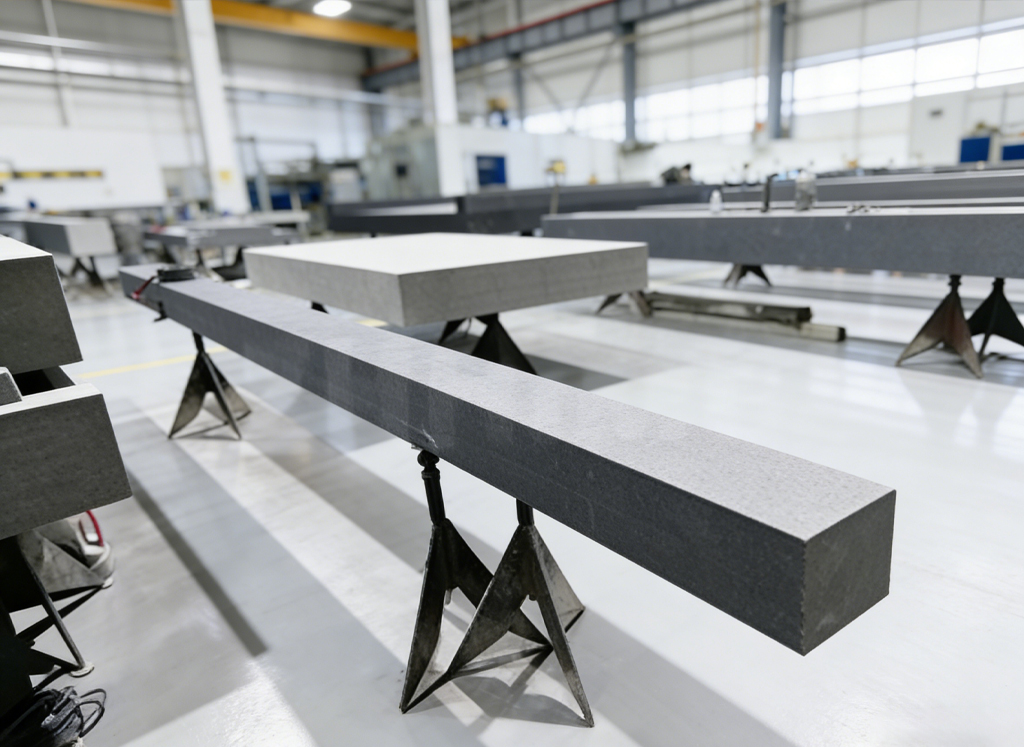
Another often-overlooked mistake is using all-purpose scouring powder containing abrasive grains. These powders include fine mineral abrasives. Wiping with scouring powder equals secondary lapping on the plate. Even fine powder will gradually wear down the benchmark surface after repeated use and slowly degrade flatness. No obvious change appears in the short term, yet prolonged use leads to flatness deterioration and impairs metrology benchmarks for AOI and CMM machines.
In summary, the core principle of stain removal for precision granite surface plates is not “removing stains forcefully”, but cleaning without damaging the nano-lapped reference surface. ZHHIMG Group’s precision granite plates undergo stress relief and ultra-precision lapping before delivery. Improper cleaning will compromise factory-grade high precision. For stubborn stains, use lint-free soft cloth and stone-specific neutral cleaner for gentle treatment. For hard-to-remove contaminants, consult the manufacturer for professional solutions rather than attempting aggressive cleaning by yourself, to maintain long-term stability of the benchmark plane.
Post time: Oct-12-2026