
During the iterative upgrading of automated inspection and motion platforms, manufacturers keep pursuing faster scanning speed, higher repeat positioning accuracy and stable long-term operation. Many equipment manufacturers have tried various structural substrates such as aluminum alloy, cast iron and mineral casting. However, under micron and nanometer-level working conditions, they repeatedly encounter precision drift, vibration noise, thermal deformation and other tough issues. With rich manufacturing experience in ultra-precision granite components, ZHHIMG Group (ZHHIMG®) introduces granite bases, beams, substrates, square boxes and other components into the design of automated equipment, targeting several core pain points of automated equipment in high-speed motion and continuous inspection scenarios.
Dimensional deformation caused by temperature change is the most common problem of automated precision equipment. Metal materials have relatively high thermal expansion coefficients. Slight temperature rise from day-night temperature difference on the production line, motor heating and light source radiation will lead to expansion and contraction of the platform substrate. On long-travel XY automated platforms, such deformation will directly convert into probe positioning error, offset workpiece inspection data and require frequent shutdown for recalibration. Granite features an extremely low thermal expansion coefficient. Dimensional changes triggered by temperature fluctuation are far smaller than those of metallic materials. Under 24-hour continuous operation on production lines, granite components can suppress benchmark drift caused by thermal expansion and cold contraction, reduce zero-point calibration frequency of sensors and probes, and guarantee consistency of continuous inspection on automated production lines.
Vibration and resonance interference generated during high-speed reciprocating motion have long troubled automated optical inspection equipment. When automated modules start, stop, accelerate and decelerate, structural vibration will be excited. Once vibration transfers to sensors, cameras and probes, blurred images, jittering measurement signals and poor repeatability will follow. Although cast iron has certain vibration damping capacity, it is relatively heavy and not suitable for lightweight high-speed mechanisms. Aluminum alloy boasts good rigidity but weak damping, so vibration decays slowly. Granite has excellent internal damping performance, which can quickly absorb and dissipate micro-vibration generated by movement and restrain resonance amplification. In AOI on-line inspection, automated contour scanning and semiconductor sorting equipment, granite bases act as vibration buffering carriers to stabilize optical imaging and measurement signals and improve inspection yield.
Benchmark creep deformation under long-term continuous load is an easily overlooked problem on automated production lines. Automated equipment runs nonstop all year round, and static and dynamic loads are continuously applied by guide rails, linear motors, camera brackets and other components. Cast iron carries creep risks under long-term force, while aluminum alloy tends to have stress rebound. After a period of operation, the flatness of the platform benchmark slowly deteriorates, the precision of equipment declines year by year, and maintenance costs rise. ZHHIMG granite components processed with complete stress aging have pre-released internal stress. The material itself will not undergo plastic deformation over time. Even in factory environments with constant temperature or slight fluctuations, the geometric shape of the reference surface can remain stable for a long time, extending the precision service life of automated equipment and reducing the cost of complete machine overhaul and benchmark rework.
The benchmark chain misalignment caused by multi-module integration can be solved by integrated granite machining. Modern automated equipment often integrates multiple cameras, sensors, air-floating guide rails, wiring grooves and vacuum suction interfaces, requiring a large number of holes and grooves processed on the same benchmark carrier. If spliced metal structures are adopted, the accumulated geometric tolerance of multiple parts will easily lead to non-concentricity and non-coplanarity between guide rail benchmarks and detection benchmarks, increasing debugging difficulty. Granite can complete grooving, drilling and counterboring finishing in one piece. All assembly features are machined based on the same main reference surface to ensure unified geometric tolerances among mounting benchmarks of holes, grooves and guide rails. During complete machine assembly, each motion module can be directly positioned and installed, greatly reducing the accumulated benchmark error brought by multi-component assembly and shortening the debugging cycle of automated equipment.
Benchmark failure caused by dust and oil erosion on production lines is also a practical problem for automated equipment. Cutting dust, cooling liquid and lubricating oil splash in factory environments, which easily adhere to metal reference surfaces and cause rust and wear and damage benchmark precision. After micro-pore sealing protection, granite is not prone to rust, with dense and smooth surfaces. Contaminants are hard to penetrate into the substrate. Simple wiping during daily maintenance can restore the state of the reference surface. It is suitable for long-term use in automated production lines, clean workshops, new energy detection production lines and other working conditions, avoiding permanent benchmark damage caused by metal rust.
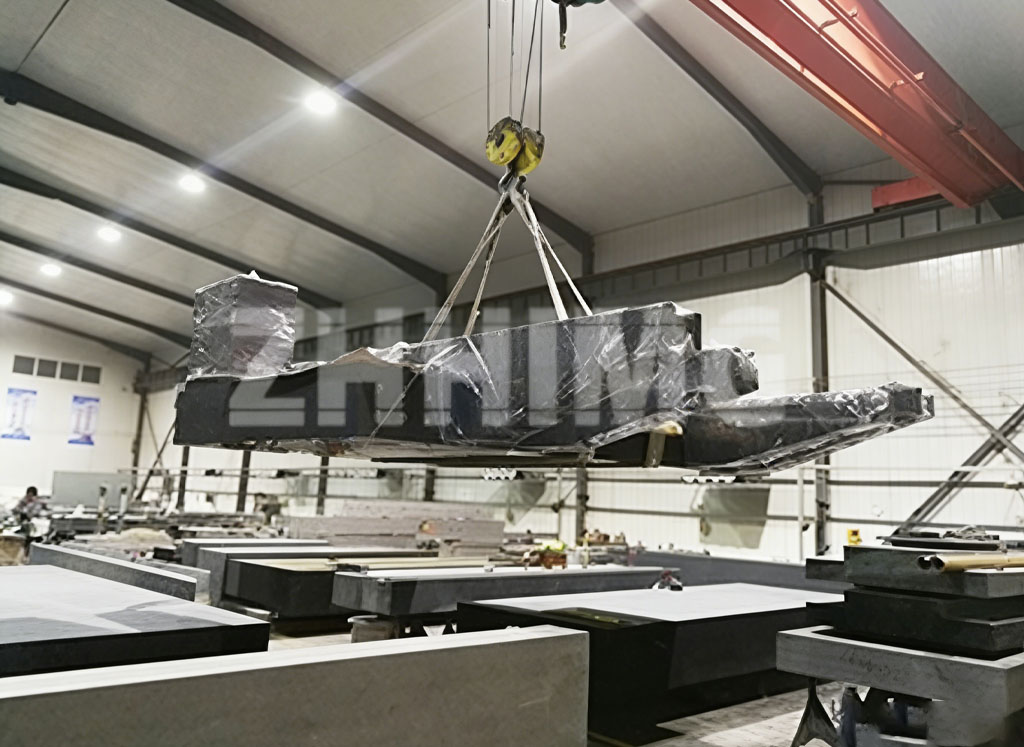
Granite can also provide a better solution for the selection dilemma between structural rigidity and self-weight. The design of many automated equipment falls into a dilemma: insufficient material rigidity leads to large deflection under high-speed movement; adopting heavy metal parts for high rigidity increases the overall weight, raises driving load, energy consumption and accelerates wear of moving parts. Granite has a high elastic modulus. Under the same rigidity index, self-weight can be reduced compared with cast iron. Combined with motion simulation of automated equipment, ZHHIMG engineers optimize the structural layout of bases and beams and reasonably design weight-reducing cavities. While maintaining structural rigidity, the overall weight is controlled to reduce the load pressure on linear motors and guide rails and extend the service life of moving components.
Automated precision equipment has rising requirements for benchmark stability, vibration resistance and environmental adaptability. Adopting precision granite components can targetedly solve a series of core problems including thermal deformation, vibration interference, long-term creep, accumulated benchmark error of multi-modules, medium corrosion and imbalance between rigidity and self-weight. ZHHIMG Group continuously supplies granite bases, beams and substrates for AOI automatic inspection, semiconductor sorting, lithium battery online inspection and precision assembly automation platforms, helping automated equipment maintain high-precision stable operation for a long time and cut production line maintenance costs.
Post time: Oct-13-2026