
Three different materials that are often confused
Before any comparison, the terms have to be separated, because they are routinely mixed up in enquiries and even in supplier literature:
- Natural granite: a quarried stone, sawn and lapped. Its structure is what the quarry produced — no binder, no casting, no cure cycle.
- Mineral casting (also called epoxy granite, polymer concrete or granite polymer): a composite of graded mineral aggregate bound in an epoxy or similar resin matrix, poured into a mould and cured. The aggregate is stone, but the material is manufactured, and its properties depend on the mix design.
- Cast iron: a molten metal poured into a mould, then stress-relieved. It is machinable, weldable in some grades, and has been the default machine bed material for over a century.
So a mineral casting machine bed is not a granite bed with a different finish. It is a cast composite whose damping, stiffness and thermal behaviour come from the aggregate grading, the binder content and the wall design — all of which are engineered and repeatable.
Comparing the three on the properties that matter
The table below summarises general material behaviour. Each row states its basis; the figures for a specific project come from that project’s mix design and test data, not from a generic table.
| Property | Mineral casting | Cast iron | Natural granite | Basis |
|---|---|---|---|---|
| Vibration damping | High — the polymer matrix and aggregate interfaces dissipate energy well; often the main reason it is selected | Lower than mineral casting; damping improves with appropriate section design | High, from internal crystal boundaries | Material behaviour and published damping comparisons |
| Thermal expansion | Low, closer to stone than to steel; depends on aggregate and binder ratio | Higher; thermal growth affects geometry over long beds | Lowest of the three | Material data sheets |
| Thermal conductivity | Low — heat stays local, causing local gradients rather than spreading | High — heat spreads and the whole structure moves together | Low, similar behaviour to mineral casting | Material data sheets |
| Structural stiffness | Lower modulus than metal; stiffness achieved through section thickness and rib layout | Highest modulus; thin sections can be very stiff | High modulus, but available only in slab-compatible shapes | Material data and design practice |
| Weight | Similar to granite, lighter than a solid iron casting of the same envelope | Heaviest for a solid design | Heaviest per unit volume for the basic shapes | Density values |
| Forming process | Cast in a mould — complex internal ribs and cooling channels are possible without extra machining | Cast then machined; complex internal geometry requires cores | Cut and lapped; geometry limited by the block | Manufacturing process |
| Lead time and cost | Mould and cure cycle set the lead time; tooling cost is significant for the first part, then amortised over a batch | Pattern and casting cost, then machining; well established supply chain | Material selection and lapping time; no tooling for simple shapes | Production experience |
| Typical use | Machine beds and columns, grinding machines, high-speed spindles, automation frames | General machine tools, heavy-duty and high-load structures | Metrology, semiconductor, ultra-precision and inspection equipment | Application practice |
Two points deserve emphasis. First, damping and stiffness pull in opposite directions in a composite: a mix optimised for damping is not automatically the stiffest, so the design has to be settled against the machine’s dominant error source — a grinder fighting chatter has different priorities from a gantry carrying a heavy load. Second, low thermal conductivity cuts both ways: it slows heat transfer into the structure, which is good for short thermal events, but it also holds heat locally, so the placement of motors and drives relative to the measuring system matters more, not less.
Which material suits which machine
The choice follows the machine’s dominant problem rather than a general ranking:
- Surface and cylindrical grinders, and machines that chatter: mineral casting and granite are both attractive for their damping, and mineral casting additionally allows the rib layout to be tailored to the mode shapes you want to suppress.
- Heavy-duty and high-load machine tools: cast iron remains the practical choice where modulus and load capacity dominate.
- High-speed spindles, automation frames and production equipment built in batches: mineral casting is efficient because the mould is amortised over the batch and complex internal geometry comes free with the pour.
- Metrology, semiconductor and ultra-precision inspection: natural granite, because long-term geometry and thermal stability are the governing requirements and the shapes are slab-compatible.
Note that this is guidance, not a rule. A given project can legitimately go either way, which is why the selection should be argued from measured requirements.
Designing a mineral casting bed
Four design areas decide whether the casting works:
- Metal inserts and mounting interfaces: threads, rail seats and drive mounts are cast in as steel or stainless inserts, positioned by the mould. The insert-to-resin joint is a load path and must be designed for the bolt load, not improvised.
- Internal structure: ribs, wall thickness and any integrated cooling or cable paths are defined by the mould, so the mould design is where much of the engineering happens. Getting this wrong is expensive to correct after cure.
- Cure process: the cure cycle controls shrinkage and residual stress. A slow, controlled cure matters more than a fast one, and the schedule should be recorded as part of the process rather than left to the workshop.
- Final accuracy verification: after curing, the critical faces are machined and then measured — flatness of rail seats, parallelism between mounting planes, and the position of inserts relative to the datum. The verification method and temperature should be agreed before casting, because reworking a cured casting is limited.
An example of a cast bed with inserts
The photo below shows a finished bed with a raised vertical wall, a lapped horizontal working surface and a pattern of cast-in threaded inserts, photographed in our workshop. It illustrates the interface work that separates a usable casting from a lump of composite: the insert pattern follows the customer’s model, the raised wall is machined square to the base datum, and the working surface is lapped after cure rather than as-cast.
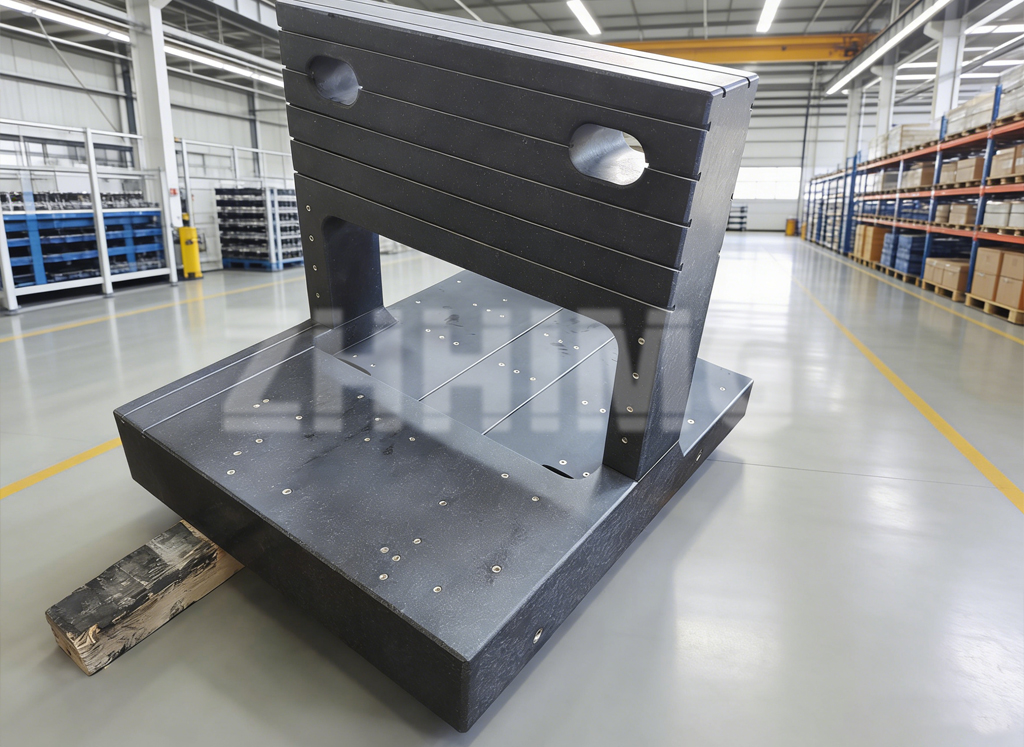
Projects like this are built as mineral casting machine bed solutions, and the same workshop produces epoxy granite composite components, so the material comparison above can be settled against parts rather than theory.
What to send for a material and structure review
A useful enquiry includes the machine type and its dominant error source, the loads and their direction, the required stiffness at the tool or measuring point, the precision actually needed at the mounting interfaces, the batch quantity, and the target lead time. With those, a mineral casting manufacturer can propose a mix and wall design, confirm which interfaces need inserts, and quote the casting with its verification plan. Send your machine bed requirement to ZHHIMG for a material and structure review.
Post time: Oct-13-2026