
In the R&D and manufacturing of precision equipment, the gantry frame acts as the skeleton reference of the complete machine, whose performance directly determines the upper limit of the whole equipment. When selecting gantry components, many equipment manufacturers often encounter practical challenges such as reference drift, poor environmental adaptability and high later‑stage maintenance costs. Though steel, cast‑iron and ordinary‑stone gantries are widely applied, their inherent drawbacks will be greatly magnified in ultra‑precision scenarios including semiconductor inspection, laser processing and coordinate metrology. Adopting high‑grade granite for gantry structures is a targeted solution to numerous practical problems in equipment manufacturing.
Deformation offset induced by temperature change is one of the most common issues for high‑precision gantry equipment. Gantries made of metal materials are highly sensitive to ambient temperature fluctuations. Thermal expansion and contraction alter the dimension and straightness of frames. Temperature variations caused by day‑night alternation or workshop startup‑shutdown will translate into measurement errors. Equipment has to stop frequently for calibration, disrupting production rhythm. Ordinary marble features loose internal texture and inconsistent thermophysical parameters, so it cannot resist precision disturbances brought by temperature either. High‑density black granite boasts an extremely low thermal deformation coefficient. Its overall deformation is negligible amid temperature changes. It can sustain the geometric form of gantry frames for a long time, cut down repeated calibration triggered by thermal drift, and guarantee consistent references during continuous equipment operation.
Vibration interference constitutes another stubborn problem for precision inspection and processing equipment. Vibration transmitted from travelling cranes, surrounding machine tools and ground surfaces can reach gantry frames, giving rise to operational jitter, and finally resulting in fluctuating inspection data and defective processing contours. While cast‑iron and steel structures deliver decent rigidity, they damp vibration slowly, and external disturbances persist within frames for a long time. Granite possesses outstanding vibration‑damping capacity. It can quickly absorb and dissipate external vibrational energy and suppress resonance. Even under certain on‑site disturbances, the reference surfaces of gantries remain stable, offering a solid foundation for linear‑motor motion, optical imaging and precision scanning.
Precision degradation caused by stress release is a latent defect that only emerges after equipment is put into service. After welding, casting and CNC machining, metal components retain residual internal stress. Months or even years after delivery, gradual stress release leads to distortion and warping of gantries. The originally qualified precision deteriorates, bringing high costs for repair and correction. As a naturally compact rock, granite contains no casting or welding stress. Its internal state stays stable after machining, free from later‑stage creep deformation. With proper raw‑material selection, the geometric precision of gantry structures can be maintained over time, greatly lowering maintenance and re‑calibration costs for end‑users.
Magnetization and wear are also troublesome for gantry systems working under precision conditions. Metal gantries tend to get magnetized. In semiconductor and magnetic‑sensor‑related equipment, magnetic interference will impair normal operation of sensors and components. Besides, long‑term reciprocating load will wear mounting reference surfaces of metal, gradually ruining flatness and parallelism. Being non‑magnetic, granite generates no magnetic disturbance. Featuring high hardness and excellent wear resistance, it serves well as gantry base and mounting benchmark. Subjected to continuous assembly loads from modules and sliding tables, its reference surfaces hardly wear out, preserving consistent mounting references for guide rails, gratings and sensors. 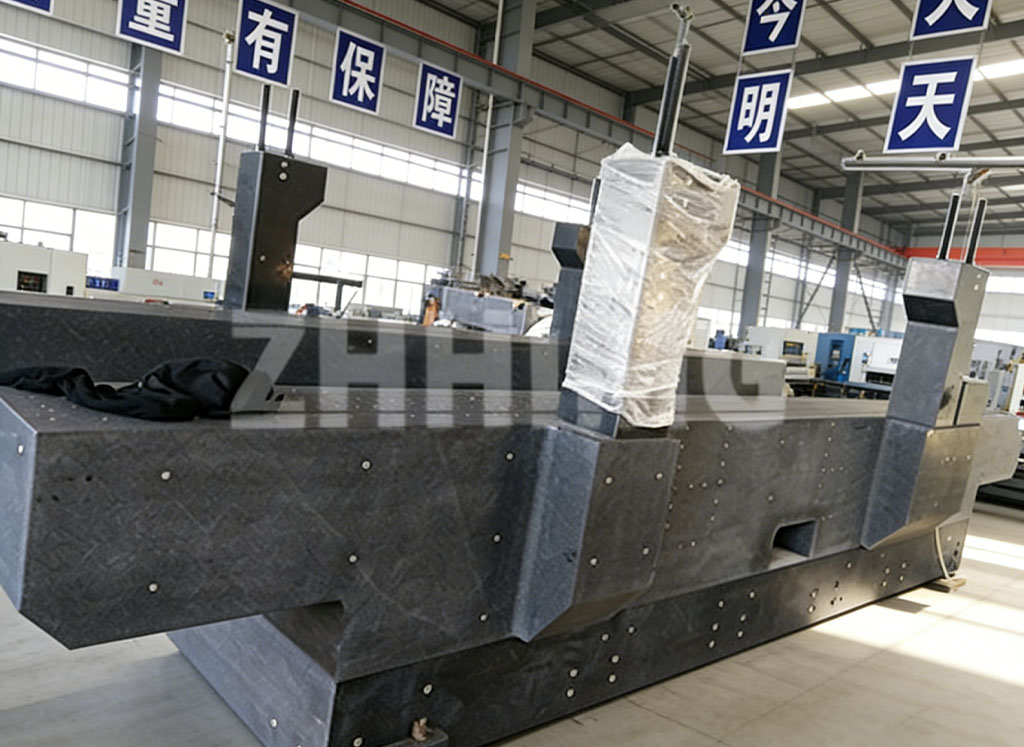
Some suppliers use cheap marble to pass for premium granite for gantry fabrication, causing secondary troubles such as uneven material, internal cracks and insufficient strength. Inherent material defects may trigger local deformation and micro‑collapse under stress, making overall equipment precision uncontrollable. High‑density black granite features uniform and compact internal texture and superior compressive strength. It supports integrated forming of large‑size, heavy‑load gantries, avoiding gaps and misalignment resulting from multi‑block splicing, and meeting dual requirements for span and load‑bearing capacity of large‑scale inspection and long‑travel optical equipment.
Nevertheless, the merits of granite gantries can only be realized with supporting processing environments, sophisticated grinding craftsmanship and complete metrological verification. Premium raw materials alone are not enough. Constant‑temperature anti‑vibration production conditions, mature grinding techniques and traceable inspection means are required to convert material advantages into finished‑product geometric accuracy. With comprehensive hardware resources, standardized multi‑national metrology systems and technical insights accumulated via long‑term cooperation with research institutes, ZHHIMG gives full play to the inherent merits of granite. It effectively addresses multiple practical pain points for equipment manufacturers concerning deformation, vibration, stress, magnetization and durability, and supplies reliable structural solutions for ultra‑precision equipment.
Post time: Sep-08-2026