
For high-speed gantry machining and inspection equipment, the core transmission beam bears all loads from linear motors, linear scales, guide rails, cutting heads and inspection modules. Gantry structures feature large spans. Even extremely minor deformation, tremor or thermal drift of the beam during high-speed reciprocating motion will directly translate into workpiece machining errors. When selecting materials, many equipment manufacturers struggle to choose between aluminum alloy, cast iron and granite beams. Drawing on rich experience in delivering high-speed gantry projects, ZHHIMG analyzes the underlying reasons why precision granite beams fit the core transmission sections of high-speed gantry machines from the dimensions of dynamic response, thermal stability and damping characteristics.
1. Low Thermal Expansion Eliminates Thermal Drift Errors During High‑Speed Operation
During continuous operation of high-speed gantries, linear motors and transmission modules keep generating heat that conducts into the beam. Metal beams expand and bend rapidly upon heating, causing straightness deviation of guide rails and offset of grating reference, so machining accuracy deteriorates with running time.
ZHHIMG high-density granite boasts an ultra-low thermal expansion coefficient. Deformation triggered by slight temperature fluctuation is minimal. Even when core transmission components heat up for a long time, granite beams will not bend or stretch obviously with temperature changes, and the mounting reference of guide rails and gratings remains stable. This advantage is especially critical for long-span gantry beams. The longer the span, the greater the error amplified by thermal deformation of metallic materials. Granite naturally restrains such thermal drift and guarantees geometric precision during continuous high-speed machining.
2. High Rigidity Plus High Internal Damping Suppresses Residual Vibration Caused by High‑Speed Start‑Stop
The most typical working condition of high-speed gantry equipment lies in frequent start-stop and rapid direction reversal. The transmission beam suffers huge inertial impact the moment acceleration and deceleration happen. Cast iron and aluminum alloy possess acceptable rigidity yet weak damping. After impact, they keep trembling for a long time. Operators have to wait for vibration attenuation before continuing machining, which slows down machine cycle time. If machining proceeds before vibration fades, tool marks and jumping inspection data will occur.
The crystal structure of precision granite beams delivers excellent inherent damping. Vibration energy generated by impact dissipates rapidly, and residual vibration decays far faster than metallic materials. Combined with ZHHIMG’s integrated precision machining technology, long-span granite beams achieve high rigidity and avoid sustained oscillation under high-speed reciprocating motion. The transmission system realizes faster acceleration and deceleration, shortens vibration waiting time, improves productivity of gantry equipment and ensures stable positioning at the motion end.
3. Matched Self-Weight and High Rigidity Maintain Geometric Profile Under Large Spans
The gantry beam is a large-span cantilever load-bearing structure. After carrying linear motors, sliding tables and detection heads, deflection of the beam itself becomes a major challenge. Insufficient beam rigidity will lead to dynamic deflection when the slide moves, destroying parallelism of guide rails.
Using granite raw material with a density of approximately 3100kg/m³, ZHHIMG optimizes structural design through mechanical simulation and reasonably arranges reinforcing ribs and weight-reducing cavities. It maximizes bending rigidity while controlling self-weight. Under load from high-speed moving slides, dynamic deflection of granite beams is strictly controlled to keep the guide rail mounting reference flat. Compared with lightweight aluminum alloy, granite will not suffer fatigue deformation under alternating high-speed loads. Its geometric shape stays stable after repeated long-term movement, and the transmission reference hardly drifts.
4. Stable Substrate Resists Deformation From Stress Release Over Long Service Life
Internal residual stress of cast iron beams will release slowly after casting. After several years of service, the beam gradually warps, shifting the reference of guide rails and gratings and requiring re-calibration. Aluminum alloy tends to creep under sustained alternating loads.
ZHHIMG granite raw material has undergone natural aging over hundreds of millions of years and contains no casting stress. Before fine finishing, granite beams are statically aged for a long period in constant-temperature workshops to release minor stress introduced by machining. As the core transmission carrier of gantry equipment, the beam body will not spontaneously deform slowly after years of high-speed reciprocating motion. It greatly reduces frequency of later calibration and maintenance, making it suitable for year-round non-stop high-speed gantry production lines. 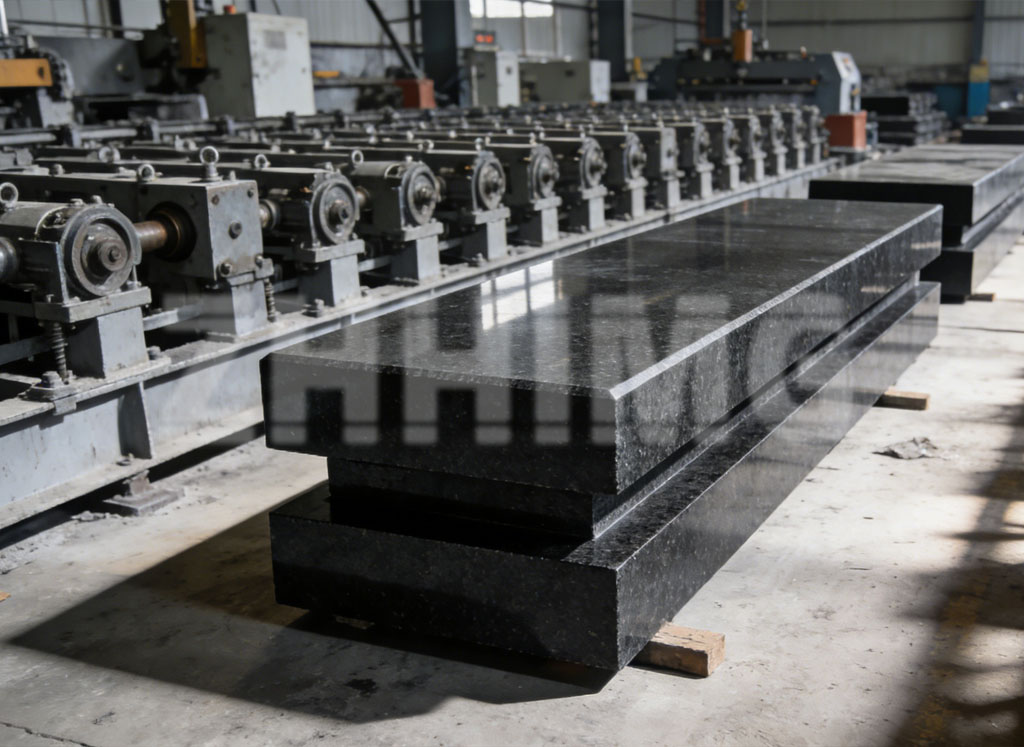
5. Superior Reference Surface Machining Performance Guarantees Mounting Precision of Transmission Components
Guide rails and linear scales are fixed directly onto the beam reference surface in core transmission areas. Flatness and straightness of reference surfaces directly determine motion accuracy of the whole transmission system. Granite can be easily fine-ground to nanometer-level surface quality without burrs. It features uniform material and avoids local inhomogeneity commonly seen in metals.
ZHHIMG completes fine grinding of granite beams in constant-temperature, constant-humidity and dust-free workshops for controllable reference precision. Mature embedded sleeve technology is also available for mounting and fixing guide rails and gratings. The embedded structure is stable and resistant to loosening under high-speed vibration, firmly fastening transmission components on the granite reference plane and preventing transmission deviation caused by failure of connection points.
6. Working Condition Adaptation: Reducing Resonance Risks for High‑Speed Gantries
Motion axes of high-speed gantry equipment have fixed excitation frequencies. As a core component, the beam’s natural frequency directly determines the resonance characteristics of the whole machine. At the design stage, ZHHIMG performs simulation calculation to optimize beam cross-section structure and adjust natural frequency, avoiding excitation frequency bands generated by high-speed operation of linear motors. Once resonance occurs, the transmission system vibrates violently and may severely damage gratings and guide rails. By optimizing cross-sections with granite material, the system can effectively stay away from resonance zones and ensure smooth operation of the high-speed gantry transmission system.
Conclusion
The core transmission beam of high-speed gantry equipment must satisfy multiple requirements simultaneously: thermal stability, high rigidity, rapid vibration suppression and long-term dimensional stability. Aluminum alloy and cast iron each have inherent drawbacks and can hardly meet all stringent requirements at the same time. With low thermal expansion coefficient, excellent internal damping and stable stress-free substrate, precision granite beams become the preferred choice for core transmission parts of high-speed gantry equipment. Supported by mature ultra-precision machining, structural simulation and embedding processes, ZHHIMG supplies long-span granite beams for high-speed gantry equipment. The transmission system maintains a stable reference under high-speed and frequent reversing working conditions, improving machining and inspection accuracy of the equipment.
Post time: Oct-10-2026