
In ultra-precision manufacturing, equipment often needs to run continuously without interruption. Production lines for semiconductors, laser processing and precision inspection usually operate 24 hours a day. Many equipment procurement engineers raise a key question: will granite machine tool bases gradually lose precision after years of non-stop machining under long-hour continuous operation? Some people take it for granted that granite is a benchmark material with permanent stability, while other clients worry that continuous vibration and heat will slowly reduce base accuracy. In fact, granite bases do not have zero precision variation, but the mechanism and magnitude of their accuracy change are fundamentally different from cast iron and metal bases. Drawing on years of mass production experience in ultra-precision components and on-site tracking of customer installations, ZHHIMG analyzes the underlying logic of precision evolution for granite bases under continuous long-running machining conditions.
1. Distinguish Two Types of Precision Variation: Reversible Thermal Offset Is Not Permanent Precision Degradation
A common misunderstanding occurs when on-site operators observe minor benchmark deviation after extended machine operation and conclude that the granite base has suffered precision degradation.
When a machine runs for long hours, spindles, linear motors and motion modules continuously generate heat that slowly transfers to the granite base and causes slight thermal expansion, resulting in reversible dimensional shift. This is elastic deformation. Once the machine stops and both equipment and base return to ambient temperature, flatness and dimensional benchmarks revert to their original factory values. This is not permanent precision decay.
The high-density black granite substrate adopted by ZHHIMG has undergone natural aging over millions of years and contains no casting residual stress. Under continuous heating and vibration, it will not gradually release residual stress through repeated thermal expansion and contraction like cast iron bases, leading to irreversible permanent distortion. This is the core advantage of granite for long non-stop machining scenarios.
2. Real Triggers of Permanent Precision Degradation Under Long Operation
Granite itself is dimensionally stable, yet this does not mean the base is completely immune to external influences. In long continuous machining, permanent precision degradation rarely originates from fatigue of the stone itself. Instead, it mostly comes from secondary problems of auxiliary structures and operating environments.
The first risk is damage to embedded threaded hole structures. Prolonged continuous vibration applies alternating loads to embedded sleeves and adhesive layers. Poor embedding craftsmanship, improperly selected sleeves or air bubbles inside poured glue may cause adhesive creep and sleeve loosening over time, which shifts assembly benchmarks and manifests as falling overall machine accuracy. This issue arises from failed embedded interfaces rather than degradation of the granite slab itself. ZHHIMG implements full control over embedded sleeve design, glue curing and pull-out testing before delivery to avoid interface failure caused by long-term alternating vibration.
The second factor is surface contamination and physical damage. Cutting dust and coolant splash continuously during long production cycles. Without adequate protection, hard abrasive particles may get trapped between guide rails and the granite reference surface, slowly scratching the benchmark plane during reciprocating movement. Accumulated scratches permanently damage the reference plane and reduce precision. ZHHIMG provides maintenance guidelines for 24-hour continuous production lines alongside delivered products to minimize abrasion of reference planes from dust and coolant.
The third risk is failure of factory foundation and vibration isolation systems. Continuous machine operation transmits vibration to the ground. If building foundation settlement or vibration isolation trenches fail, the entire granite base tilts, which appears as persistent equipment accuracy deterioration. The root cause lies in changed supporting foundation conditions rather than defects of granite material. When undertaking large granite bed projects, ZHHIMG communicates foundation and anti-vibration design schemes with customers in advance to reduce benchmark offset induced by foundation deformation.
3. Comparison of Long-Term Degradation Characteristics Between Granite and Cast Iron Bases Under Continuous Machining
For cast iron bases under long continuous machining, multiple overlapping factors create ongoing irreversible precision decay. Heat generated during continuous operation plus alternating day-night temperature cycles trigger repeated thermal expansion and contraction, steadily releasing casting residual stress and slowly warping the base. Meanwhile metal oxidation and rust further aggravate deformation, and re-grinding repair is generally required after several years of service.
In contrast, properly manufactured high-density granite bases barely develop permanent precision degradation of the stone body when operating under reasonable working conditions, reliable embedding workmanship and proper surface protection. Many semiconductor and optical inspection clients of ZHHIMG run their equipment 24/7 all year round. Re-testing base flatness after multiple years still maintains nanometer-level benchmark performance. Its precision stability does not naturally deplete with running time. 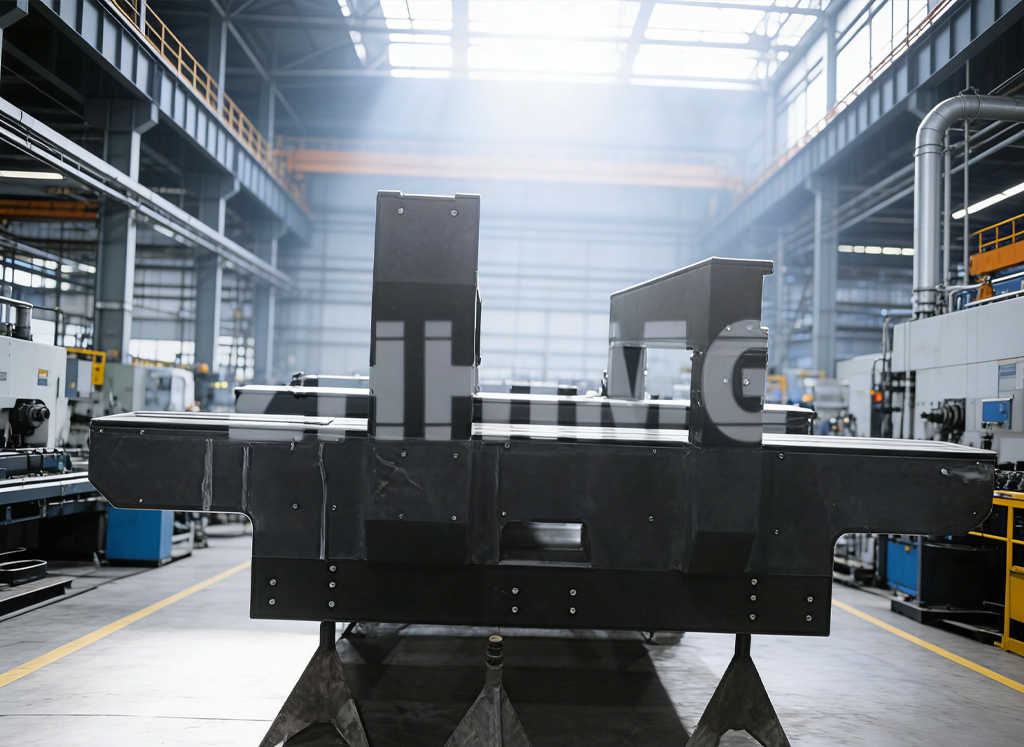
4. Methods to Mitigate and Avoid Benchmark Offset During Long Continuous Machining
To steadily preserve granite base precision under extended continuous operation, both equipment design and on-site operation & maintenance must be addressed.
On the manufacturing side, ZHHIMG optimizes structural layout for granite bases designed for 24-hour continuous operation. It rationally arranges weight-reduction grooves and reinforcing ribs to achieve uniform heat distribution and prevent local deformation caused by heat accumulation. Fine grinding and embedded assembly are completed in constant-temperature, constant-humidity and dust-free workshops. Products undergo long-period static aging before delivery to release minor processing stress and avoid slow deformation after shipment.
For customer on-site maintenance, regularly clean reference surfaces to prevent scratches from hard particles; periodically recheck locking torque of assembly bolts to avoid loosening induced by long-term vibration; and continuously monitor workshop temperature, humidity and foundation status. When precision drift occurs, inspect thermal balance, foundation and embedded assembly factors first instead of directly judging granite substrate failure.
5. Precision Inspection Strategy: Periodic Calibration Logic for Long-Term Operation
For precision equipment running in continuous production, a periodic benchmark inspection system is essential. ZHHIMG recommends customers use laser interferometers, electronic levels and other precision metrology instruments to regularly recheck base flatness and linear benchmarks.
During measurement, leave the machine shut down long enough so the granite base fully cools to ambient temperature before testing, eliminating temporary reading deviations caused by thermal imbalance. If benchmarks return to factory specifications after cooling, the granite body remains intact, and only thermal compensation parameters of the machine need adjustment. If fixed deviation persists after cooling, inspect embedded structures, scratched reference planes or foundation settlement.
Conclusion
In summary, qualified high-density granite bases will not spontaneously develop permanent precision degradation under long-hour continuous machining. Most observed precision drift comes from reversible thermal deformation, or external factors including failed embedded structures, worn reference surfaces and foundation changes.
With stable high-density granite raw materials, mature embedding processes and strict pre-delivery inspection, ZHHIMG manufactures granite machine tool bases suitable for non-stop 24-hour operation. With proper preliminary structural design, embedding process control and basic on-site maintenance, granite benchmarks can remain stable for years of continuous machining. This explains why many research institutes and world-leading enterprises choose granite bases for ultra-precision equipment running continuously for long periods.
Post time: Oct-10-2026