
Boasting ultra-low deformation, high rigidity and excellent temperature stability, granite machine tool bases have become the core reference carriers for ultra-precision machining, semiconductor equipment and laser inspection equipment. In the whole production process of the base, surface fine grinding and precision testing often receive much attention, while the process of embedded sleeves and assembly threaded holes is frequently overlooked. In fact, most of the loosening, edge chipping, microcracks and precision drift of granite bases in later service stem from careless embedding and threaded hole assembly. Unlike cast iron metal bases that allow direct tapping and locking, granite is a brittle dense mineral material with extremely high process requirements for hole opening, embedding, glue pouring and tightening torque. As an industry benchmark enterprise deeply engaged in ultra-precision stone components with full self-developed processes, ZHHIMG explains the key points of embedding and assembly threaded holes for granite machine tool bases based on years of mass-production experience of large granite beds, and avoids hidden dangers of equipment long-term operation through process details.
1. Selection of Embedded Sleeves: Match Substrate Properties to Prevent Thermal Stress Damage
It is a general rule in the ultra-precision industry that threading shall not be directly processed on granite. Special metal embedded sleeves are the core structure for load bearing. Most small manufacturers on the market simply adopt ordinary carbon steel sleeves, which easily leave long-term hidden risks. ZHHIMG adheres to the precision matching principle in sleeve selection to eliminate quality problems caused by mismatched materials.
For its self-developed high-density black granite substrate (density ≈3100kg/m³), ZHHIMG preferentially selects low-expansion alloy embedded sleeves, greatly narrowing the difference in thermal expansion coefficient between metal sleeves and granite substrates. Temperature fluctuations such as day-night temperature difference in workshops and temperature rise generated by equipment operation will not produce continuous shear stress between sleeves and stone hole walls, fundamentally avoiding microcracks at holes and loosening or falling off of sleeves.
In terms of structural selection, ZHHIMG uniformly adopts integrated sleeves with knurled outer walls and annular anti-slip grooves, abandoning ordinary smooth sleeves. After structural adhesive cures, a high-strength mechanical interlocking structure is formed, which effectively resists torque and tension brought by high-frequency vibration of equipment and prevents sleeve rotation or detachment. Meanwhile, all sleeves are passivated with rounded corners without sharp edges, completely avoiding cracking of granite substrates caused by stress concentration. For heavy-load scenarios such as large machine tool beds and linear motor platforms, ZHHIMG customizes thick-walled sleeves with deeper embedding specifications to disperse single-point stress and guarantee long-term bearing stability of the base.
2. Machining of Embedded Holes: Strictly Control Hole Wall Precision to Eliminate Hidden Crack Risks
The machining quality of embedded holes directly determines the stability of subsequent embedded structures and is the core detail distinguishing ordinary processing from ultra-precision processing. Many manufacturers adopt fast feeding speed and rough processing for hole drilling, resulting in hole edge chipping and invisible microcracks on hole walls. These cracks will keep expanding under vibration and temperature cycling and directly scrap the whole base.
Relying on advanced CNC processing equipment and mature process system, ZHHIMG formulates standardized processing procedures for granite embedded holes: special diamond drill bits are used for uniform low-speed feeding to avoid substrate damage caused by impact cutting; hole wall roughness is strictly controlled to retain proper adhesion surface while eliminating deep scratches and concave-convex defects; flat-bottom holes are uniformly processed to prevent dust and residual debris at hole bottoms from affecting bonding effect.
At the same time, ZHHIMG strictly controls the glue layer clearance accuracy and reserves uniform filling gaps according to sleeve specifications, preventing insufficient glue filling and internal voids caused by too small gaps, as well as sleeve offset induced by glue creep when gaps are too large. After hole drilling, multiple procedures of dust removal, drying and degreasing cleaning are carried out to thoroughly remove stone powder and impurities inside holes, ensure the bonding strength between structural adhesive, granite substrate and metal sleeves, and prevent debonding and loosening in later stage.
3. Glue Pouring and Curing Process: Special Precision Adhesive, Standard Operation in Constant-Temperature Dust-Free Environment
The fixing effect of embedded sleeves mainly depends on adhesive selection and curing environment. Ordinary industrial epoxy adhesive cannot meet the service standards of ultra-precision granite bases. ZHHIMG abandons general adhesives and specially matches low-shrinkage, low-creep and high-modulus precision structural adhesive to adapt to long-term stable working conditions of ultra-precision equipment.
This special adhesive features extremely low curing shrinkage and will not pull sleeves to produce displacement deviation, perfectly retaining the original reference precision of granite bases. It also has excellent toughness to buffer tiny thermal stress between metal sleeves and granite substrates and adapt to temperature fluctuation working conditions. For high-precision scenarios such as semiconductors and optical inspection, ZHHIMG completes glue pouring operations in a class 10,000 constant-temperature, constant-humidity and dust-free workshop. Low-pressure glue injection technology is adopted to completely exhaust bubbles inside glue layers and realize 360° full glue wrapping on sleeve outer walls.
During curing, ZHHIMG implements static curing standards strictly. No moving, collision or vibration is allowed within the curing cycle to ensure uniform curing and stable performance of adhesive, avoiding process defects such as sleeve offset and glue cracking, and guaranteeing the overall strength and positioning precision of embedded structures.
4. On-site Threaded Hole Assembly: Precise Torque Control to Prevent Stress Deformation
Most equipment assembly failures are not caused by embedding during production, but by non-standard on-site locking operations. Brute-force locking by experience is forbidden for threaded hole assembly of granite bases. Excessive torque will directly crack the substrate at hole mouths, while insufficient torque will trigger loosening under long-term vibration and lead to precision drift.
For delivered products, ZHHIMG provides a dedicated assembly torque parameter manual. Standard locking torque is calibrated according to different sleeve specifications and load scenarios. Torque wrenches are required for operation to avoid over-tightening. Meanwhile, the assembly sequence is standardized. Multi-point locking must follow the diagonal progressive tightening principle. One-time full tightening at a single point is prohibited to prevent slight deformation of granite bases caused by local stress concentration and damage to precision flat reference planes.
In terms of accessory matching, ZHHIMG recommends supporting standard thick hard gaskets to increase contact area and disperse compression force, effectively protecting hole mouths on granite surfaces and avoiding edge crushing and chipping, so as to guarantee assembly precision and substrate integrity. 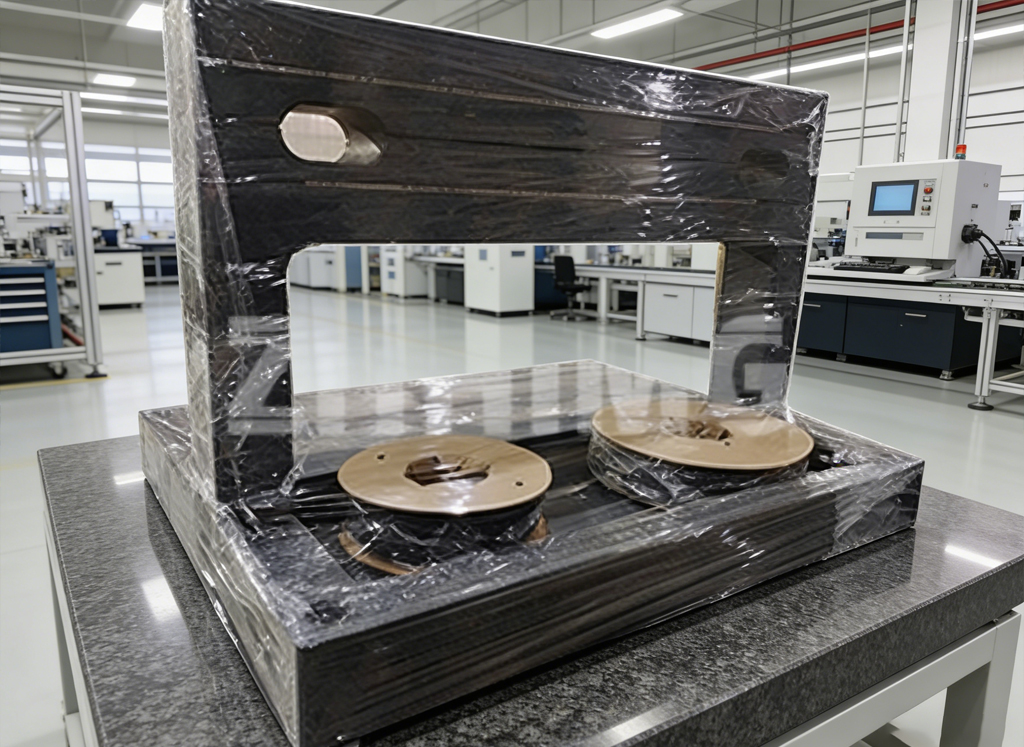
5. Working Condition Oriented Layout Design: Avoid Long-term Hidden Risks Combined with Application Scenarios
At the stage of embedded point layout design, ZHHIMG customizes layout schemes combined with multiple factors such as equipment application scenarios, operating conditions and ambient temperature difference to avoid later risks from the source. For high-frequency vibration equipment such as laser processing platforms and semiconductor XY displacement platforms, the layout of embedded points is optimized to disperse single-point load, and professional anti-loosening processes are matched to improve structural stability.
For production scenarios with obvious day-night temperature difference and seasonal temperature variation, ZHHIMG avoids concentrated arrangement of sleeves, preventing uneven thermal deformation triggered by concentrated metal components and keeping the overall flat reference of bases stable. Meanwhile, safety margin standards are strictly implemented. All embedded holes retain compliant spacing from stone edges to completely eliminate edge cracking under stress and temperature change.
6. Non-destructive Delivery Inspection: Full-dimensional Quality Control for Finished Embedded Products
Different from the simple industry standard that only inspects appearance and dimensions, ZHHIMG establishes a complete inspection system for granite base embedding processes. After embedding and curing, sleeve position tolerance, perpendicularity and coaxiality are inspected one by one to guarantee subsequent assembly adaptability. Sampling pull-out tests are conducted to verify the bonding strength and bearing capacity of sleeves. Non-destructive testing technology is used to check hidden microcracks around holes and thoroughly eliminate hidden dangers during long-term equipment operation.
Conclusion
The core advantages of granite machine tool bases lie in high precision and great stability, while the embedding sleeves and assembly threaded hole processes are the key details determining the durability of long-term precision of bases. Many enterprises only focus on static factory precision but ignore the standardization of embedding and assembly processes, resulting in frequent precision drift, structural loosening and substrate cracking after equipment commissioning. With mature ultra-precision processing technology, strict production inspection standards and full-scenario embedding and assembly solutions, ZHHIMG controls details throughout the whole process from material selection, processing and curing to assembly, maximizes the performance advantages of high-density granite substrates, and provides stable, long-lasting and high-precision base solutions for global ultra-precision equipment.
Post time: Oct-10-2026