
1. Material Fundamentals: Thermal Expansion Coefficient Gap Creates the Dividing Line for Temperature Resistance
The linear thermal expansion coefficient, which describes how much a material expands per unit length with every 1℃ temperature change, determines deformation under temperature fluctuation. The lower the value, the better the temperature stability. This is the primary distinction between the two base materials.
High-quality cast iron (such as HT300), widely used for precision machine tools, features a linear thermal expansion coefficient of 11~13×10⁻⁶/℃ and is highly sensitive to temperature changes. For example, a 10-meter cast iron machine base will deform by 0.55~0.65mm when the workshop temperature fluctuates by 5℃. This invisible deformation is enough to cause out-of-tolerance results in high-precision processes like CMM inspection, laser micro-machining, and semiconductor component calibration. Furthermore, casting residual stress, micro-pores and uneven grain structure inside cast iron lead to inconsistent deformation across different regions of the base during temperature changes, resulting in twisting and warping that cannot be corrected by simple calibration.
High-density black granite (ZHHIMG® exclusive high-density substrate) for premium precision equipment has a thermal expansion coefficient of merely 4.5~6×10⁻⁶/℃, roughly half that of cast iron. Top-grade finely lapped granite substrates can reach as low as 0.5×10⁻⁶/℃, with nearly negligible thermal deformation. Under the same conditions: a 10-meter base and 5℃ temperature fluctuation, the granite base deforms less than 0.3mm. Formed over millions of years of natural aging, the granite has a dense, uniform internal structure free of residual stress. Its deformation under temperature change is uniform and predictable, without local distortion. It eliminates accuracy drift induced by temperature changes from the material source.
2. Dynamic Thermal Response: Response Speed Differentiates Precision Production Stability
Absolute constant temperature does not exist in industrial sites. Equipment startup and shutdown, continuous machining, and workshop ventilation switches all create dynamic temperature differences. In such scenarios, thermal response speed matters more than static deformation values and defines suitable application scenarios for each material.
Cast iron is metallic with good thermal conductivity and rapid thermal diffusion, so it reacts sensitively to temperature shifts. When the workshop warms up, the cast iron base absorbs heat and expands quickly; when it cools down, it releases heat and contracts rapidly. This “real-time following” deformation causes continuous accuracy fluctuation of equipment. Especially with day-night temperature variation and intermittent machining, the base’s accuracy drifts repeatedly, requiring frequent shutdowns for calibration and greatly reducing productivity. For precision machining requiring ±1μm tolerance, cast iron bases can only function under extremely strict constant-temperature environments with very low error tolerance.
Granite is a dense natural mineral substrate with strong thermal inertia. Its thermal response speed is over 40 times slower than cast iron. Faced with short-term temperature fluctuations, instantaneous heat generation from equipment, or minor workshop temperature drift, granite bases do not absorb or release heat rapidly. They can retain benchmark dimensions and flatness for a long time. Even normal temperature variations in non-constant-temperature workshops will not trigger instant deformation. It is ideal for scenarios requiring sustained high precision, such as semiconductor equipment assembly, femtosecond laser processing and precision gauge calibration. Even slight temperature fluctuations inside ordinary thermostatic workshops can be mostly offset by its inherent thermal stability, significantly cutting environmental temperature control costs.
3. Deformation Reversibility & Long-Term Performance: Temporary Errors vs Permanent Damage
Deformation under temperature variation falls into reversible elastic deformation and irreversible permanent deformation. This differentiates service life and long-term precision stability, a detail overlooked by many manufacturers.
When cast iron bases are exposed to cyclic temperature changes, repeated thermal expansion and contraction continuously release internal casting residual stress. Over time, irreversible plastic deformation occurs. In short, after long-term temperature cycling, cast iron bases suffer permanent distortion, flatness deviation and benchmark failure which cannot recover automatically. Re-grinding and calibration are usually required after 1 to 3 years of use, adversely affecting equipment service life. In addition, cast iron is prone to slight oxidation and rust under alternating temperature and humidity, further aggravating deformation errors, which is a major drawback in high-precision metrology.
Thermal deformation of granite bases is fully reversible elastic deformation. It expands when temperature rises and contracts when temperature falls, with no residual stress or permanent deformation. Once temperature returns to the standard value, dimensional accuracy and flat benchmark can be fully restored. Boasting ultra-high density (≈3100kg/m³), dense structure, no pores and water resistance, the substrate resists corrosion. Subjected to alternating temperature and humidity over long periods, it maintains nanometer-level flatness and micron-level dimensional accuracy, requiring far less rework and calibration, with a service life multiple times longer than cast iron bases. 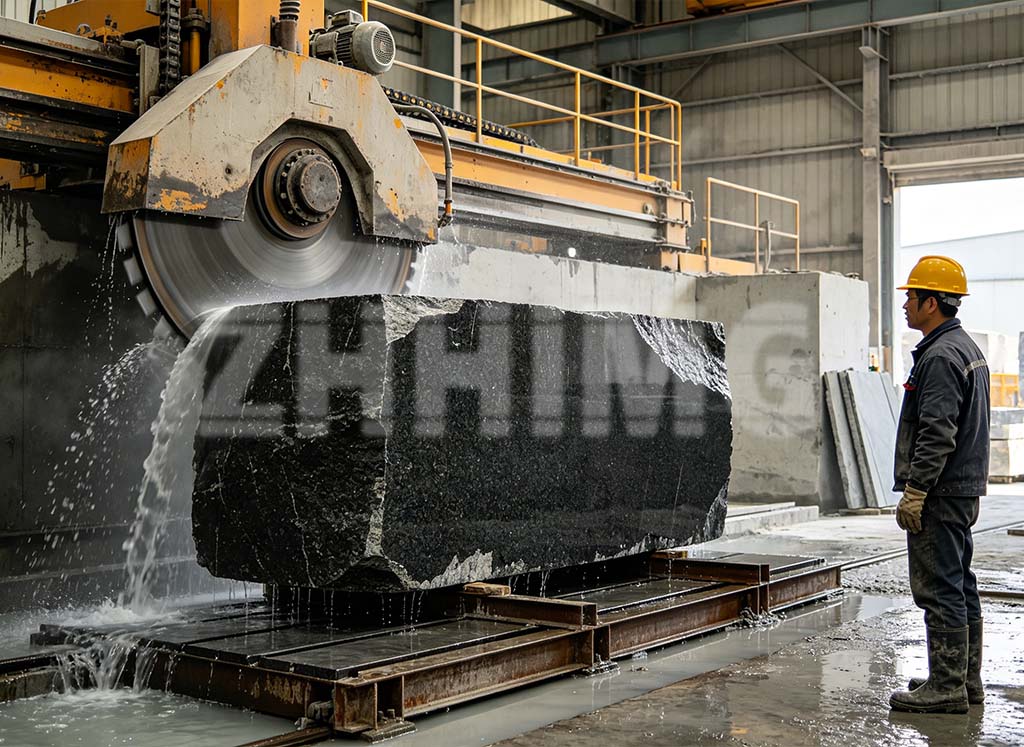
4. Application Selection Guide: Core Logic for Material Selection in Temperature-Varying Conditions
From multi-dimensional comparison of thermal performance, neither material is universally superior. Each fits different precision grades and temperature environments:
Conventional cast iron bases have low cost and sufficient rigidity for ordinary machining. They are suitable for general machining scenarios with accuracy requirements ≥5μm, stable constant temperature and acceptable periodic calibration. Minor temperature fluctuations can be compensated by manual calibration.
With ultra-low thermal expansion coefficient, strong thermal inertia and no permanent deformation, high-density granite bases perfectly fit ultra-precision scenarios requiring 0.1~1μm accuracy, frequent temperature fluctuations and 24-hour continuous high-precision operation, including semiconductor equipment, precision laser machines, CMM metrology tools, new energy precision inspection equipment and high-end optical inspection systems. It is the core substrate for ultra-precision industry to counteract temperature-induced errors.
Conclusion
In precision industry, the competition of accuracy is essentially the competition of environmental stability. Micron-level errors caused by temperature variation mark the boundary between conventional machining and ultra-precision machining. Restricted by inherent thermal drawbacks, cast iron bases cannot overcome accuracy bottlenecks in temperature-changing environments. In contrast, high-density granite bases overcome long-standing environmental accuracy drift issues in the industry with outstanding thermal stability. This is why global Fortune 500 enterprises, top metrology institutes and leading university research teams prefer granite substrates for ultra-precision equipment base selection.
Post time: Oct-10-2026