
In the rapidly evolving landscape of high-tech manufacturing, the quest for the ultimate material—one that combines absolute stability, thermal resilience, and vibration damping—has led engineers back to one of the earth’s oldest resources. While cast iron and steel have long been the backbone of industrial machinery, a paradigm shift is occurring. Today, black granite is not just a secondary option; it is becoming the definitive standard for the foundations of precision engineering.
From semiconductor fabrication and coordinate measuring machines (CMMs) to high-speed CNC centers and laser cutting systems, the demand for sub-micron accuracy is no longer a luxury—it is a requirement. To understand why black granite is the future of these industries, one must look beyond its aesthetic appeal and dive into the unique physical and chemical properties that make it a geological masterpiece of engineering.
The Science of Stability: Why Granite Outperforms Metals
The primary challenge in any precision machining or measuring environment is environmental instability. Temperature fluctuations, ambient vibrations from the factory floor, and internal stresses within the machine frame can all lead to catastrophic errors in measurement and production.
Black granite, particularly high-quality varieties like Jinan Black, offers a coefficient of thermal expansion that is significantly lower than that of steel or cast iron. When the temperature in a facility shifts by even a fraction of a degree, metal structures expand or contract at a predictable but disruptive rate. Granite, however, remains remarkably inert. This thermal stability ensures that a machine calibrated in the morning will maintain its accuracy throughout a grueling production cycle, reducing the need for constant recalibration and downtime.
Furthermore, the internal structure of granite is naturally stress-relieved. Unlike cast iron, which requires a lengthy aging process or heat treatment to remove internal stresses created during the cooling of the molten metal, granite has been “seasoning” underground for millions of years. When a block of black granite is quarried and finished, it does not warp or “creep” over time. For an engineer designing a machine base meant to last decades, this inherent dimensional stability is the ultimate insurance policy.
Superior Vibration Damping: The Silent Advantage
In the world of micro-machining and high-speed optics, vibration is the enemy of perfection. Every motor movement, every spindle rotation, and even the footsteps of a technician can introduce resonance into a machine’s frame. Metal structures, due to their elastic nature, tend to ring like a tuning fork, amplifying these vibrations and transferring them directly to the workpiece or the sensor.
Granite possesses an exceptional ability to damp these vibrations. Its dense, non-homogeneous crystalline structure absorbs kinetic energy rather than reflecting it. This high damping ratio allows for faster settling times in automated systems. When a high-speed gantry stops at a coordinate, a granite base ensures that the residual vibration dies out almost instantaneously, allowing the machine to take a measurement or execute a cut without delay. This directly translates to higher throughput and better surface finishes for the end product.
Durability and Maintenance in Harsh Industrial Environments
One of the most overlooked advantages of black granite in precision engineering is its resistance to corrosion and wear. In many manufacturing environments, cooling fluids, humidity, and chemical exposure are constant threats to metal components. Steel and iron require painting, plating, or constant oiling to prevent rust—a process that is not only labor-intensive but can also introduce contaminants into cleanroom environments.
Black granite is naturally acid-resistant and completely rust-proof. It does not require any protective coatings to maintain its integrity. Moreover, granite is incredibly hard—ranking high on the Mohs scale. While a metal surface can be easily scratched or dented, leading to “burrs” that throw off the flatness of a reference surface, granite is much more resilient. Even if a granite surface is chipped, the surrounding area remains flat, whereas a dent in metal usually causes a raised ridge around the impact site. This “non-burring” characteristic makes it the ideal material for surface plates and machine ways where sliding contact is frequent.
The Role of Black Granite in the Age of Industry 4.0
As we push toward the era of Industry 4.0 and the Internet of Things (IoT), the integration of sensors into machine structures is becoming more common. The non-magnetic and non-conductive nature of granite is a significant benefit here. It does not interfere with sensitive electronic sensors or magnetic linear motors, providing a “clean” environment for the high-tech components that drive modern automation.
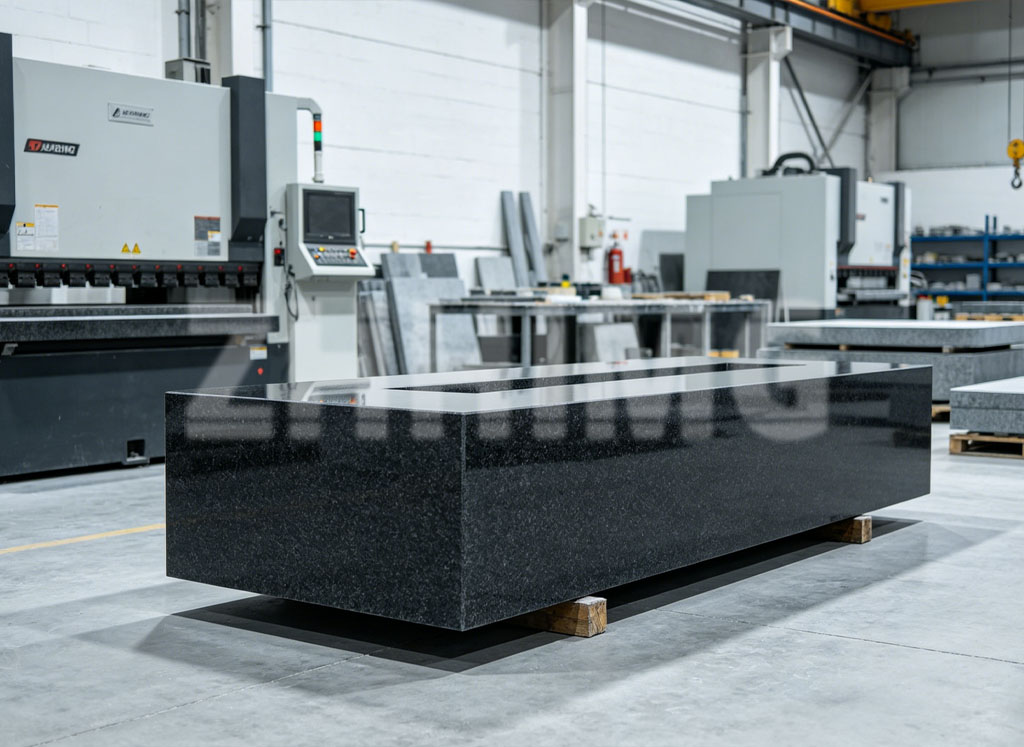
Moreover, the process of manufacturing granite components has reached a level of sophistication that rivals the precision of the machines they support. Using diamond-tipped tools and advanced lapping techniques, manufacturers can achieve flatness tolerances measured in microns across several meters of material. This level of precision is virtually impossible to achieve and maintain with large-scale metal castings without astronomical costs.
Conclusion: A Foundation Built for the Next Century
The transition to black granite machine bases and structures is not merely a trend; it is a logical response to the increasing demands of global manufacturing. As components get smaller, tolerances get tighter, and the cost of error rises, the foundation of the machine becomes the most critical component of the entire system.
For engineers and designers currently in the research phase of their next project, the choice is becoming clear. While the initial investment in high-quality black granite may differ from traditional materials, the long-term benefits—minimal maintenance, unparalleled stability, and superior vibration control—provide a return on investment that metals simply cannot match. Black granite is the silent partner in the precision revolution, providing the solid, unwavering ground upon which the future of technology is being built. By choosing granite, you aren’t just selecting a material; you are choosing a legacy of precision that will endure as long as the stone itself.
Post time: Apr-28-2026