
Granite air bearings deliver zero-friction motion essential for sub-micron precision in semiconductor inspection, CMM, and optical metrology systems. Unlike steel or ceramic alternatives, high-density granite (≈3100kg/m³) provides superior thermal stability (<0.001mm/°C), natural damping, and long-term dimensional stability. ZHHIMG® manufactures granite air bearings up to 20,000mm with ISO-grade tolerance control, serving global precision equipment manufacturers.
What Are Air Bearings and How Do They Work?
Air bearings—also called aerostatic bearings—support loads on a thin film of compressed air rather than solid contact surfaces. Pressurized air flows through precision orifices into the bearing gap, creating a near-zero stiffness air film typically ranging from 5 to 20 micrometers.
This design eliminates mechanical contact entirely, removing stick-slip friction, wear debris, and vibration sources that plague conventional rolling or sliding bearings. The result: smooth, backlash-free motion achievable at nanometer-level positioning accuracy.
For semiconductor wafer handling, coordinate measuring machines (CMM), and AOI (automated optical inspection) equipment, this zero-friction characteristic is not optional—it’s the fundamental prerequisite for throughput and yield specifications.
Why Is Granite the Ideal Material for Air Bearing Construction?
1. Exceptional Thermal Stability
Granite exhibits a thermal expansion coefficient of approximately 8×10⁻⁶/°C, translating to dimensional change below 0.001mm per degree Celsius. Steel, by comparison, expands roughly 12×10⁻⁶/°C.
In semiconductor fabs where ambient temperature is tightly controlled (typically ±0.5°C), this stability ensures measurement systems maintain calibration across shifts and batch runs. ZHHIMG® black granite, with its dense crystalline structure (density ≈3100kg/m³), provides inherent thermal mass that resists rapid temperature fluctuations.
2. Superior Vibration Damping
Granite’s natural microstructure absorbs vibrational energy far more effectively than steel. Steel oscillates with minimal damping—energy reverberates through the structure. Granite dampens vibration internally, reducing harmonic resonance in high-speed scanning and step-and-repeat processes.
For optical inspection systems operating at kHz-level frame rates, this damping translates directly into image blur reduction and faster, more reliable defect detection.
3. Corrosion Resistance and Longevity
Precision granite components resist corrosion from coolants, cleaning agents, and atmospheric moisture. Steel bearings require protective coatings (chrome, nickel, or ceramic plating) that can degrade over time. Granite’s mineral structure remains chemically inert, preserving surface flatness and accuracy for decades of service life.
4. Dimensional Stability Over Time
Steel components accumulate residual stress from machining and thermal treatment. Over months and years, these internal stresses slowly release, causing dimensional drift—catastrophic for metrology equipment requiring traceable calibration.
Granite, as a natural igneous rock, has already undergone millions of years of geological “annealing.” Its crystalline matrix shows negligible creep or stress relaxation, maintaining flatness specifications (<1μm/1000mm) indefinitely under proper use.
Granite Air Bearings vs. Steel vs. Ceramic: A Direct Comparison
|
Property |
Granite Air Bearings |
Steel Air Bearings |
Ceramic Air Bearings |
| Material Density | ≈3100 kg/m³ | ≈7800 kg/m³ | ≈4000 kg/m³ |
| Thermal Expansion | 8×10⁻⁶/°C | 12×10⁻⁶/°C | 7×10⁻⁶/°C |
| Thermal Stability | <0.001mm/°C | <0.002mm/°C | <0.001mm/°C |
| Vibration Damping | Excellent (natural) | Poor | Moderate |
| Corrosion Resistance | Inherent | Requires coating | Good |
| Machinability | Moderate | Excellent | Difficult |
| Weight (for same load) | Moderate | Heavy | Moderate-Light |
| Cost Efficiency | Excellent (large sizes) | Moderate | High |
| Max Practical Size | 20,000mm+ | Limited by tooling | 2000-3000mm |
| Surface Flatness Longevity | Decades | Years (coating wear) | Years |
Key Takeaway
For ultra-precision applications requiring large-format construction (>1000mm travel) with long-term stability—semiconductor equipment, large CMMs, industrial CT scanners—granite air bearings provide the lowest total cost of ownership. Steel and ceramic excel in compact, high-speed rotary applications where weight savings or maximum stiffness-to-weight ratios dominate the specification.
What Are the Key Applications for Granite Air Bearings?
Semiconductor Manufacturing and Inspection
- · Wafer handling stages requiring particle-free, non-contact motion
- · AOI (Automated Optical Inspection) systems for defect detection at μm-level resolution
- · IC test handlers demanding rapid, repeatable positioning
- · Industrial CT equipment for package integrity verification
- · Coordinate Measuring Machines (CMM) for aerospace and automotive component inspection
- · Laser interferometer stages for calibration reference systems
- · Form measurement systems for optical lens and mold surface profiling
- · CNC grinding machines for optical lens and mold insert fabrication
- · High-speed milling centers for micro-machining operations
- · Wire EDM stages requiring vibration-free linear travel
- · TFT-LCD inspection systems for flat panel display quality control
- · Microscopy stages for biological and materials research
- · Telescope mounting systems requiring tracking precision
Precision Metrology
Precision Machining
Optical Systems
Why Choose ZHHIMG® for Your Granite Air Bearing Requirements?
Manufacturing Capability
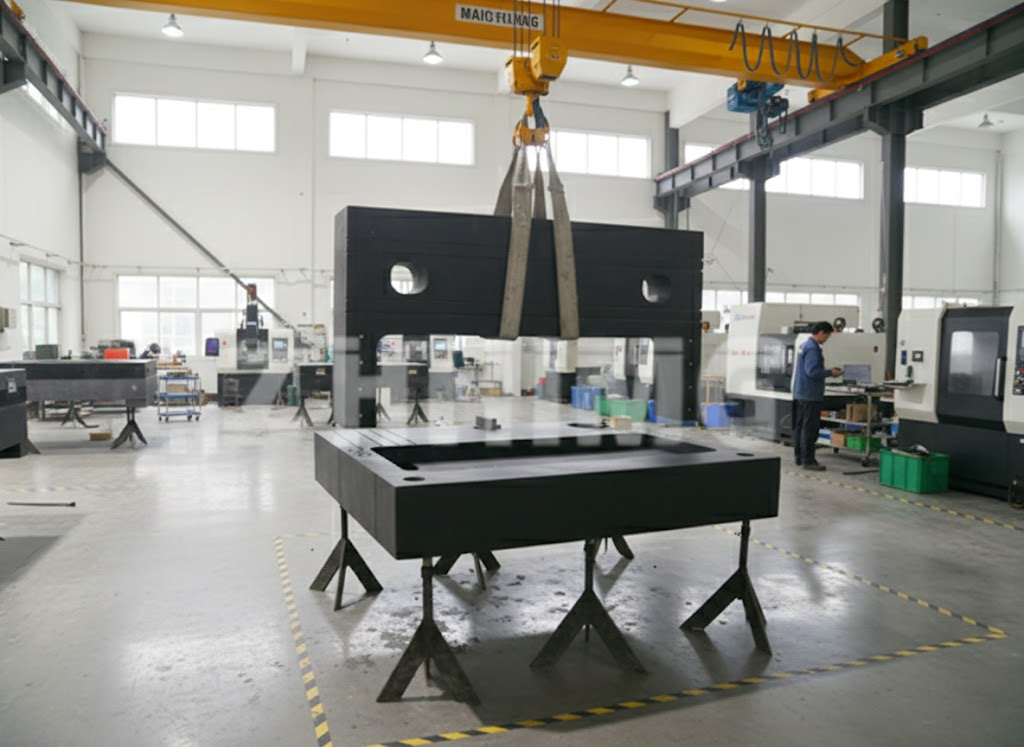
ZHHIMG® (Zhonghui Group) operates one of the world’s largest precision granite machining facilities:
- · Maximum machining dimensions: 20,000 × 4,000 × 1,000mm
- · Single-piece capacity: Up to 100 tons
- · Monthly production capacity: 20,000 sets (at 5000mm specification)
- · Surface flatness tolerance: <1μm/1000mm achievable
Quality Assurance
Every ZHHIMG® granite air bearing undergoes rigorous inspection before shipment:
- · German Mahr micro-indicator systems (0.1μm resolution)
- · UK Renishaw laser interferometers for linear measurement verification
- · Swiss Wyler electronic levels for geometric accuracy
Global Client Base
ZHHIMG® supplies precision granite components to leading precision equipment manufacturers worldwide, including:
- · Akribis Systems (Singapore) – precision motion systems
- · STI Semiconductor – semiconductor handling equipment
- · Flex (Israel) – manufacturing services
- · Wyler AG (Switzerland) – precision measurement instruments
- · Vitrox (Malaysia) – electronic assembly inspection equipment
This global supply chain experience ensures ZHHIMG® understands the technical specifications, documentation requirements, and delivery expectations of tier-one precision equipment manufacturers.
FAQ: Granite Air Bearings for Precision Applications
1. How long do granite air bearings last compared to steel bearings?
Under proper air supply (filtered to ISO 8573-1 standards, pressure within specification), granite air bearings can maintain precision flatness for 20+ years. Steel bearings may require refurbishment every 3-5 years due to coating wear and surface degradation. The zero-friction design means no mechanical wear on the bearing surfaces themselves.
2. Can granite air bearings handle high acceleration and speed?
Yes. Air bearings operate with virtually no friction, enabling accelerations exceeding 1g (9.8m/s²) even on large-format stages. Typical traverse speeds range from 100-500mm/s for positioning stages to >1000mm/s for scanning applications. Dynamic load capacity depends on air pressure and orifice design—ZHHIMG® engineers optimize bearing geometry for your specific payload and performance requirements.
3. What air supply specifications are required?
Standard specifications include:
- · Supply pressure: 4-8 bar (58-116 psi)
- · Air cleanliness: ISO 8573-1:2010 Class 2 (≤1μm particle size)
- · Dew point: -40°C or lower (to prevent moisture condensation)
- · Consumption: Varies by bearing size; typically 20-100 L/min per bearing
4. How does granite compare to other natural stone materials like cast iron or mineral casting?
Cast iron offers excellent damping but poor thermal stability and corrosion resistance. Mineral casting (epoxy-bound granite aggregate) provides good damping and thermal stability but lacks the long-term dimensional consistency of natural granite. ZHHIMG® uses proprietary black granite with optimized mineral composition for maximum stability and damping characteristics.
5. What flatness and parallelism tolerances can ZHHIMG® achieve?
Standard tolerances for precision granite air bearings:
- · Flatness: <1μm/1000mm (<2μm/2000mm)
- · Parallelism: <2μm/1000mm
- · Straightness: <1μm/1000mm
- · Surface roughness: Ra <0.2μm (polished bearing surfaces)
Tighter tolerances available upon request—consult ZHHIMG® engineering for application-specific specifications.
6. What documentation and support does ZHHIMG® provide for OEM customers?
ZHHIMG® provides:
- · Material certificates including mineral composition and physical properties
- · Inspection reports with measured dimensional data
- · Assembly drawings with tolerance callouts
- · Surface treatment specifications (if applicable)
- · Application engineering support for bearing selection and integration guidance
Ready to Upgrade Your Precision Motion System?
Granite air bearings represent the definitive choice for applications demanding zero-friction, long-term stability, and large-format precision. Whether you’re designing next-generation semiconductor inspection equipment, coordinate measuring machines, or industrial CT systems, the material properties of high-density granite provide irreplaceable advantages.
ZHHIMG® combines 20,000mm-scale manufacturing capability with micron-level tolerance control, serving global precision equipment manufacturers with consistent quality and competitive pricing.
Contact ZHHIMG® engineering today to discuss your granite air bearing requirements. Provide your application specifications, travel envelope, and accuracy requirements—and receive a preliminary design proposal within 3-5 business days.
Post time: Jun-10-2026