
Precision granite surface plates serve as the foundational reference plane for dimensional measurement in manufacturing, quality control, and calibration laboratories worldwide. But not all granite surface plates deliver the same performance. When selecting a metrology reference surface, understanding material properties—such as black granite density, thermal stability, and flatness grade—can mean the difference between sub-micron accuracy and costly measurement errors.
This guide examines why high-density black granite outperforms competing materials, how to select the correct flatness grade (Grade 00, Grade 0, or Grade 1), and what specifications B2B buyers should demand from suppliers.
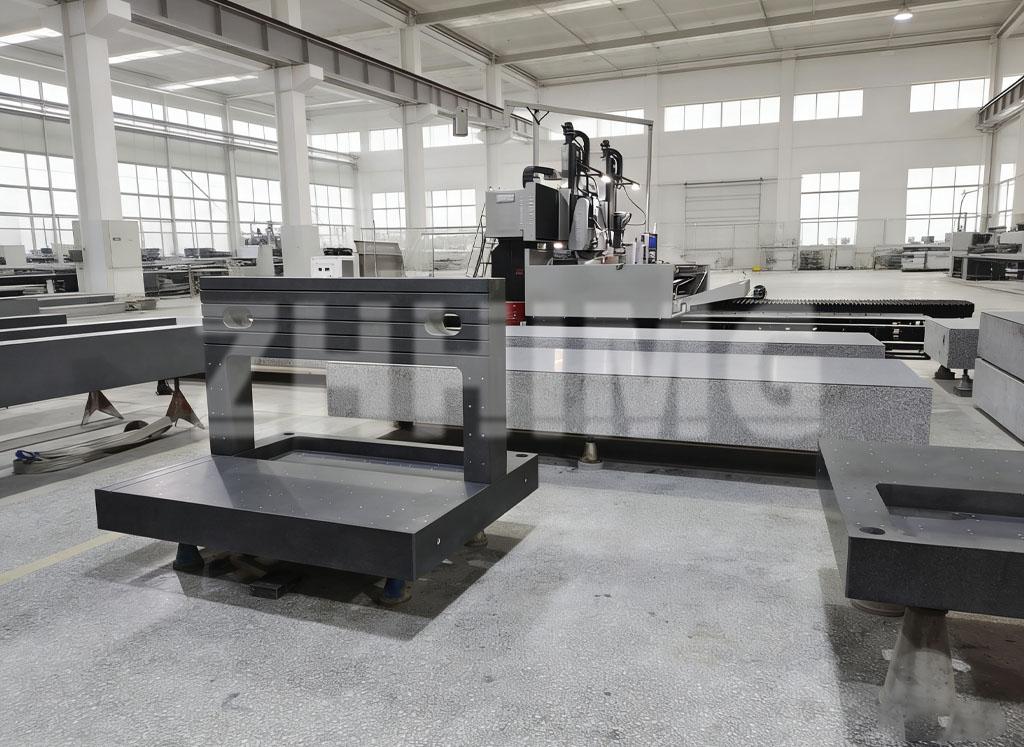
High-density black granite (density ≥3100 kg/m³) offers superior physical properties compared to cast iron, standard granite, or marble alternatives. ZHHIMG® precision granite surface plates achieve thermal stability below 0.001 mm/°C, with flatness tolerances as tight as ≤0.5 μm/m for Grade 00 applications. Manufactured in a 10,000 m² climate-controlled facility with anti-vibration design, ZHHIMG® delivers sizes up to 20,000 × 4,000 × 1,000 mm with full traceability to national metrology institutes. Partners including Schunk, Bosch, Rexroth, THK, Hiwin, GE, Oracle, and Samsung trust ZHHIMG® for their critical dimensional metrology needs.
What Makes Black Granite the Preferred Material for Precision Surface Plates?
Black granite has become the industry standard for precision measurement platforms because of its unique combination of mineral composition and physical properties. Unlike lighter-colored granites, black granite contains a higher percentage of plagioclase feldspar and biotite, creating an exceptionally fine-grained, homogeneous matrix that resists wear and maintains flatness over decades of use.
The primary advantages of black granite for metrology applications include:
- · Exceptional hardness: Black granite measures approximately 70 on the Shore hardness scale, roughly twice the hardness of cast iron. This translates to minimal surface wear and long-term flatness retention.
- · Low thermal expansion: With a temperature coefficient below 1.0 × 10⁻⁶/°C, black granite maintains dimensional stability even in environments with moderate temperature fluctuations.
- · Non-magnetic properties: Unlike steel or cast iron, black granite does not attract ferrous particles or interfere with magnetic measurement tools.
- · Corrosion and rust resistance: Black granite is impervious to moisture, cutting fluids, and common workshop chemicals—no rust prevention or protective coatings required.
- · Natural vibration damping: The internal crystal structure of granite absorbs vibrational energy more effectively than metal alternatives, providing a stable reference surface even near heavy machinery.
Why Does Surface Plate Density Matter for Metrology Accuracy?
Material density directly impacts a surface plate’s ability to resist deformation under load and maintain long-term stability. High-density black granite (typically 3100–3200 kg/m³) offers several measurable advantages over lower-density alternatives:
Reduced elastic deflection: Denser materials exhibit lower elastic deformation under identical loading conditions. When supporting a 50 kg workpiece on a granite surface plate, higher density reduces the microscopic deflection that can introduce measurement uncertainty.
Superior internal damping: Denser granite crystals form tighter interlocked structures, improving vibration absorption and reducing harmonic interference during dynamic measurement processes.
Enhanced thermal mass: Higher density materials resist temperature changes more effectively, providing greater thermal stability in workshops without precision climate control.
Improved wear resistance: Dense, fine-grained granite surfaces resist particle indentations and surface wear, maintaining micron-level flatness over extended service periods.
⚠️ Critical warning: Some manufacturers substitute marble or low-density granite to reduce costs. Marble (calcium carbonate-based) absorbs moisture, expands inconsistently, and degrades rapidly in workshop environments. Always verify material specifications and source from reputable manufacturers.
How ZHHIMG® Black Granite Outperforms European and American Alternatives
ZHHIMG® precision granite surface plates are manufactured from proprietary Jinan Black granite, a premium material quarried in Shandong Province, China. Extensive testing confirms that ZHHIMG® black granite delivers measurable advantages over commonly used European and American granite varieties:
|
Property |
ZHHIMG® Black Granite |
European Black Granite |
American Black Granite |
| Density | 3100 kg/m³ | 2800–2950 kg/m³ | 2700–2900 kg/m³ |
| Quartz content | 25–30% | 15–20% | 12–18% |
| Compressive strength | 220 MPa | 180–200 MPa | 160–190 MPa |
| Water absorption | <0.1% | 0.2–0.4% | 0.3–0.5% |
| Thermal stability | <0.001 mm/°C | 0.002–0.003 mm/°C | 0.002–0.004 mm/°C |
| Service life | 30+ years | 20–25 years | 15–20 years |
The higher density and quartz content of ZHHIMG® black granite directly translate to improved flatness retention, better vibration damping, and longer service life—critical factors for B2B buyers evaluating total cost of ownership.
Understanding Surface Plate Grades: Grade 00 vs. Grade 0 vs. Grade 1
Surface plate flatness grades are defined by international standards including DIN 876, ASME B89.3.7, JIS B7513, and GB/T 20428. The grade determines the maximum permissible deviation from perfect flatness, measured in microns per meter (μm/m).
Grade 00 – Laboratory and Calibration Standard
Grade 00 represents the highest commercial accuracy available for granite surface plates. These plates are designed for controlled metrology laboratory environments where temperature is maintained at 20 ± 0.5°C and vibration is minimized.
- · Flatness tolerance: ≤0.5 μm/m (overall) | ≤0.3 μm/m (local 250×250mm area)
- · Primary applications: National metrology institute reference standards, CMM base plates, laser interferometer calibration, optical instrument alignment
- · Inspection frequency: Annual calibration with laser interferometer traceability
Grade 0 – Quality Control and Inspection Standard
Grade 0 plates serve as the workhorse of precision manufacturing quality control. These plates balance high accuracy with practical durability for production floor environments.
- · Flatness tolerance: ≤1.0 μm/m (overall) | ≤0.6 μm/m (local 250×250mm area)
- · Primary applications: Dimensional inspection stations, gauge calibration, precision machining QC, gear and tool inspection
- · Inspection frequency: Semi-annual calibration with electronic level verification
Grade 1 – Tool Room and Production Standard
Grade 1 plates provide reliable reference surfaces for general workshop applications where extreme precision is not required.
- · Flatness tolerance: ≤2.0 μm/m (overall) | ≤1.0 μm/m (local 250×250mm area)
- · Primary applications: Rough machining layout, assembly fixtures, tool setting, educational training
- · Inspection frequency: Annual calibration with mechanical level verification
How to Calculate Required Grade for Your Application
When selecting a surface plate grade, consider the cumulative error budget of your measurement system:
If your surface plate tolerance is ±5 μm and your height gauge has ±3 μm uncertainty, your total measurement uncertainty reaches ±8 μm before touching the workpiece.
Recommendation: Choose a surface plate grade that provides at least a 3:1 accuracy ratio relative to the tolerance of parts being measured. For parts with 10 μm tolerances, select Grade 0 or better. For sub-micron precision work, Grade 00 is mandatory.
What Testing Equipment Ensures ZHHIMG® Surface Plate Accuracy?
ZHHIMG® employs world-class metrology equipment to verify every surface plate before shipment:
|
Equipment |
Model/Origin |
Measurement Capability |
| Electronic micrometer | Mahr (Germany) | 0.5 μm resolution |
| Digital micrometer | Mitutoyo (Japan) | 1 μm resolution |
| Laser interferometer | Renishaw (UK) | 0.1 μm/m accuracy |
| Electronic level | Wyler (Switzerland) | 0.001 mm/m sensitivity |
All ZHHIMG® surface plates are calibrated with full traceability to national metrology institutes through the Jinan Metrology Institute and Shandong Provincial Metrology Institute. Calibration certificates are available for every plate, meeting requirements of ISO 17025 accredited laboratories and supporting compliance with ASME Y14.5, ISO 1101, and DIN EN ISO 9001 quality systems.
How Are ZHHIMG® Surface Plates Manufactured?
Every ZHHIMG® precision granite surface plate undergoes a rigorous multi-stage manufacturing process:
1. Material verification: Raw granite blocks are tested for density, mineral composition, and internal defect-free structure before processing.
2. Rough machining: CNC grinding establishes the basic geometry and overall dimensions.
3. Semi-fine grinding: Removes machining marks, achieving flatness of 0.02–0.05 mm/m.
4. Hand lapping: Skilled technicians use progressively finer diamond abrasives to achieve final flatness—this step distinguishes high-quality plates from machine-finished alternatives.
5. Stabilization: Plates are conditioned in a climate-controlled room at 20 ± 1°C for 24 hours before final measurement.
6. Precision verification: Flatness and straightness tested with electronic levels or laser interferometers across a minimum 25-point grid pattern.
7. Functional machining: Threaded inserts, T-slots, or custom features are added as specified.
8. Final inspection and certification: Every plate is measured and documented with a unique serial number and calibration certificate.
Where Are Precision Granite Surface Plates Used?
ZHHIMG® precision granite surface plates serve critical applications across multiple industries:
- · Aerospace manufacturing: CMM reference surfaces for turbine blade inspection and fuselage assembly
- · Automotive production: Tool room and inspection stations for engine block, transmission, and brake component verification
- · Semiconductor fabrication: Wafer inspection platforms and lithography machine bases
- · Medical device manufacturing: Implant measurement and surgical instrument calibration
- · Defense and aerospace: Precision machining and weapons systems calibration
- · Research laboratories: Optical experiment platforms and vibration testing tables
- · General manufacturing: Machine tool beds, spindle mounting reference surfaces, and assembly line gauges
FAQ: Frequently Asked Questions About Precision Granite Surface Plates
How do I choose between Grade 00 and Grade 0 surface plates?
Choose Grade 00 if your operation maintains a climate-controlled metrology lab (20 ± 0.5°C), your part tolerances are below ±5 μm, or you require calibration traceability to national standards. Choose Grade 0 for general quality control stations where temperature fluctuations up to ±2°C occur and tolerances fall in the 5–20 μm range. Selecting Grade 00 for applications that only require Grade 0 adds 30–50% cost without practical benefit.
What causes granite surface plates to lose flatness over time?
Surface plates lose flatness primarily through surface wear from repetitive workpiece placement, edge chipping from impact damage, and thermal cycling in uncontrolled environments. ZHHIMG® black granite’s high density and hardness minimize wear, while the anti-vibration foundation (1000mm+ thick anti-vibration trenches) in ZHHIMG® facilities prevents resonance damage during transport and installation.
Can marble or limestone be used as a cheaper alternative to granite?
No. Marble and limestone are calcium carbonate-based materials that absorb moisture, expand inconsistently, and degrade rapidly in workshop environments. Many low-cost suppliers substitute marble for granite to reduce prices—always request material certification and verify water absorption rates (<0.1% for quality granite, >0.5% for marble).
What maximum size can ZHHIMG® manufacture?
ZHHIMG® manufactures precision granite surface plates up to 20,000 × 4,000 × 1,000 mm. Large-format plates maintain flatness accuracy through proprietary manufacturing techniques, including segmented grinding, point-by-point lapping, and computer-aided measurement verification.
How often should surface plates be recalibrated?
Recommended recalibration intervals depend on usage and environment: Grade 00 plates in metrology labs: annual calibration with laser interferometer. Grade 0 plates in QC environments: semi-annual calibration with electronic level. Grade 1 plates in tool rooms: annual calibration with mechanical level. Additionally, perform weekly surface inspection for chips, scratches, or contamination that could compromise measurement accuracy.
What international standards do ZHHIMG® surface plates comply with?
ZHHIMG® precision granite surface plates are manufactured to comply with multiple international standards: Germany DIN 876, USA ASME B89.3.7 / GGG-P-463c, Japan JIS B7513, China GB/T 20428, UK BS 817, and Russia GOST. This multi-standard compliance ensures ZHHIMG® plates meet or exceed flatness, surface finish, and repeat reading requirements for global export markets.
Choose ZHHIMG® for Your Precision Metrology Requirements
Selecting a precision granite surface plate is an investment in measurement confidence, product quality, and long-term operational efficiency. ZHHIMG® combines premium Jinan Black granite with 10,000 m² climate-controlled manufacturing facilities, world-class German and Japanese inspection equipment, and full national traceability to deliver surface plates that meet the most demanding metrology requirements.
Why B2B buyers choose ZHHIMG®:
- · ✅ Superior density (3100 kg/m³) vs. European/American alternatives
- · ✅ Tighter thermal stability (<0.001 mm/°C) for uncontrolled environments
- · ✅ Maximum precision (≤0.5 μm/m) Grade 00 available
- · ✅ Largest standard size range (up to 20,000 × 4,000 × 1,000 mm)
- · ✅ Multi-standard certification (DIN, ASME, JIS, GB, BS, GOST)
- · ✅ Trusted by global partners: Schunk, Bosch, Rexroth, THK, Hiwin, GE, Oracle, Samsung
Ready to discuss your surface plate requirements?
Contact ZHHIMG® today for detailed specifications, custom engineering consultation, and competitive B2B pricing. Our technical sales team supports OEM partnerships, custom fabrication, and high-volume procurement contracts.
Post time: Jun-10-2026