
At ultra-precision inspection sites, metrologists often observe a striking phenomenon: steel straightedges of the same accuracy grade and length gradually suffer linearity drift and subtle bending after years of continuous inspection. In contrast, ZHHIMG® granite straightedges retain factory benchmark geometry even after long-term use for machine tool guide calibration and optical substrate verification. Such huge difference in deformation is not merely caused by hardness variance. It originates from fundamental material microstructure, internal stress evolution and thermal response mechanisms. This is also a core technical research field for ultra-precision gauges developed by ZHHIMG Group.
1. Essential differences in residual stress determine long-term deformation trend
Steel retains massive residual lattice stress after forging, cutting and milling. Tempering can only partially release stress instead of eliminating it fully. Under combined impacts of cyclic temperature, repeated handling and sustained load, internal stress releases slowly and triggers irreversible plastic bending. This deformation develops slowly and usually emerges after long service time, easily overlooked by on-site operators. ZHHIMG® adopts exclusive black granite with a density of approximately 3100kg/m³. Its dense and uniform crystals have extremely low inherent base stress after hundreds of millions of years of geological aging. After rough cutting of stone blanks, products undergo multi-stage aging treatment to eliminate new stress generated by cutting. All machining procedures are completed in a 10,000 ㎡ constant temperature & humidity workshop. The workshop floor is no less than 1000mm thick, equipped with shock isolation trenches to block vibration interference, balancing the stress field of the ruler body. It will not bend continuously due to spontaneous stress release over time. Unlike some manufacturers that use marble to replace granite gauges — marble features high porosity and poor stability and cannot achieve equivalent long-term stability. ZHHIMG firmly opposes such deceptive practices of shoddy substitution in the market.
2. Thermal bending induced by temperature gradient: two materials deliver totally different responses
Steel has a higher linear expansion coefficient. When day-night temperature differences in workshops or heat dissipation from equipment create single-side temperature rise, temperature gradients form between the front and back surfaces of steel straightedges and directly trigger bending deformation. After repeated heating and cooling cycles, tiny plastic deformations accumulate inside metal. Overlapping repeatedly, permanent bending forms and cannot rebound. ZHHIMG® black granite boasts an ultra-low thermal expansion coefficient. Faced with the same temperature fluctuation, its dimensional change is minimal. Deformation caused by temperature difference is elastic and reversible. When ambient temperature returns to the reference value, deformation can almost recover without accumulating permanent bending. After machining, the full-length straightness is inspected with world-leading measuring instruments including German Mahr 0.5μm dial gauges, British Renishaw laser interferometers and Swiss WYLER electronic levels. All measuring tools have calibration certificates issued by Shandong Metrology Institute and China National Institute of Metrology, complying with DIN, ASME, JIS, GB and other international standards. Thermal stability is verified by simulating on-site temperature changes to guarantee stable benchmarks during inspection.
3. No metal creep, long-term dead load will not degrade benchmarks continuously
For long-span gauges placed between support points, bending caused by self-weight is an objective physical phenomenon. Steel materials have creep characteristics: under constant long-term load, metal lattices slip slowly. Even with unchanged load, bending deflection increases continuously over time. Granite is brittle crystalline material without lattice slip creep. Deformation from self-weight is purely elastic. With fixed support points, deflection remains stable for a long time and will not grow with placement duration. ZHHIMG engineers optimize Airy support points via finite element simulation, apply deflection pre-compensation for long straightedges in lapping processes. Senior technicians with over 30 years of manual lapping experience conduct fine finishing. With micron-level lapping sensitivity, they create stable reference edges and control self-weight deformation under standard support configurations.
4. Secondary deformation from corrosion and fatigue is an unavoidable drawback for steel straightedges
Splashing cutting fluid and humid air in workshops gradually corrode steel straightedges. Corroded areas expand in volume, creating unbalanced local stress and triggering twisting deformation. Uneven wear on different parts of working surfaces further damages benchmark profiles. Alternating loads from continuous workshop vibration accelerate metal fatigue and even resonance, disturbing reading stability. ZHHIMG® granite straightedges resist weak acid and alkali and never rust. No local stress comes from oxidative expansion. Its dense crystal structure delivers great wear resistance with low surface abrasion rate. Working surfaces wear evenly during long inspection operations. Meanwhile, granite features excellent vibration damping to absorb workshop vibration rapidly. Alternating loads hardly accumulate fatigue damage on the ruler body, adapting to complex environments such as machine workshops and semiconductor cleanrooms. 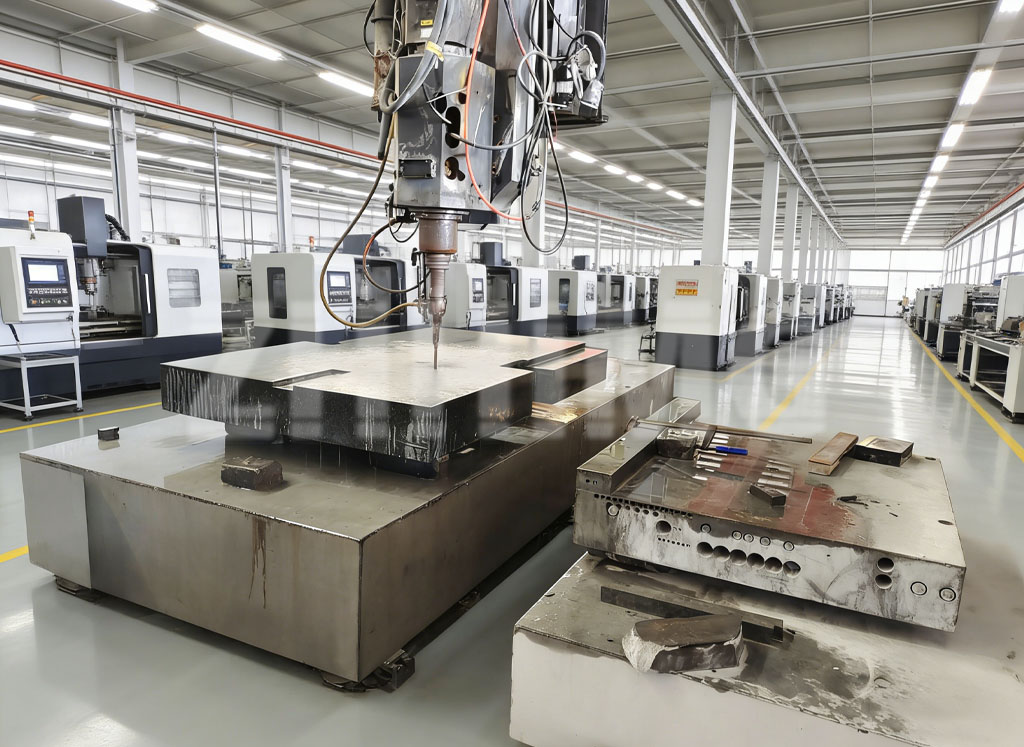
5. Quality control system locks long-term linear benchmarks from raw materials to finished products
ZHHIMG Group is an ultra-precision component manufacturer holding ISO9001, ISO45001, ISO14001 and CE certifications simultaneously. It owns more than 20 international trademarks and patents registered in EU, United States, Southeast Asia and other regions. The factory is equipped with four large Taiwan Nantou grinding machines each worth over 500,000 US dollars, paired with silent overhead cranes to process single components up to 20 meters long. All employees receive annual training on global metrology standards. The group maintains long-term cooperation with world-class research institutions including National University of Singapore, National Physical Laboratory UK, Chinese Academy of Sciences and Xi’an Jiaotong University to continuously upgrade measurement technologies. Every granite straightedge undergoes grid multi-point full-length straightness collection as well as thermal cycle tests to evaluate long-term stability. It should be noted that granite straightedges are not damage-proof. Severe temperature gradients, improper supports and hard impacts still cause precision failure. Complete operation guidelines are delivered together with products to prevent benchmark damage caused by human error.
Conclusion
Permanent bending of steel straightedges after long service results from combined effects of stress release, accumulated plastic deformation in thermal cycles, metal creep, corrosion and fatigue. Leveraging the crystal advantages of exclusive high-density black granite, together with integrated simulation design, multi-stage aging, constant-temperature precision lapping and comprehensive metrology inspection, ZHHIMG® granite straightedges fundamentally restrain irreversible bending and keep linear benchmarks stable during workpiece verification year after year. Adhering to the quality policy “The precision business can’t be too demanding” and the values of Openness, Innovation, Integrity and Unity, ZHHIMG Group keeps promoting the development of ultra-precision industry, supplying reliable metrology benchmark solutions for global semiconductor, optical and precision equipment customers.
Post time: Oct-15-2026