
In the ultra-precision equipment supporting market, many purchasers evaluate granite component quality by checking geometric indicators such as flatness and position tolerance at factory acceptance, regarding a one-time qualified inspection report as equivalent to long-term product reliability. Nevertheless, in real industrial applications, many reference parts experience subtle dimensional shift one year or longer after installation, forcing repeated shutdown and recalibration. The root cause usually lies not in raw material defects, but insufficient release of residual stress generated during machining. ZHHIMG has developed a full-process multi-stage stress relief system to control stress throughout granite manufacturing, fundamentally suppressing long-term dimensional drift and keeping precision benchmarks stable over extended service life.
Every material removal operation including sawing, cavity milling, drilling, grooving and rough grinding breaks the original mechanical balance inside granite crystals and creates residual cutting stress. If components only undergo simple static storage after finishing, stress cannot be fully released and merely hidden temporarily. Under cyclic ambient temperature and continuous assembly preload, trapped residual stress releases slowly and gradually triggers micro-deformation of reference surfaces, eventually resulting in dimensional and geometric drift. Such deformation progresses slowly and covertly, hard to detect in factory inspection, yet it continuously impairs the accuracy of CMM, semiconductor optical platforms and laser processing equipment.
The core principle of multi-stage stress relief is not a single long storage period, but inter-process stress release, intervening at key machining stages instead of carrying out stress treatment only after all machining is finished. ZHHIMG embeds stress relief into rough cutting, cavity milling, special-shaped grooving, deep hole machining and rough grinding. After every heavy material removal pass, workpieces go through constant-temperature static aging. For complex workpieces with large material removal volume, vibration stress relief and thermal cycling aging are applied to gradually eliminate cutting stress generated in each operation. Workpieces can only proceed to the next process after stress is verified stable, preventing accumulated stress from multiple machining steps.
This segmented process is especially critical for large beds and workpieces with deep holes or special-shaped weight-reduction grooves. Massive material removal creates disordered stress distribution, which cannot be balanced by one single aging session. Skipping intermediate stress relief only polishes away temporary deformation during fine grinding while residual stress remains trapped. After delivery, stress release will cause rebound distortion of reference surfaces. Supported by an independent large raw stone yard and constant-temperature vibration-isolation workshops, ZHHIMG possesses sufficient space and stable surroundings to support multi-round aging and protect stress release from external vibration and temperature disturbance.
High-precision inspection is essential to implement multi-stage stress relief. After each aging cycle, technicians recheck geometric tolerances in constant-temperature environments using metrology instruments including German Mahr micrometers, Swiss WYLER electronic levels and Renishaw laser interferometers to track deformation trends. Workpieces can move to fine grinding and manual nano lapping only after consecutive measurements show stable readings and no ongoing deformation. This inter-process monitoring quantifies stress relief effectiveness and avoids fine machining before stress stabilizes. 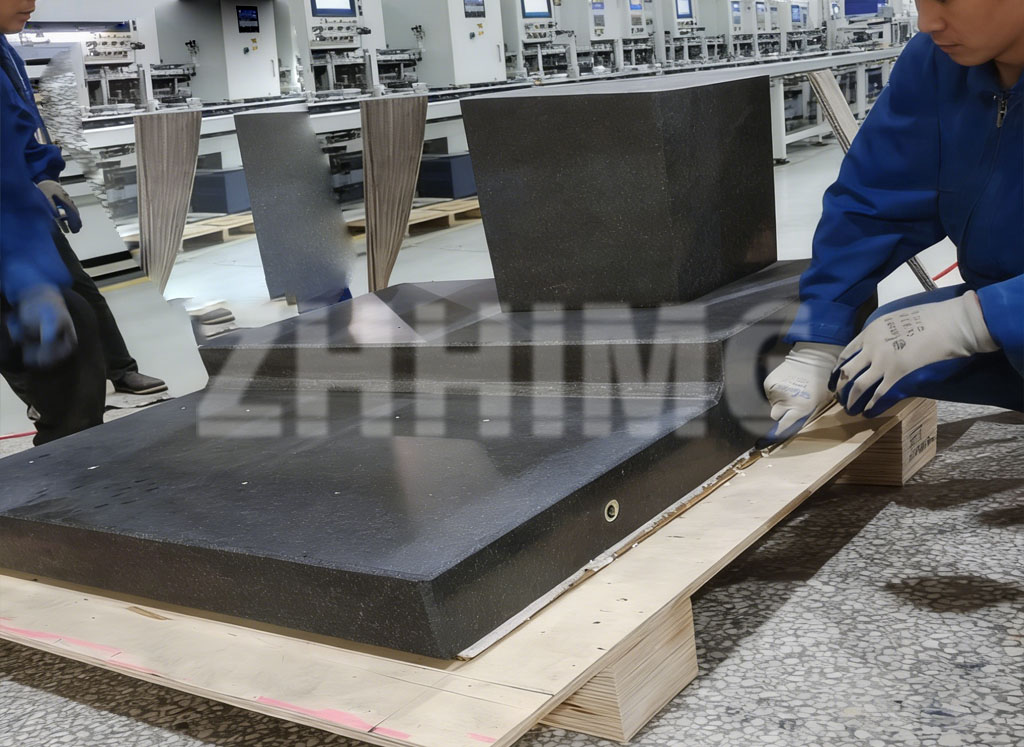
Compared with simplified single-stage aging, multi-stage stress relief extends total production lead time and requires more workshop space, bringing higher challenges to production scheduling and cost control. The core benefit is residual stress minimized to an extremely low level, greatly mitigating dimensional drift risks over years of operation. Combined with ZHHIMG high-density black granite base material, superior inherent material stability together with full-process stress control deliver dual protection and cut later calibration & maintenance cost for high-end equipment such as semiconductor inspection, precision metrology and linear motor platforms.
Precision drift never occurs as a sudden failure. It is the inevitable consequence of slow residual stress release. Final inspection reports alone cannot predict precision performance years later. Only by moving stress control forward and distributing it across every machining step can hidden risks be eliminated at source. ZHHIMG persistently applies inter-process multi-stage stress relief technology to eliminate latent stress, delivering precision granite components with long-term dimensional stability. We provide ultra-precision benchmarks capable of withstanding years of working conditions for metrology institutes, research universities and high-end manufacturers worldwide.
Post time: Oct-15-2026